Clean Up Property Notice With React Js
Description
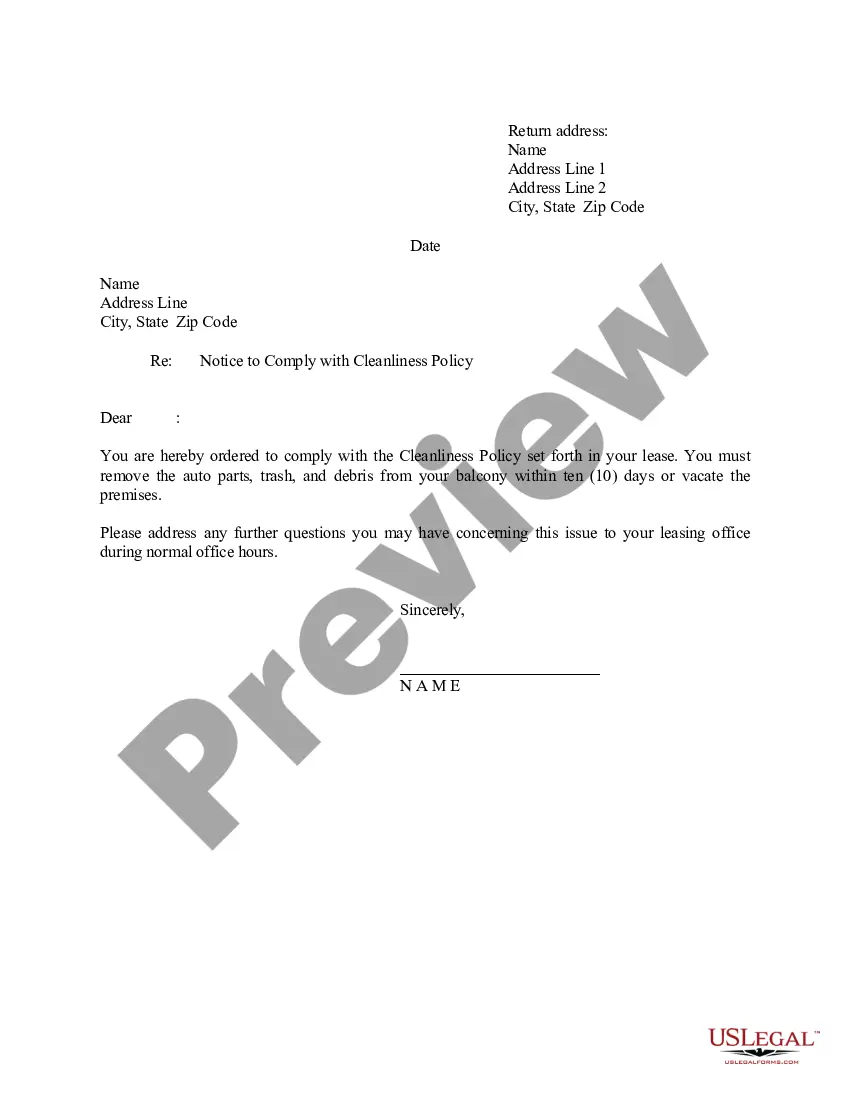
Get your form ready online
Our built-in tools help you complete, sign, share, and store your documents in one place.
Make edits, fill in missing information, and update formatting in US Legal Forms—just like you would in MS Word.
Download a copy, print it, send it by email, or mail it via USPS—whatever works best for your next step.
Sign and collect signatures with our SignNow integration. Send to multiple recipients, set reminders, and more. Go Premium to unlock E-Sign.
If this form requires notarization, complete it online through a secure video call—no need to meet a notary in person or wait for an appointment.
We protect your documents and personal data by following strict security and privacy standards.

Make edits, fill in missing information, and update formatting in US Legal Forms—just like you would in MS Word.

Download a copy, print it, send it by email, or mail it via USPS—whatever works best for your next step.

Sign and collect signatures with our SignNow integration. Send to multiple recipients, set reminders, and more. Go Premium to unlock E-Sign.

If this form requires notarization, complete it online through a secure video call—no need to meet a notary in person or wait for an appointment.

We protect your documents and personal data by following strict security and privacy standards.
Looking for another form?
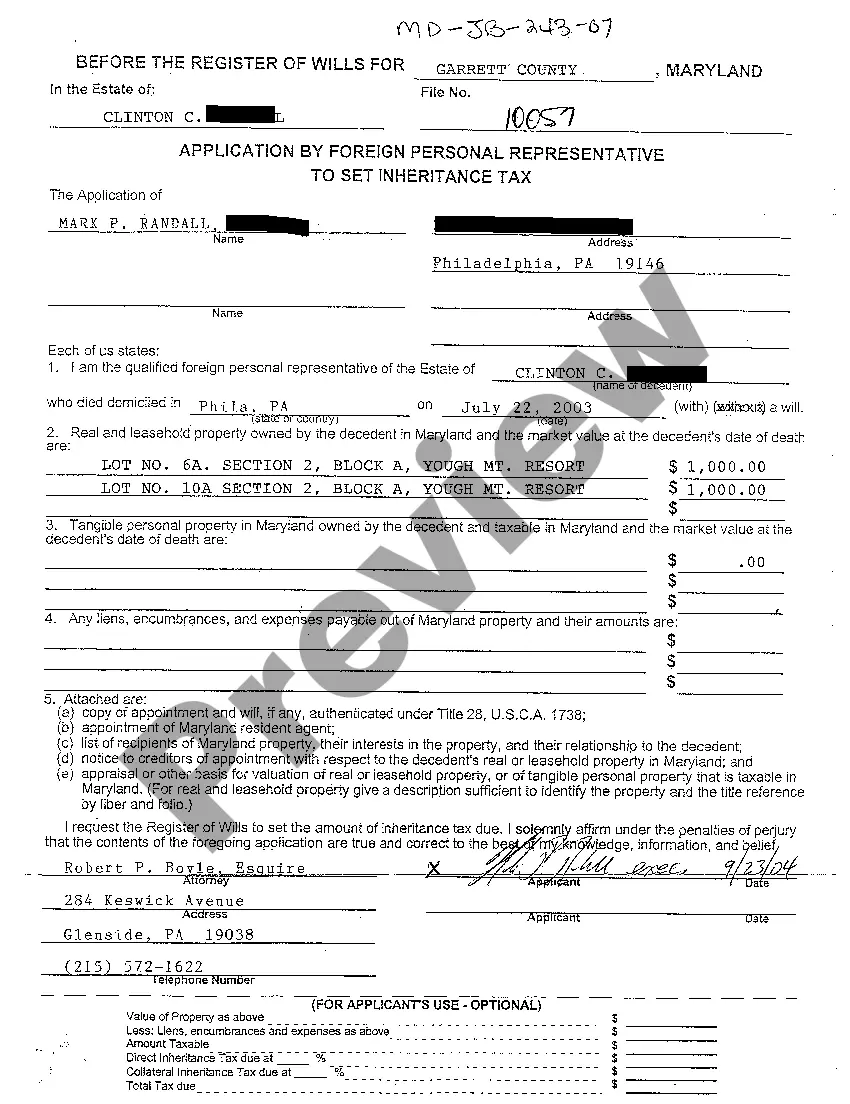



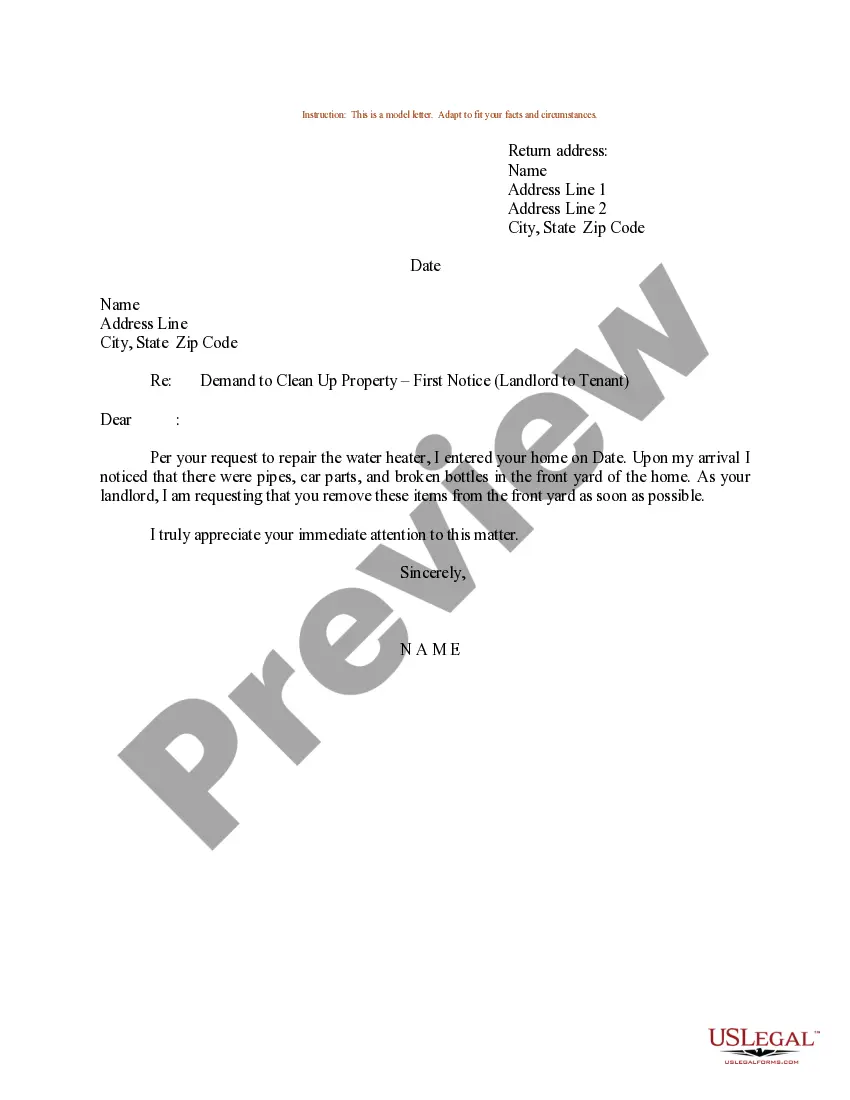
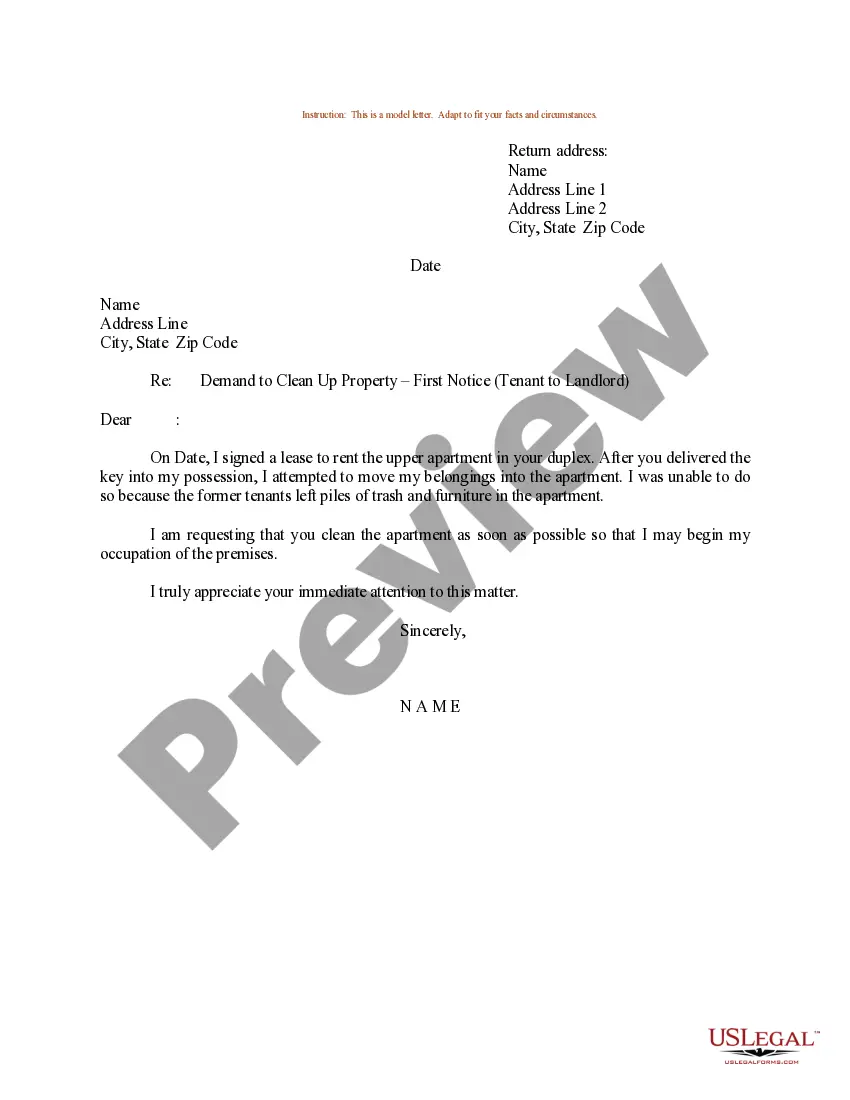
How to fill out Sample Letter Regarding Demand To Clean Up Property - First Notice From Landlord To Tenant?
Whether for professional reasons or personal affairs, everyone must confront legal circumstances at some stage in their existence.
Completing legal documents requires meticulous care, commencing with selecting the appropriate form template.
Once downloaded, you can fill out the form using editing software or print it and complete it manually. With an extensive US Legal Forms catalog available, you do not have to waste time searching for the right template across the web. Utilize the library’s easy navigation to find the suitable template for any situation.
- Acquire the template you require by using the search bar or through the catalog browsing.
- Review the form’s description to confirm it aligns with your situation, jurisdiction, and area.
- Select the form’s preview to inspect it.
- If it is the incorrect document, return to the search feature to find the Clean Up Property Notice With React Js example you need.
- Download the template if it satisfies your requirements.
- If you already possess a US Legal Forms account, simply click Log in to access previously stored documents in My documents.
- If you do not have an account yet, you can obtain the form by clicking Buy now.
- Select the correct pricing option.
- Fill out the account registration form.
- Choose your payment method: use a credit card or PayPal account.
- Select the file format you desire and download the Clean Up Property Notice With React Js.
Form popularity
FAQ
Here are some rules to follow for writing clean code: Use meaningful variable and function names: ... Keep your code organized: ... Use consistent formatting: ... Avoid long functions: ... Use reusable components: ... Use propTypes and defaultProps: ... Use stateless functional components: ... Use ES6 features:
How to Write Cleaner React Code Make use of JSX shorthands. ... Move unrelated code into a separate component. ... Create separate files for each component. ... Move shared functionality into React hooks. ... Remove as much JavaScript from your JSX as possible. ... Format inline styles for less bloated code.
What is the useEffect cleanup function? It is a function of the useEffect hook that allows us to stop side effects that no longer need to be executed before our component is unmounted. useEffect is built in such a way that we can return a function inside it and this return function is where the cleanup happens.
In this version of the UserProfile component, the useEffect cleanup function cancels the ongoing API request by calling the abort method on the AbortController instance. This ensures that the request is stopped when the component is unmounted, helping to prevent unnecessary network traffic and data inconsistencies.
How to write clean React code? Use meaningful component names. Give component names that reflect their functionality. ... Break down components. ... Use destructuring. ... Keep components small. ... Use prop-types. ... Use functional components. ... Avoid using inline styles. ... Use arrow functions.