Pet Trust Template With Calculator
Description
Get your form ready online
Our built-in tools help you complete, sign, share, and store your documents in one place.
Make edits, fill in missing information, and update formatting in US Legal Forms—just like you would in MS Word.
Download a copy, print it, send it by email, or mail it via USPS—whatever works best for your next step.
Sign and collect signatures with our SignNow integration. Send to multiple recipients, set reminders, and more. Go Premium to unlock E-Sign.
If this form requires notarization, complete it online through a secure video call—no need to meet a notary in person or wait for an appointment.
We protect your documents and personal data by following strict security and privacy standards.

Make edits, fill in missing information, and update formatting in US Legal Forms—just like you would in MS Word.

Download a copy, print it, send it by email, or mail it via USPS—whatever works best for your next step.

Sign and collect signatures with our SignNow integration. Send to multiple recipients, set reminders, and more. Go Premium to unlock E-Sign.

If this form requires notarization, complete it online through a secure video call—no need to meet a notary in person or wait for an appointment.

We protect your documents and personal data by following strict security and privacy standards.
Looking for another form?






How to fill out Bequest In Trust For The Care And Maintenance Of Pet (Long Form)?
Whether for commercial reasons or for personal matters, everyone must handle legal circumstances sooner or later in their life.
Filling out legal documents requires meticulous attention, starting from selecting the appropriate form sample.
Once it is saved, you can fill out the form using editing software or print it and complete it manually. With an extensive US Legal Forms catalog available, you don't need to waste time searching for the right template online. Utilize the library’s straightforward navigation to find the correct template for any circumstance.
- For example, if you choose an incorrect version of a Pet Trust Template With Calculator, it will be rejected upon submission.
- Thus, it is crucial to have a reliable source of legal documents like US Legal Forms.
- If you need to obtain a Pet Trust Template With Calculator sample, follow these straightforward steps.
- Locate the template you require using the search bar or catalog browsing.
- Review the form’s details to confirm it suits your case, state, and locality.
- Click on the form’s preview to examine it.
- If it is the wrong document, return to the search function to find the Pet Trust Template With Calculator sample you require.
- Acquire the template when it aligns with your needs.
- If you possess a US Legal Forms profile, click Log in to access previously saved files in My documents.
- If you do not yet have an account, you may download the form by clicking Buy now.
- Select the suitable pricing option.
- Complete the profile registration form.
- Choose your payment method: you can use a credit card or PayPal account.
- Select the document format you wish and download the Pet Trust Template With Calculator.
Form popularity
FAQ
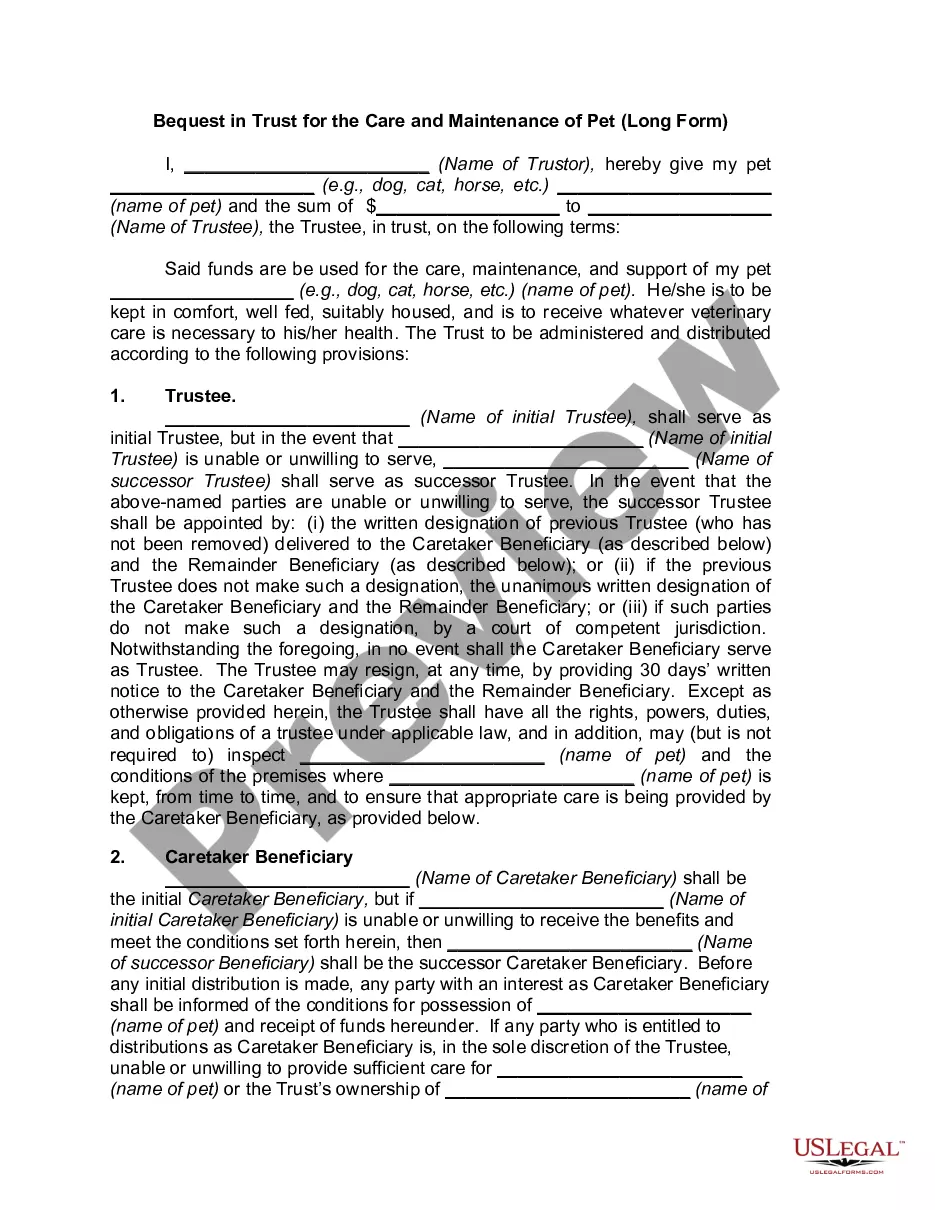
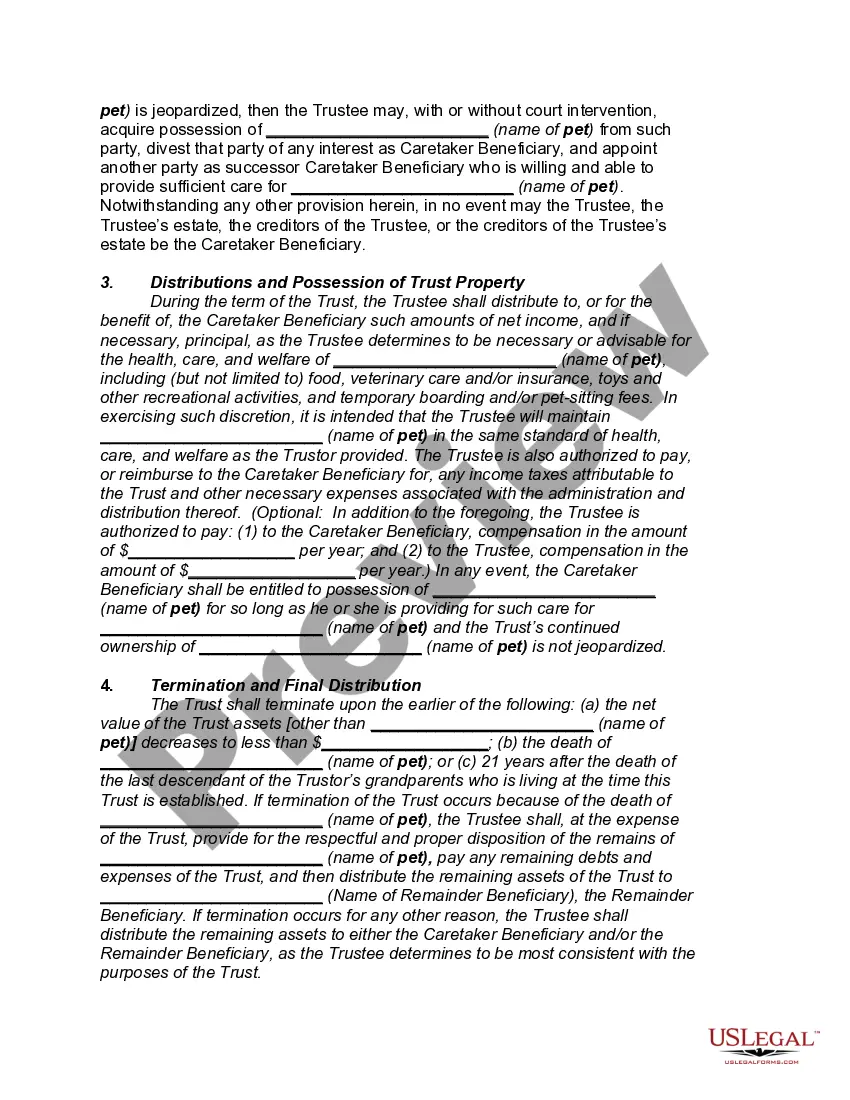
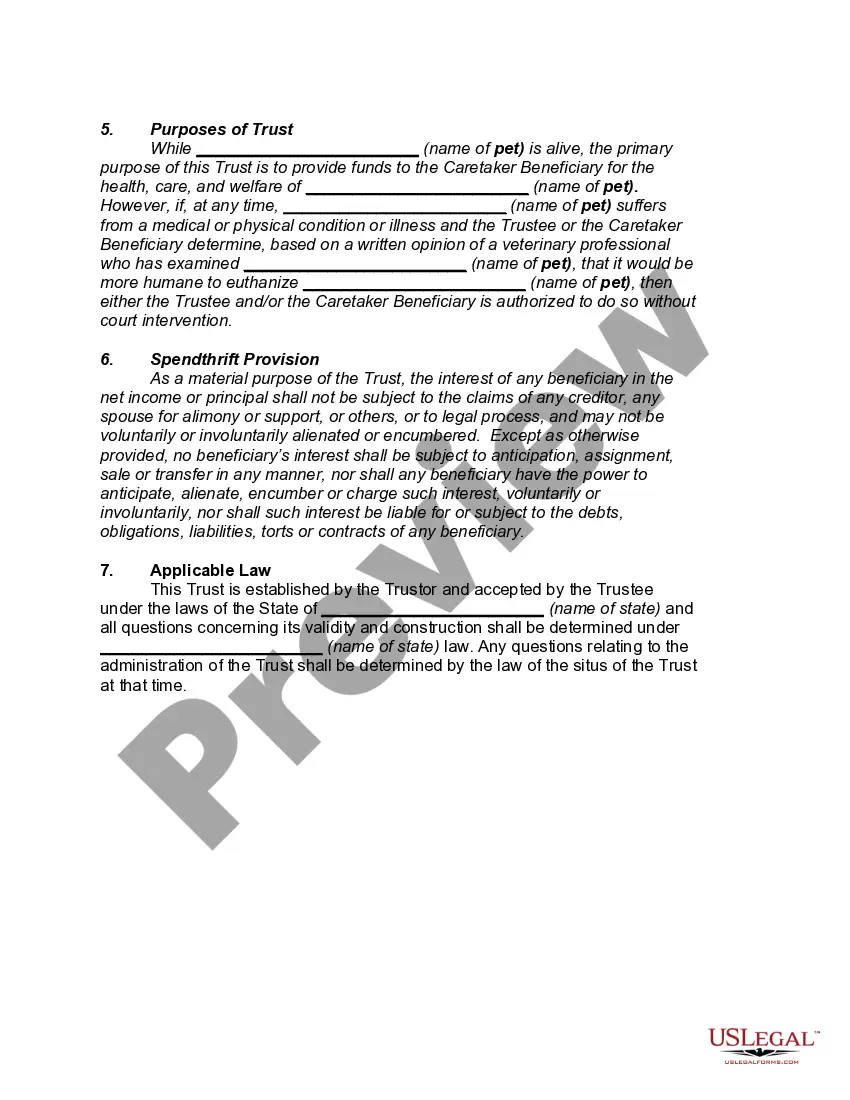
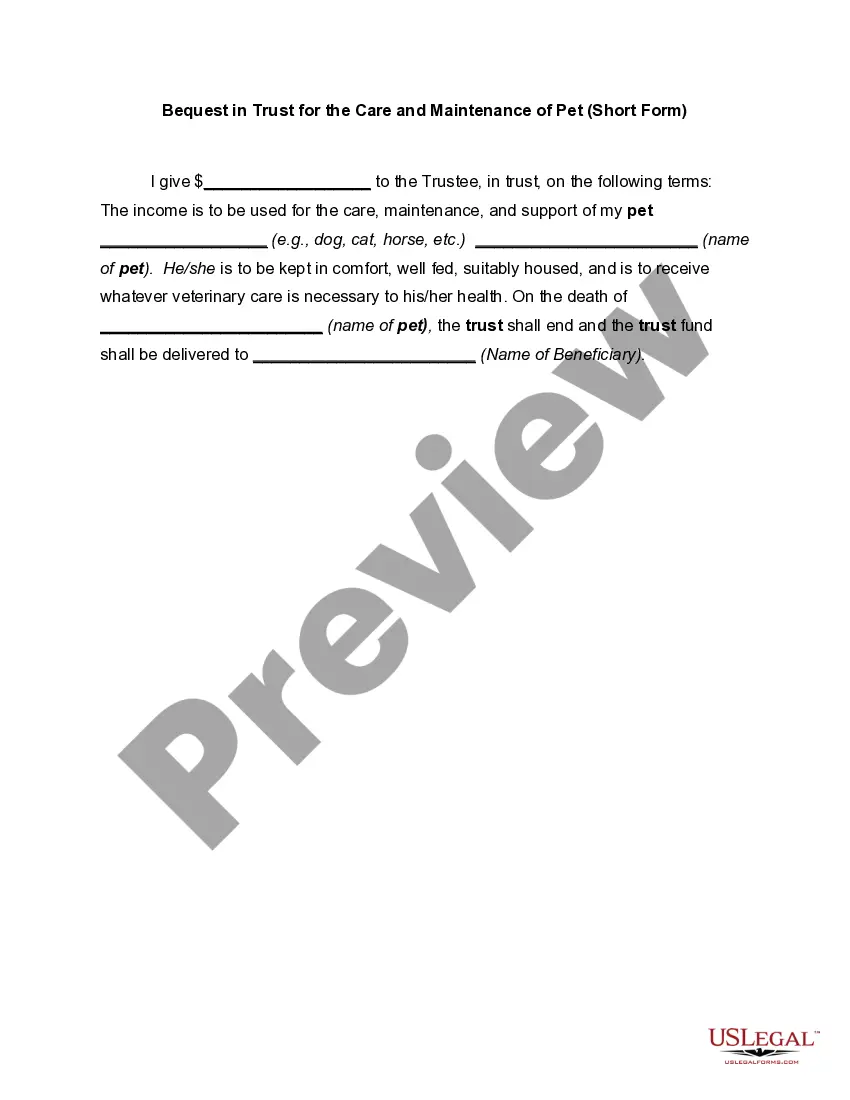
Determine the amount of funds needed to adequately cover the expenses of administering the pet trust; Designate a remainder beneficiary in the event the funds in the pet trust are not exhausted; Provide instructions for the final disposition of your pet (for example, burial or cremation).
While you may consider your pet part of the family, you unfortunately can't name your pet as a life insurance beneficiary. You can, however, make sure your furry friend is taken care of if anything were to happen to you.
But in the eyes of the law, pets are considered property, and you can't use your will to leave them an inheritance. However, you can still provide for your pets' care when you make a will by naming a ?pet guardian,? a.k.a. a beneficiary for your pet.
Ing to the law, pets are considered property and part of your estate, so you cannot legally leave money or any assets to a pet in your Last Will and Testament. Basically, property cannot inherit property.
With a traditional pet trust you leave your pet to someone in your will, just like with an honorary pet trust. However, there are no conditional bequests involved. Instead the trust has a trustee who regularly dispenses funds as necessary to care for the pet and meet the trust's instructions.