Beneficiary Information In Income Certificate
Description

Get your form ready online
Our built-in tools help you complete, sign, share, and store your documents in one place.
Make edits, fill in missing information, and update formatting in US Legal Forms—just like you would in MS Word.
Download a copy, print it, send it by email, or mail it via USPS—whatever works best for your next step.
Sign and collect signatures with our SignNow integration. Send to multiple recipients, set reminders, and more. Go Premium to unlock E-Sign.
If this form requires notarization, complete it online through a secure video call—no need to meet a notary in person or wait for an appointment.
We protect your documents and personal data by following strict security and privacy standards.

Make edits, fill in missing information, and update formatting in US Legal Forms—just like you would in MS Word.

Download a copy, print it, send it by email, or mail it via USPS—whatever works best for your next step.

Sign and collect signatures with our SignNow integration. Send to multiple recipients, set reminders, and more. Go Premium to unlock E-Sign.

If this form requires notarization, complete it online through a secure video call—no need to meet a notary in person or wait for an appointment.

We protect your documents and personal data by following strict security and privacy standards.
Looking for another form?
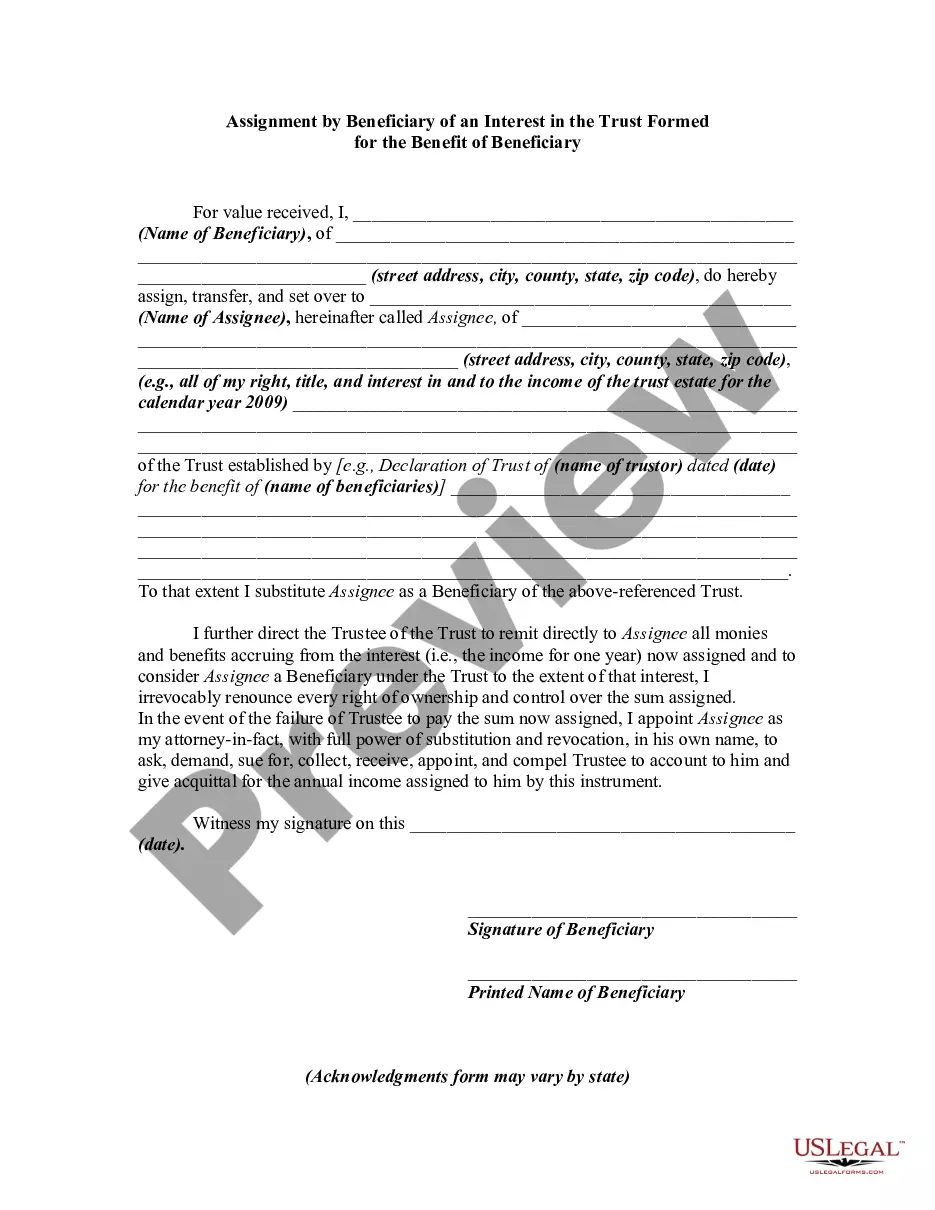
How to fill out Assignment By Beneficiary Of An Interest In The Trust Formed For The Benefit Of Beneficiary?
When you have to complete Beneficiary Information In Income Certificate following your local state's directives, there can be various selections to choose from.
There's no requirement to assess every form to ensure it meets all the legal standards if you are a US Legal Forms member.
It is a reliable service that can aid you in obtaining a reusable and current template on any topic.
Obtaining expertly drafted official paperwork becomes uncomplicated with the US Legal Forms. Moreover, Premium users can also take advantage of the robust integrated tools for online PDF editing and signing. Try it today!
- US Legal Forms is the most comprehensive online directory with a collection of over 85k ready-to-use documents for business and personal legal matters.
- All templates are validated to comply with each state's laws and regulations.
- Consequently, when downloading Beneficiary Information In Income Certificate from our site, you can be assured that you will have a legitimate and current document.
- Acquiring the necessary sample from our platform is impressively easy.
- If you already possess an account, simply Log In to the system, verify your subscription is active, and save the chosen file.
- Later, you can navigate to the My documents section in your profile and maintain access to the Beneficiary Information In Income Certificate whenever you need.
- If it's your first encounter with our library, please follow the instructions below.
- Review the suggested page and ensure it complies with your needs.
Form popularity
FAQ
If you inherit assets that generate income, you may need to file a K-1 form to report that income to the IRS. This filing will include essential beneficiary information in income certificate, showing your share of the inherited income. Ignoring this requirement could lead to tax complications. To ensure compliance, consider using resources like uslegalforms to navigate the K-1 filing process with ease.
Individuals who receive income from partnerships, S corporations, estates, or trusts must fill out a K-1 form. This requirement ensures that all beneficiary information in income certificate is reported for taxation purposes. By accurately completing the form, beneficiaries comply with tax regulations and understand their share of the income. It’s best to consult legal resources or tax professionals to navigate this process confidently.
Failing to file a K-1 can lead to significant consequences, including penalties and interest on unpaid taxes. Beneficiaries may find themselves in a difficult financial position if their income does not get reported officially. Additionally, the IRS may initiate inquiries or audits if discrepancies arise. Therefore, it is crucial to file your K-1 in a timely manner to ensure all beneficiary information in income certificate is represented correctly.
To fill out a beneficiary designation correctly, start by clearly stating the beneficiary's name and relationship to you. Provide any required beneficiary information in income certificate, such as the Social Security number or date of birth, as this helps in accurately locating records in the future. Double-check the details to ensure correctness, as this affects estate distribution. Using reliable platforms like uslegalforms can simplify this process.
A Schedule K-1 for a beneficiary outlines the income, deductions, and credits that a beneficiary must report on their personal tax return. This document includes essential beneficiary information in income certificate that shows how income is divided among beneficiaries. It's important to review this form carefully, as it informs your tax responsibilities. Receiving accurate K-1 forms will help ensure compliance with tax laws.
Filling out Form 1041 requires you to gather beneficiary information in income certificate to ensure accurate reporting. First, you need to provide details about the estate or trust, including the name and identification number. Next, input the income, deductions, and credits appropriately, as these figures will impact the final tax obligations. Ensure accuracy, as errors can lead to delays or audits.
To fill in beneficiary details, begin by listing their full name and contact information. Next, include their relationship to you and any specific percentage they are entitled to receive. Ensuring that you incorporate accurate beneficiary information in income certificate helps create a comprehensive and clear document, reducing the possibility of future disputes.
A certificate of beneficiary is a formal document that identifies the designated beneficiaries of a financial account or trust. It outlines who will receive the benefits and under what conditions. Having clear beneficiary information in income certificates is essential, as it mitigates potential conflicts and ensures all parties are aware of their entitlements.
When specifying a beneficiary type, you should indicate whether the beneficiary is an individual, corporate entity, or trust. Additionally, clarify if the beneficiary is a primary or contingent beneficiary. This classification plays a vital role in ensuring that the correct beneficiary information in income certificates is recorded and understood by all parties involved.
An income beneficiary is specifically entitled to receive income generated from an asset, while a beneficiary may inherit the asset itself. Understanding this distinction is crucial when preparing documentation for financial matters. Accurate identification ensures clarity in your income certificate and helps in managing beneficiary information in income certificate, leading to fewer misunderstandings.