Risk For Property
Description
Get your form ready online
Our built-in tools help you complete, sign, share, and store your documents in one place.
Make edits, fill in missing information, and update formatting in US Legal Forms—just like you would in MS Word.
Download a copy, print it, send it by email, or mail it via USPS—whatever works best for your next step.
Sign and collect signatures with our SignNow integration. Send to multiple recipients, set reminders, and more. Go Premium to unlock E-Sign.
If this form requires notarization, complete it online through a secure video call—no need to meet a notary in person or wait for an appointment.
We protect your documents and personal data by following strict security and privacy standards.

Make edits, fill in missing information, and update formatting in US Legal Forms—just like you would in MS Word.

Download a copy, print it, send it by email, or mail it via USPS—whatever works best for your next step.

Sign and collect signatures with our SignNow integration. Send to multiple recipients, set reminders, and more. Go Premium to unlock E-Sign.

If this form requires notarization, complete it online through a secure video call—no need to meet a notary in person or wait for an appointment.

We protect your documents and personal data by following strict security and privacy standards.
Looking for another form?








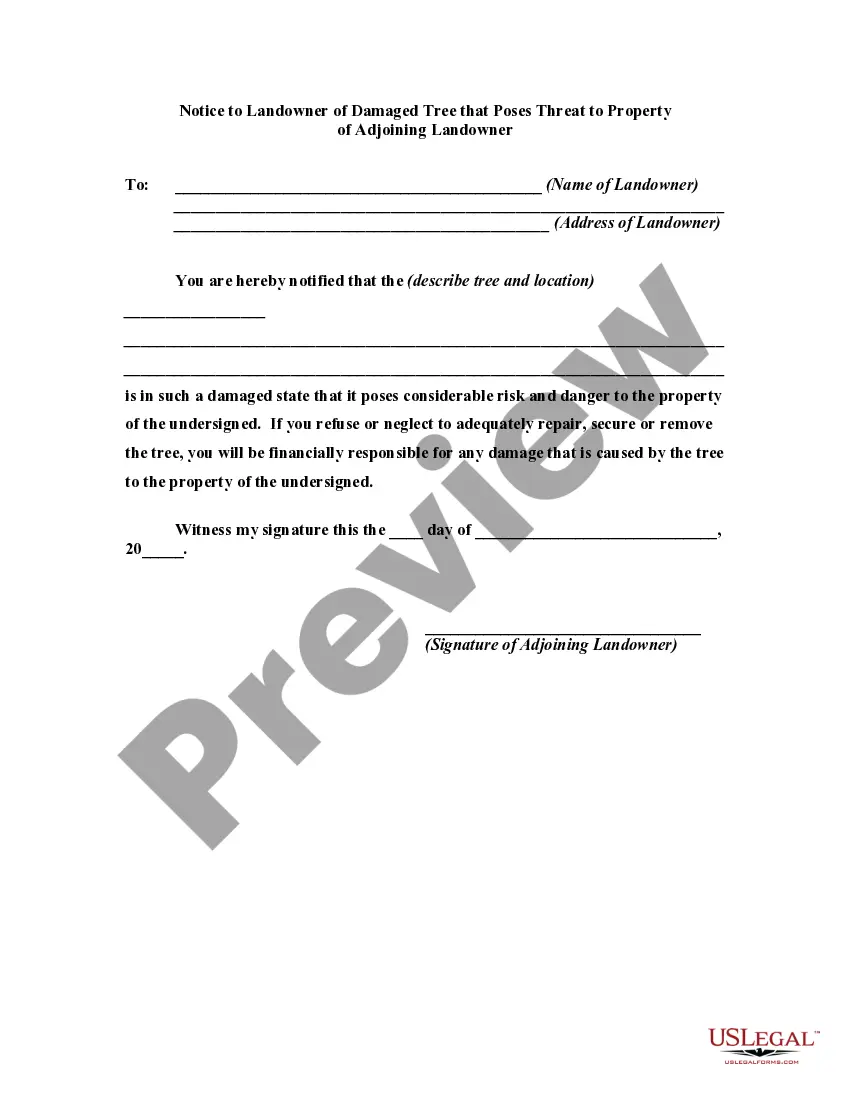
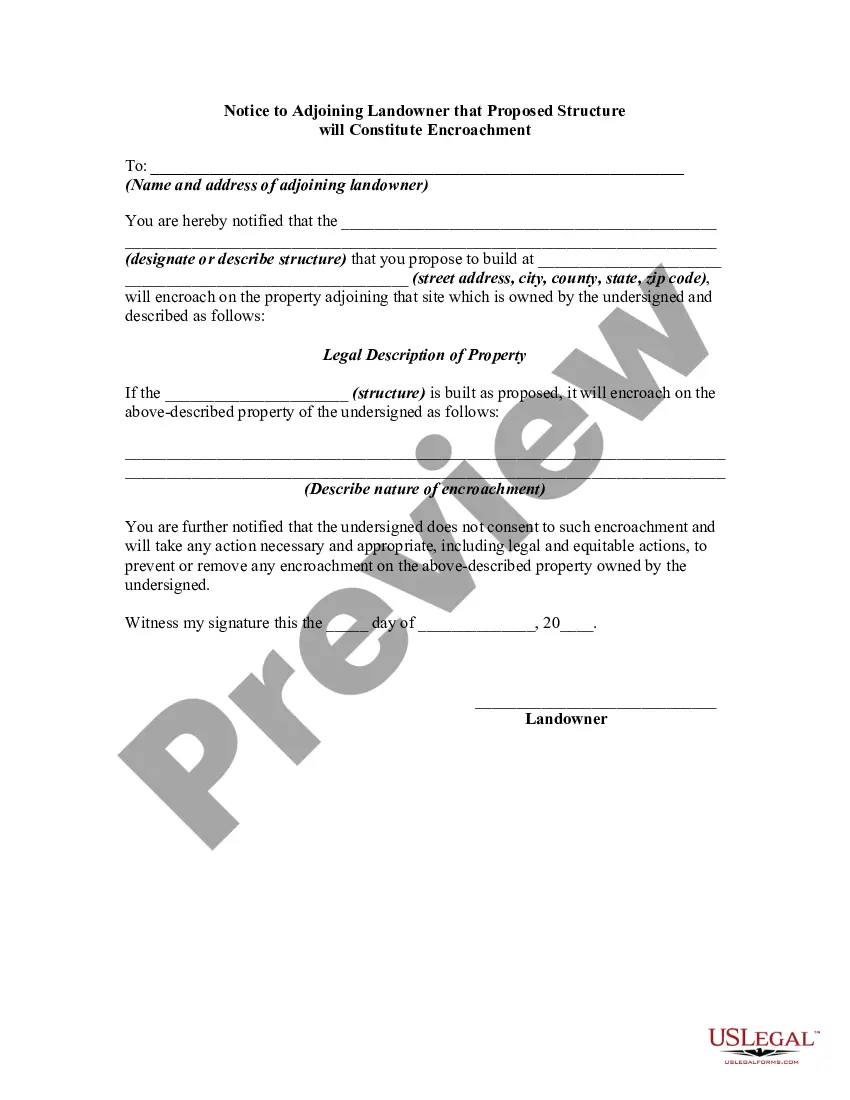
How to fill out Notice To Landowner Of Damaged Tree That Poses Threat To Property Of Adjoining Landowner?
Engaging with legal documents and processes can be a lengthy addition to your entire day.
Risk For Property and similar forms typically require you to locate them and navigate the best way to complete them correctly.
Therefore, whether you are managing financial, legal, or personal issues, having a comprehensive and user-friendly online library of forms available when needed will be extremely beneficial.
US Legal Forms is the premier online platform for legal templates, offering over 85,000 state-specific forms and a variety of resources to assist you in completing your documents effortlessly.
Is this your initial time using US Legal Forms? Register and create your account in just a few minutes, and you will gain access to the form library and Risk For Property. Next, follow the steps outlined below to complete your form: Ensure you possess the correct form by utilizing the Preview option and reviewing the form details. Select Buy Now when you are ready, and choose the monthly subscription plan that suits your requirements. Click Download, then fill out, sign, and print the form. US Legal Forms has 25 years of expertise assisting users in managing their legal documents. Obtain the form you need today and streamline any process without exerting yourself.
- Explore the collection of relevant documents accessible to you with just one click.
- US Legal Forms provides state- and county-specific forms available anytime for download.
- Protect your document management processes with a premium service that enables you to create any form within minutes without additional or hidden charges.
- Simply Log In to your account, locate Risk For Property, and download it immediately from the My documents section.
- You can also retrieve forms you have downloaded previously.
Form popularity
FAQ
In the state of Illinois, it's possible to go to jail for writing a bad check. The crime of doing so falls under ?financial institution fraud,? and it's punishable by time in jail or in prison.
810 ILCS 5/3-118: Statute of limitation An action to enforce the obligation on a certified check, teller's check, cashier's check, or traveler's check must be commenced within 3 years after demand for payment is made.
It is considered a criminal offense, however, under 720 ILCS 5/17-1(B) to issue or deliver a check or other order for the payment of money to a third party when the writer knows that it will not be paid by the bank upon which it was issued.
Finally, there's the possibility of criminal charges for deceptive practices. That's a Class A misdemeanor?maximum penalty 1 year and $1,000. It becomes a Class 4 felony?maximum 3 years?if you obtain at least $150 worth of property within 90 days with your bad check(s).
Another key difference is the dollar amount to be charged with a felony. If you are charged with retail theft, any amount over $300 is a felony in Illinois. If you are charged with theft, any amount over $500 is a felony in Illinois.
Many people believe that check fraud, as a white collar crime, is not all that serious. In truth, if your charges of check fraud fall under the Illinois definitions of forgery or embezzlement, you could face felony charges and prison time.
It is considered a criminal offense, however, under 720 ILCS 5/17-1(B) to issue or deliver a check or other order for the payment of money to a third party when the writer knows that it will not be paid by the bank upon which it was issued.