Adverse Possessor For Possession
Description

Get your form ready online
Our built-in tools help you complete, sign, share, and store your documents in one place.
Make edits, fill in missing information, and update formatting in US Legal Forms—just like you would in MS Word.
Download a copy, print it, send it by email, or mail it via USPS—whatever works best for your next step.
Sign and collect signatures with our SignNow integration. Send to multiple recipients, set reminders, and more. Go Premium to unlock E-Sign.
If this form requires notarization, complete it online through a secure video call—no need to meet a notary in person or wait for an appointment.
We protect your documents and personal data by following strict security and privacy standards.

Make edits, fill in missing information, and update formatting in US Legal Forms—just like you would in MS Word.

Download a copy, print it, send it by email, or mail it via USPS—whatever works best for your next step.

Sign and collect signatures with our SignNow integration. Send to multiple recipients, set reminders, and more. Go Premium to unlock E-Sign.

If this form requires notarization, complete it online through a secure video call—no need to meet a notary in person or wait for an appointment.

We protect your documents and personal data by following strict security and privacy standards.
Looking for another form?


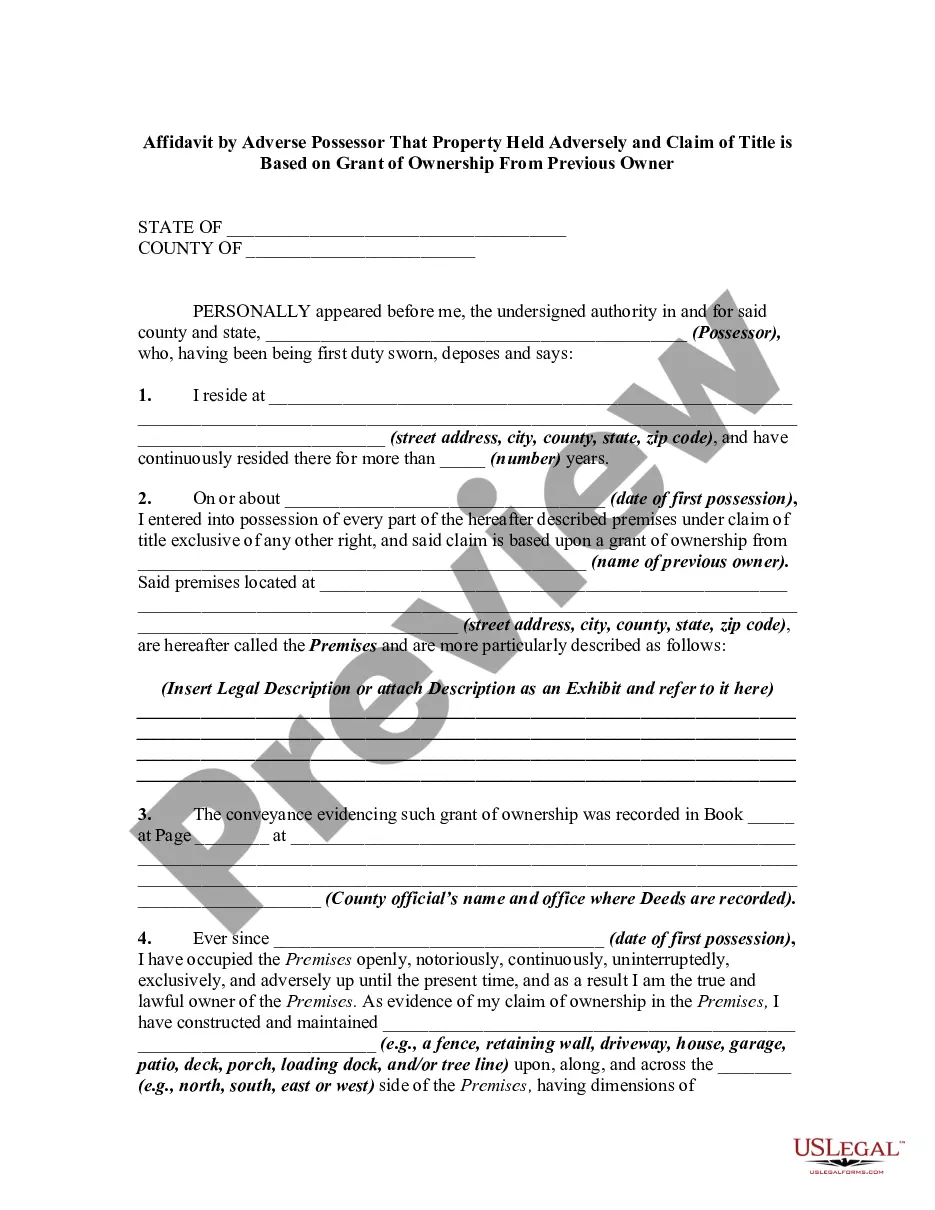
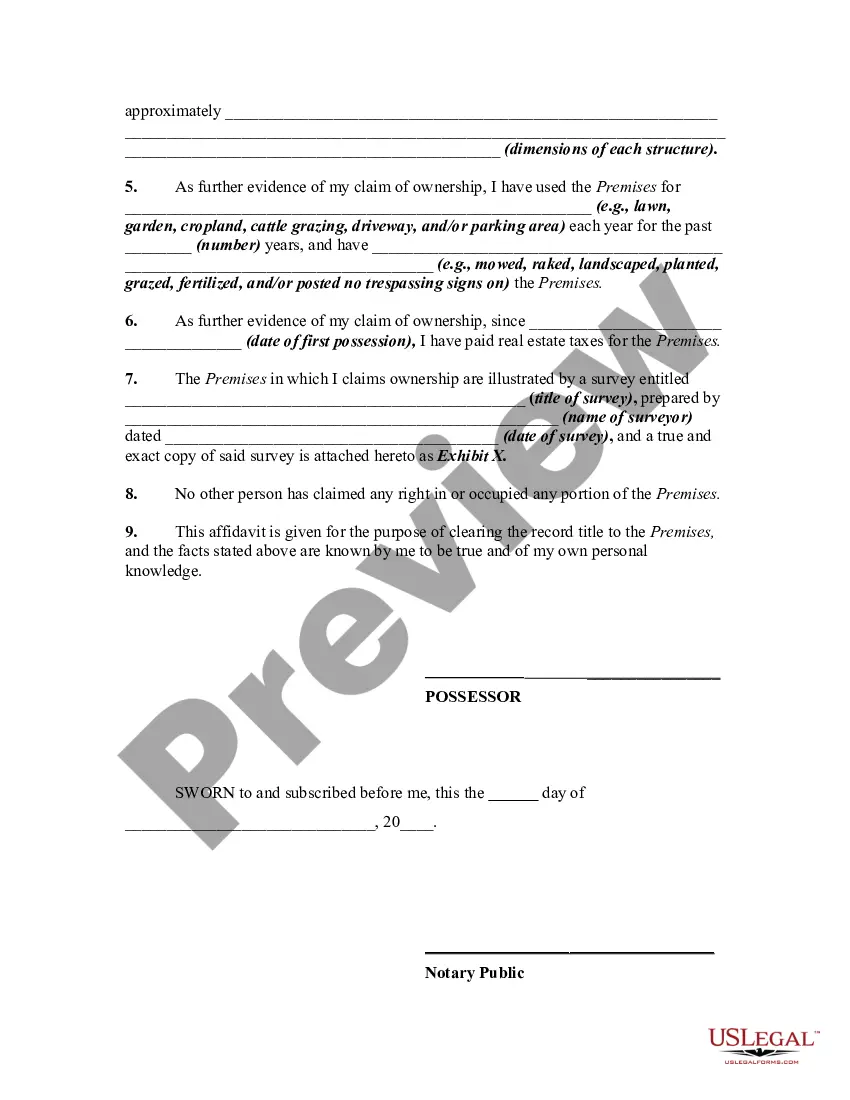
How to fill out Affidavit By Adverse Possessor That Property Held Adversely And Claim Of Title Is Based On Grant Of Ownership From Previous Owner - Squatters Rights?
- If you're a returning user, log into your account and check the status of your subscription. Ensure it’s active to access form templates.
- For first-time users, begin by browsing our extensive library of over 85,000 legal forms. Use the Preview mode to confirm you've selected the right document for your needs.
- If you require a different template, utilize the Search tab to find legal forms that align with your local jurisdiction requirements.
- Once you've identified the correct document, click the Buy Now button and choose a subscription plan that fits your needs. You will need to create an account to access the resources.
- Complete your purchase using a credit card or PayPal, ensuring a smooth transaction.
- Finally, download your selected form and save it on your device. You can also access it anytime through the My Forms menu in your profile.
In conclusion, US Legal Forms offers an exceptional service that allows individuals and attorneys to efficiently handle their legal documentation needs. With a vast collection of templates and access to expert assistance, creating legally sound documents is easier than ever.
Take the first step today and explore our library to ensure you're legally equipped!
Form popularity
FAQ
One common misconception is that paying property taxes is a requirement of claiming adverse possession. While paying taxes can strengthen a claim, it is not an absolute requirement. The essential elements include continuous, open, and hostile use, along with exclusivity for a prescribed period. For in-depth understanding, exploring resources on the US Legal Forms platform can clarify these requirements and help you navigate the complexities of property law.
A common example of adverse possession occurs when someone has been using a vacant piece of land for years without the owner's permission. For instance, if a neighbor regularly mows and maintains abandoned land, and does so openly for the required statutory period, they might be able to claim ownership as an adverse possessor for possession. This scenario illustrates how prolonged, visible use can result in gaining legal property rights. Learning from case studies on US Legal Forms can provide further insights into these real-life situations.
To claim property through adverse possession, you must prove several key elements: the use must be continuous, open, hostile, exclusive, and for a statutory period, which varies by state. You must show that your possession has been uninterrupted and visible, giving the true owner notice of your claim. Additionally, the possession must be without permission from the original owner. Resources on platforms like US Legal Forms can help you understand these criteria better.
To successfully defeat an adverse possession claim, you must demonstrate that the claimant does not meet all the necessary legal requirements. This involves proving your own ownership rights or showing that the claimant's use of the property was not continuous, exclusive, or open. Maintaining proper documentation of property use and boundaries can also help establish ownership. If you need assistance with these legal factors, consider utilizing the US Legal Forms platform for resources and guidance.
To establish adverse possession in Florida, five key requirements must be met. First, the possession must be actual, implying physical presence on the land. Second, it should be continuous for the statutory period of 7 years. Third, the usage must be exclusive, meaning the possessor operates without sharing the property with the owner. Fourth, the possession must be visible and notorious, and finally, it must be hostile, which means without permission from the original owner. Consulting uslegalforms can help you understand these requirements thoroughly.
In Minnesota, the period for an adverse possessor for possession is 15 years. During this time, the possessor must demonstrate continuous, uninterrupted use of the property. This timeframe allows for a significant amount of time for a possessor to establish their claim. If you’re in a similar situation, consider reaching out for professional advice to discuss your options.
An example of adverse possession could be when a person builds a fence around an empty lot and maintains it for a certain number of years without the owner's knowledge. This act establishes the individual as an adverse possessor for possession. If they meet all legal requirements, they could potentially claim ownership of the land. Understanding these nuances can be essential when assessing property rights.
In Florida, the period for an adverse possessor for possession is typically set at 7 years. During this time, the possessor must continuously occupy the property in a manner that is open and notorious. It is crucial to note that the possession must be exclusive and without permission from the original owner. If you believe you meet these criteria, consulting legal experts may help you navigate the process.
To defeat a claim of adverse possession, it's essential to document your ownership and take legal action promptly. Make sure to regularly inspect your property and respond to any unauthorized use. You may challenge the adverse possessor for possession by proving that their use was not exclusive or without permission. Legal assistance, such as through USLegalForms, can provide you with the necessary resources to protect your ownership effectively.
In Tennessee, the duration for an adverse possessor for possession is typically 7 years. The adverse possessor must demonstrate continuous and open use of the property during this time, without the permission of the original owner. After the 7-year period, the adverse possessor may successfully claim ownership. Thus, it's critical to monitor your property to prevent adverse claims.