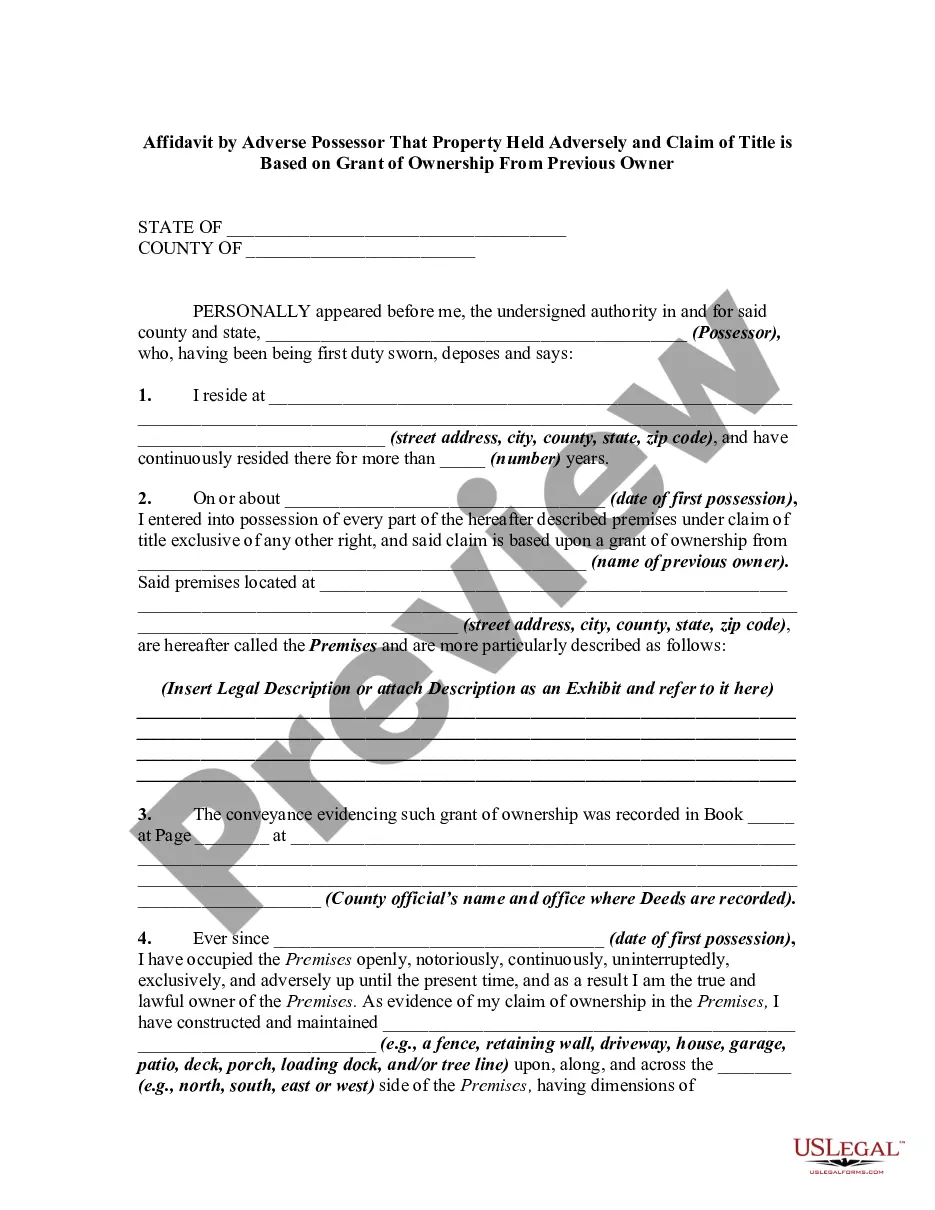
Adverse Possession Requirements Texas
Description

Get your form ready online
Our built-in tools help you complete, sign, share, and store your documents in one place.
Make edits, fill in missing information, and update formatting in US Legal Forms—just like you would in MS Word.
Download a copy, print it, send it by email, or mail it via USPS—whatever works best for your next step.
Sign and collect signatures with our SignNow integration. Send to multiple recipients, set reminders, and more. Go Premium to unlock E-Sign.
If this form requires notarization, complete it online through a secure video call—no need to meet a notary in person or wait for an appointment.
We protect your documents and personal data by following strict security and privacy standards.

Make edits, fill in missing information, and update formatting in US Legal Forms—just like you would in MS Word.

Download a copy, print it, send it by email, or mail it via USPS—whatever works best for your next step.

Sign and collect signatures with our SignNow integration. Send to multiple recipients, set reminders, and more. Go Premium to unlock E-Sign.

If this form requires notarization, complete it online through a secure video call—no need to meet a notary in person or wait for an appointment.

We protect your documents and personal data by following strict security and privacy standards.
Looking for another form?






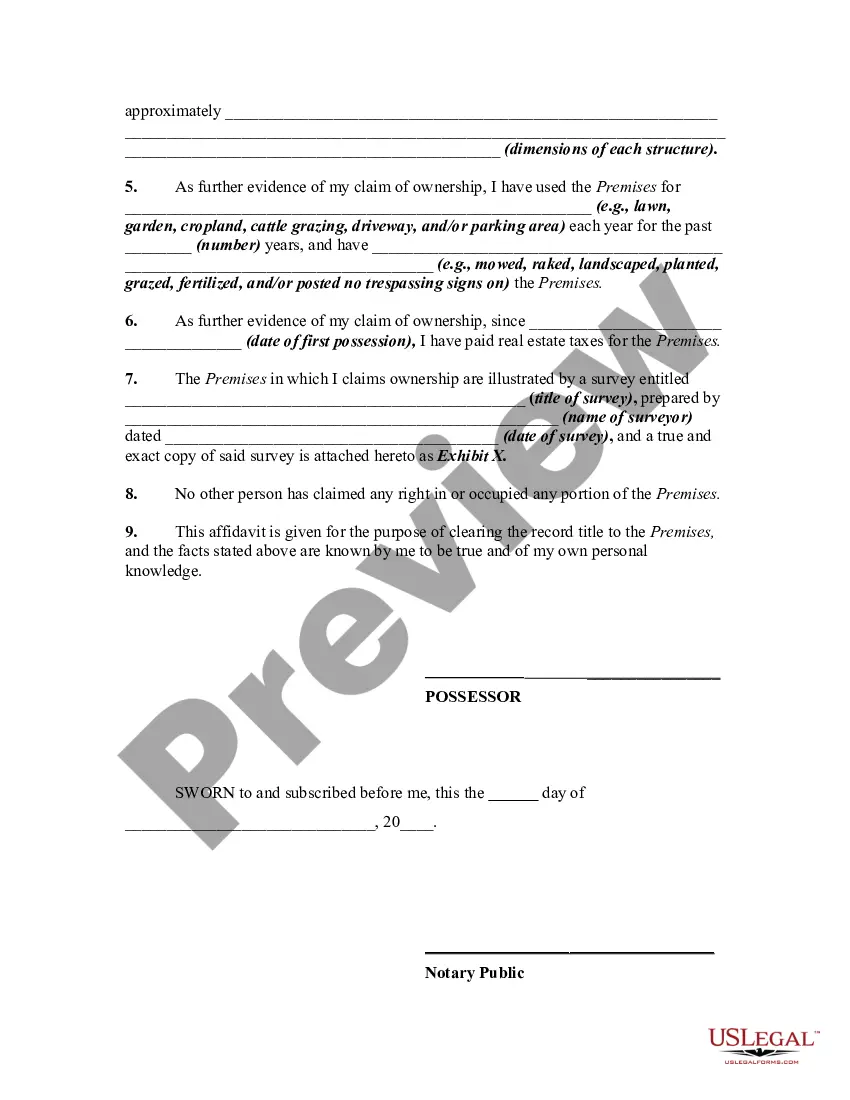
How to fill out Affidavit By Adverse Possessor That Property Held Adversely And Claim Of Title Is Based On Grant Of Ownership From Previous Owner - Squatters Rights?
- Log into your existing US Legal Forms account. If you're new to the service, create an account first.
- Navigate to the form description and preview mode to ensure the document meets your local jurisdiction and specific needs.
- Utilize the search feature if you need to find alternative templates that may be more suitable.
- Select the desired document and proceed to click the 'Buy Now' button to choose your preferred subscription plan.
- Complete the payment process using your credit card or PayPal account to access the form.
- Download the finalized template to your device and find it in the 'My Forms' section of your profile for future reference.
In conclusion, US Legal Forms simplifies the process of acquiring legal documentation. With a robust library of over 85,000 forms and expert assistance available, you can be assured of getting the right documents for your needs.
Start your legal journey today and leverage the resources available at US Legal Forms for your adverse possession requirements in Texas.
Form popularity
FAQ
In Texas, you typically have between 3 to 10 years to file for adverse possession, depending on the specific circumstances of your claim. You must meet certain adverse possession requirements in Texas, such as continuously occupying the land and claiming it as your own. The type of title under which you claim possession dictates the time frame. It's important to consult with legal resources, such as US Legal Forms, to ensure you understand all requirements and properly file your claim.
Defeating a claim of adverse possession requires a solid understanding of the law. In Texas, showing that the claimant did not meet the adverse possession requirements Texas defines, such as proving a lack of intent to possess, can effectively undermine their case. Consulting a legal expert or a platform like USLegalForms can provide clarity and support in preparing a proper defense.
A few key factors could defeat an adverse possessor's claim in Texas. If the original owner can demonstrate that the land was not used in an open or notorious way, the claim may fail. Additionally, lack of continuous possession or failure to adhere to adverse possession requirements Texas specifies can significantly weaken the adverse possessor’s case.
An example of adverse possession might involve a person who maintains a vacant lot for ten years without the owner's consent. During this time, they build a fence, mow the lawn, and treat the property as their own, thus meeting the adverse possession requirements Texas law establishes. Such actions may lead to legal recognition of the possessor’s claim over the property.
Several factors can defeat a claim of adverse possession in Texas. For instance, proving that the possession was not continuous or that permission was granted can nullify the claim. The adverse possessor must also meet the adverse possession requirements Texas outlines, so any deviations can play a pivotal role in your defense.
In Texas, to record an adverse possession claim, the possessor must file a lawsuit to establish their claim formally. This process involves providing evidence that satisfies the adverse possession requirements Texas has set. After a successful trial, the court may issue a judgment, which can then be recorded with the local property records.
To defeat an adverse possession claim in Texas, property owners can prove that the claimant did not meet the adverse possession requirements Texas outlines. You can show evidence of your own continuous use and management of the land. Additionally, if the claimant lacks the required period or fails to demonstrate that their possession was open and notorious, your defense may succeed.
The finders keepers law in Texas is often misunderstood. It generally refers to the belief that if you find something, you can keep it. However, this principle does not apply to real property, especially when discussing adverse possession requirements in Texas. Under Texas law, merely finding property does not grant ownership; instead, property must meet specific adverse possession requirements to legally claim it.
In Texas, the five fundamental requirements for adverse possession include actual possession, open and notorious use, exclusive possession, continuous use for the statutory period, and possession that is adverse to the interests of the true owner. Each of these elements plays a vital role in supporting your claim. Understanding these adverse possession requirements in Texas is essential for anyone considering this route. Utilizing resources like USLegalForms can provide guidance and help ensure that all criteria are clearly met in your claim process.
The 3-year rule in Texas refers to a specific provision allowing a person to claim adverse possession after occupying the property for just three years. This applies when the property is either under a deed that is invalid, or when the property is acquired from a property owner who did not have legal title. Meeting the adverse possession requirements in Texas under this rule can lead to ownership if the conditions are properly fulfilled, making it a crucial option for certain cases.