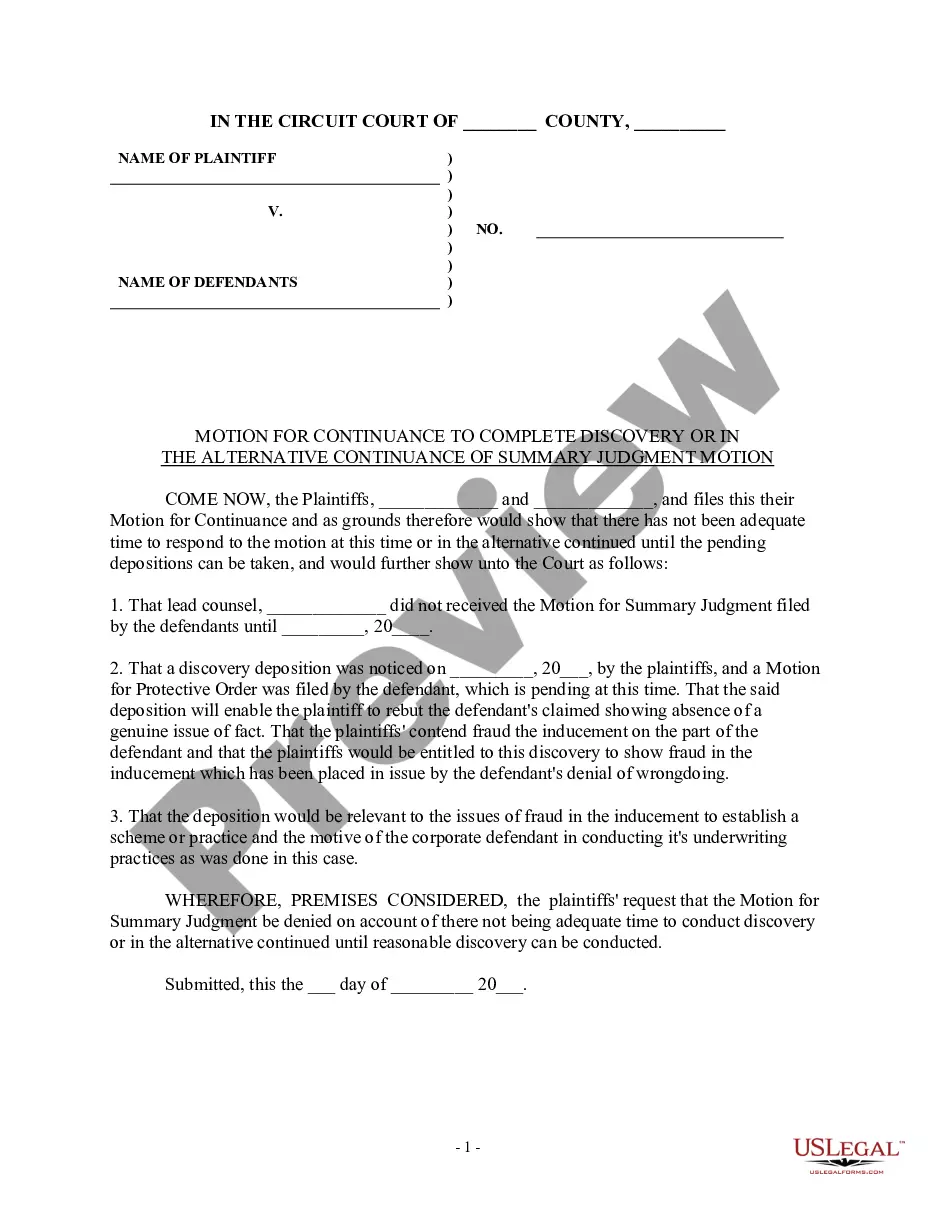
Motion Stay Sample For Job
Description
Get your form ready online
Our built-in tools help you complete, sign, share, and store your documents in one place.
Make edits, fill in missing information, and update formatting in US Legal Forms—just like you would in MS Word.
Download a copy, print it, send it by email, or mail it via USPS—whatever works best for your next step.
Sign and collect signatures with our SignNow integration. Send to multiple recipients, set reminders, and more. Go Premium to unlock E-Sign.
If this form requires notarization, complete it online through a secure video call—no need to meet a notary in person or wait for an appointment.
We protect your documents and personal data by following strict security and privacy standards.
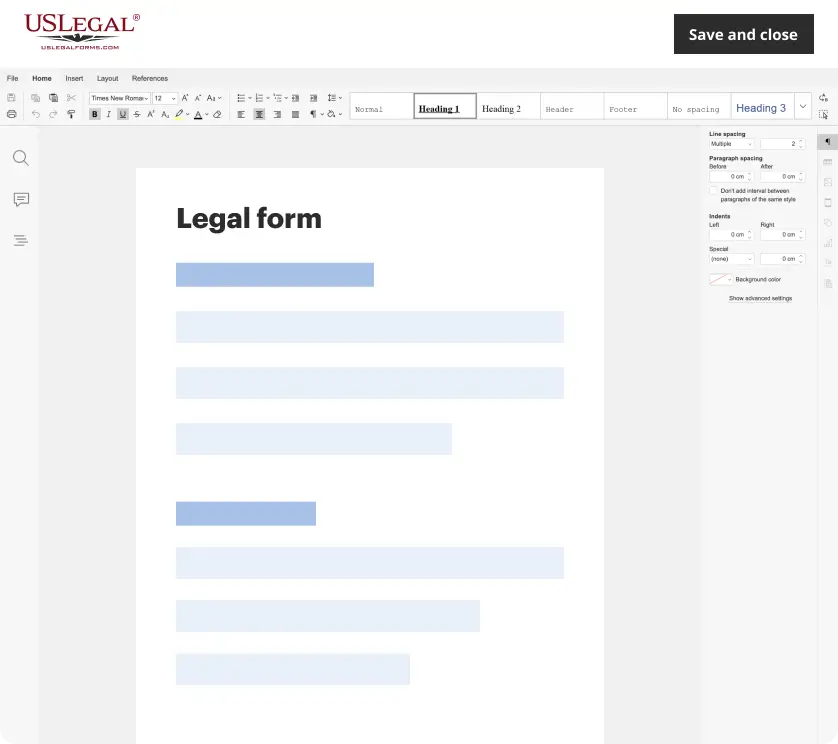
Make edits, fill in missing information, and update formatting in US Legal Forms—just like you would in MS Word.
Download a copy, print it, send it by email, or mail it via USPS—whatever works best for your next step.
Sign and collect signatures with our SignNow integration. Send to multiple recipients, set reminders, and more. Go Premium to unlock E-Sign.

If this form requires notarization, complete it online through a secure video call—no need to meet a notary in person or wait for an appointment.
We protect your documents and personal data by following strict security and privacy standards.
Looking for another form?

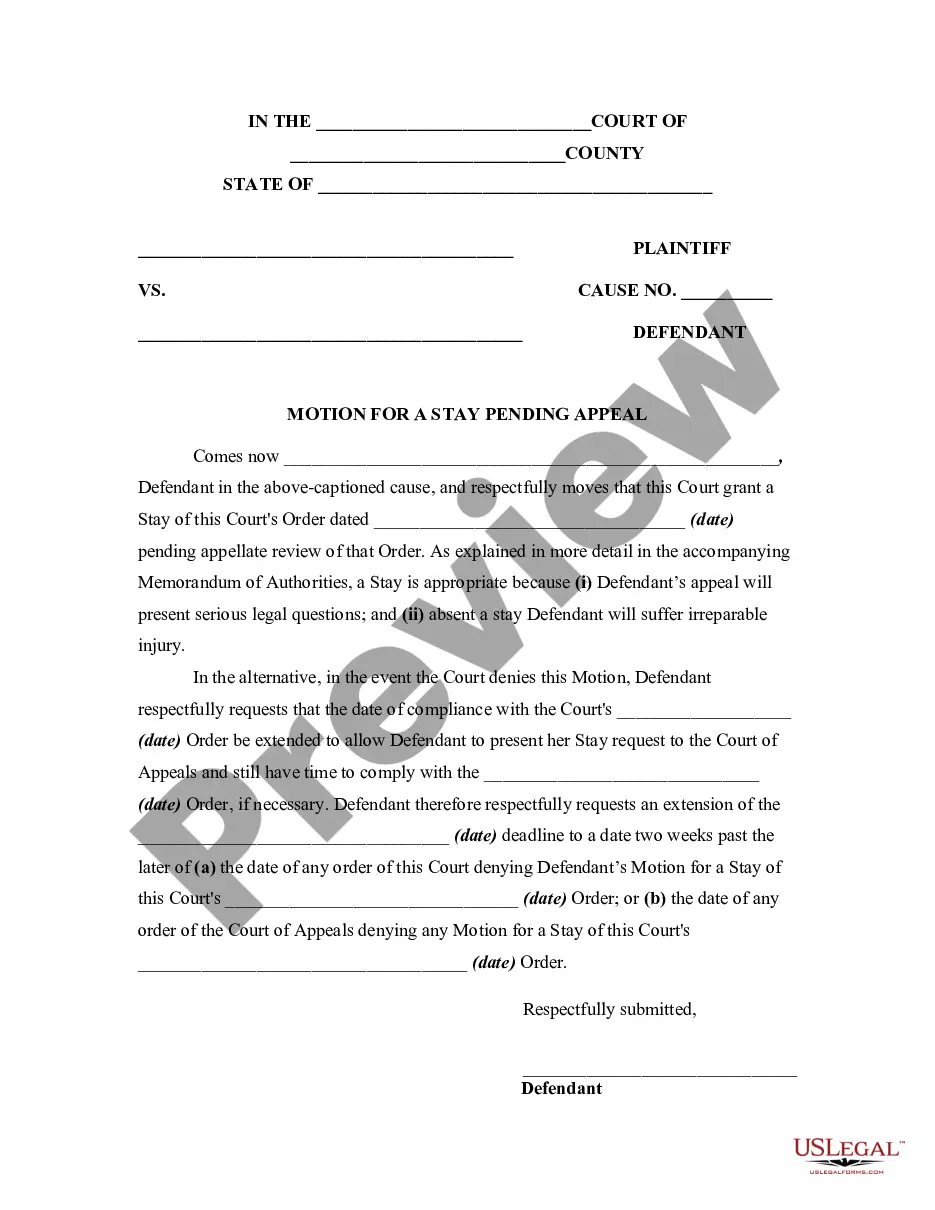
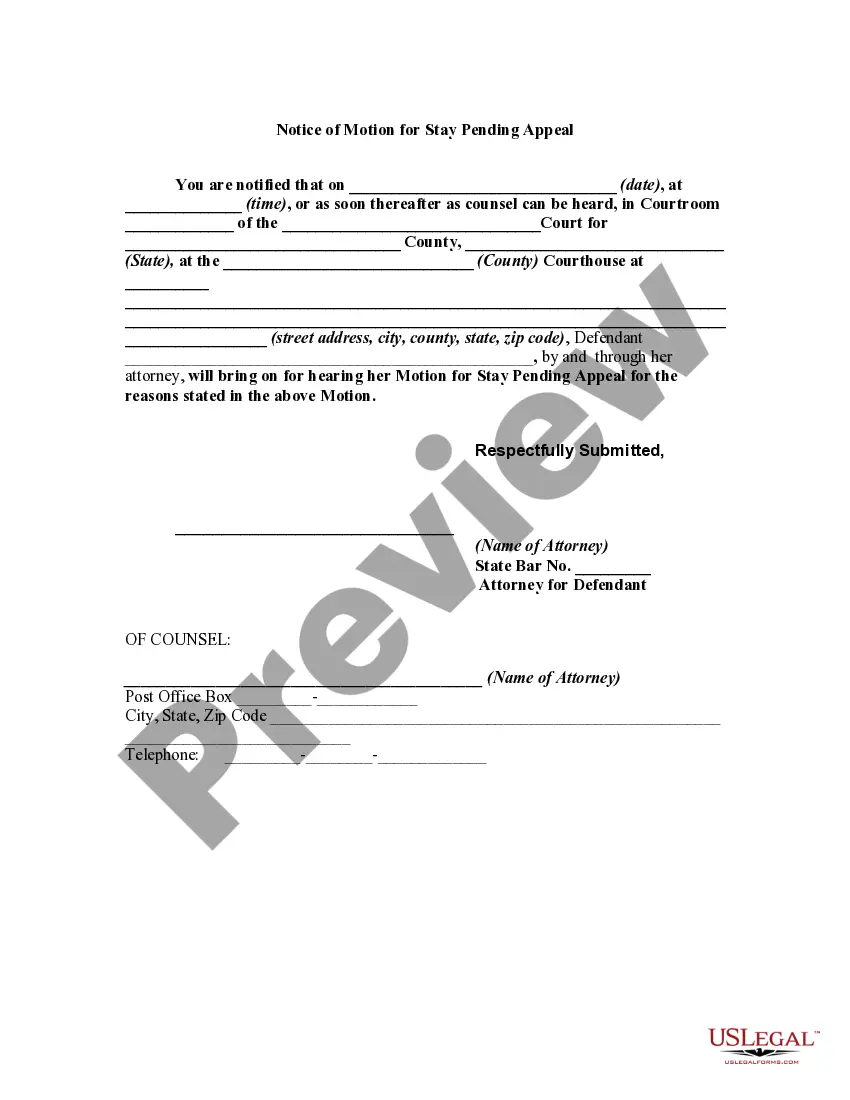
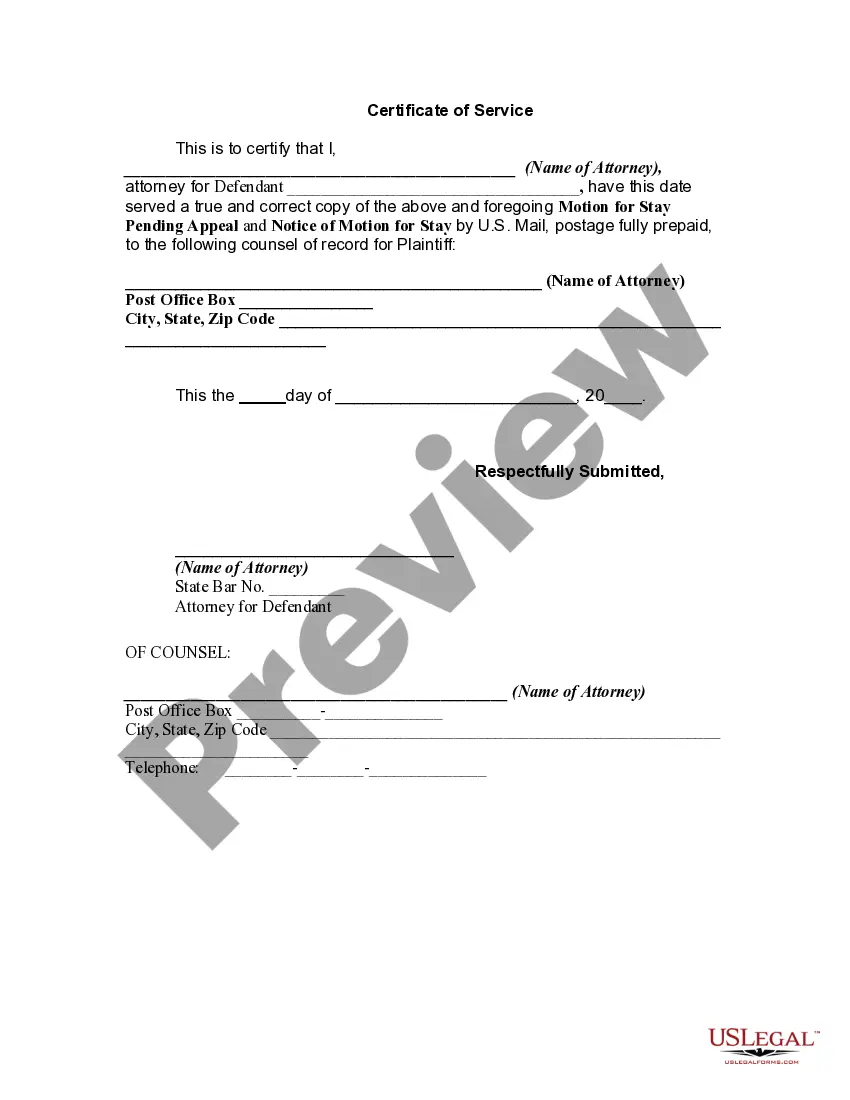
How to fill out Motion For Stay Pending Appeal And Notice Of Motion?
Managing legal paperwork can be daunting, even for the most experienced individuals.
When you're seeking a Motion Stay Example For Employment and don't have the opportunity to look for the suitable and current version, the process can be stressful.
Employ state-of-the-art tools to complete and manage your Motion Stay Example For Employment.
Tap into a valuable repository of articles, guides, and resources tailored to your situation and needs.
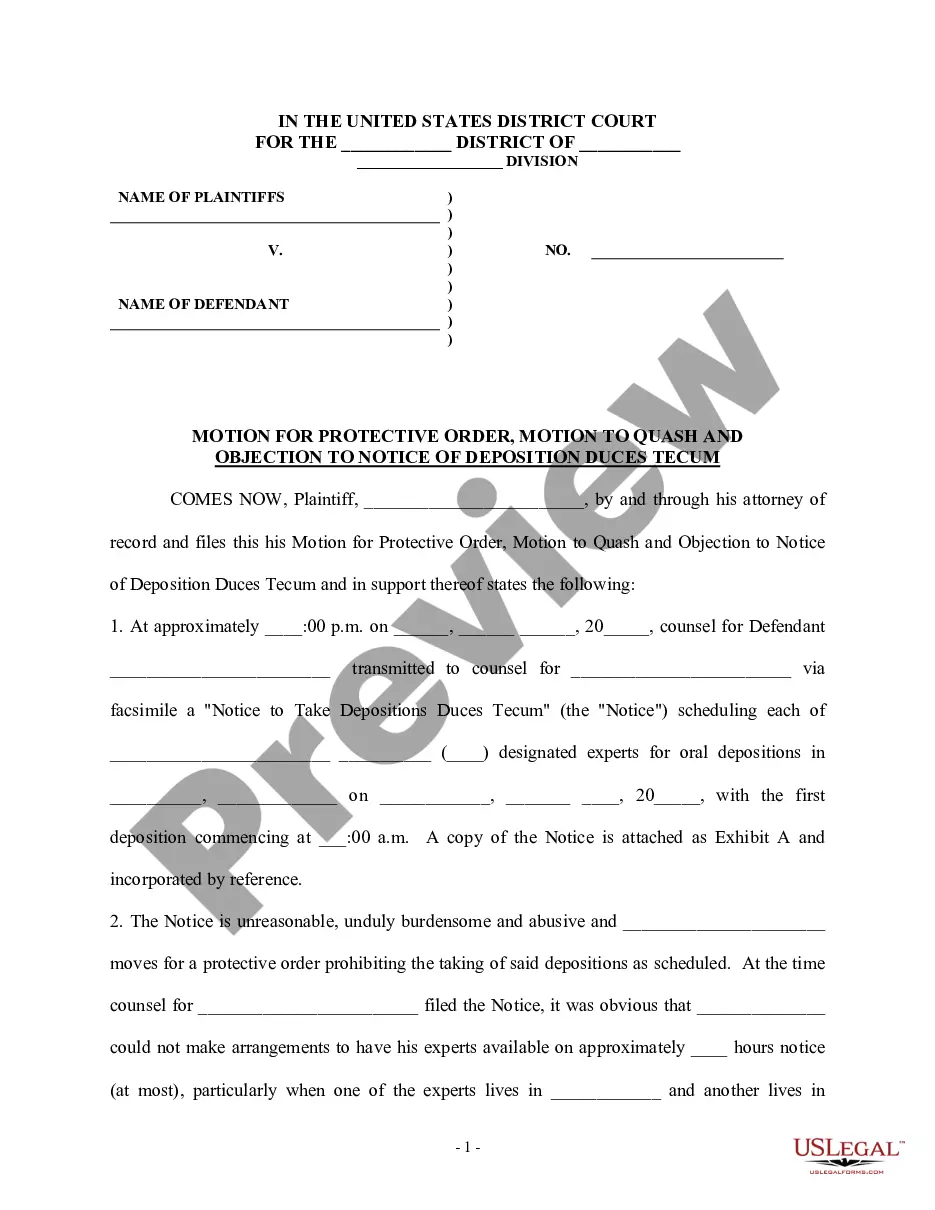
Verify that it is the correct form by previewing it and reviewing its details.
- Save time and effort sourcing the documents you require, utilizing US Legal Forms’ sophisticated search and Review feature to locate the Motion Stay Example For Employment and obtain it.
- If you hold a monthly subscription, Log In to your US Legal Forms account, search for the form, and acquire it.
- Check your My documents section to view the documents you have previously downloaded and manage your folders as desired.
- If this is your first experience with US Legal Forms, register an account and gain unlimited access to the entire benefits of the library.
- Here are the steps to follow after acquiring the form you need.
- Leverage a comprehensive web form library that can significantly benefit anyone aiming to handle these matters effectively.
- Access state- or local-specific legal and business forms.
- US Legal Forms caters to any requirements you might have, from personal to corporate documentation, all in one location.
Form popularity
FAQ
'Stay the motion' means to pause or suspend the progress of a particular legal motion. When a court grants a stay, it prevents any further action on the motion until specific conditions are met or a certain time period passes. This notion is important for maintaining order in legal proceedings, especially when outcomes may be uncertain. For more detailed examples, look for motion stay samples for job that demonstrate this in action.
Newton's Third Law states that for every action, there is an equal and opposite reaction. This principle indicates that forces always occur in pairs; when one object applies a force on another, the second object applies an equal force in the opposite direction. Integrating this understanding into your motion stay sample for job illustrations the balance of actions and responses, which is crucial in career advancement.
This phrase reflects Newton's First Law of Motion, which explains that objects in motion remain in motion unless influenced by an external force. It emphasizes the idea that movement is a persistent state, barring interference. In crafting your motion stay sample for job purposes, this concept of continuous movement is vital, as it highlights the importance of stability in your career path.
We can define motion as the change of position of an object with respect to time. A book falling off a table, water flowing from the tap, rattling windows, etc., all exhibit motion. Even the air that we breathe exhibits motion! Everything in the universe moves.
There are several different types of post-judgment motions, but the most common are motions for new trial, motions to vacate, and motions to set-aside. Motions for new trial, motions to vacate, and motions to set-aside are the three most common post-judgment motions.
Be as persuasive as possible as you write your motion in a sequential, logical format. Express your ideas clearly, and make sure you outline what steps are necessary and how they will help your case. Use facts of the case whenever you can to avoid baseless emotional appeals.
General format - each motion generally consists of a case caption, a title that briefly identifies the relief sought, a series of numbered paragraphs that explains -- in a logical way -- why you are entitled to that relief, a prayer for relief, a signature block, a certification that a copy of the motion was sent to ...