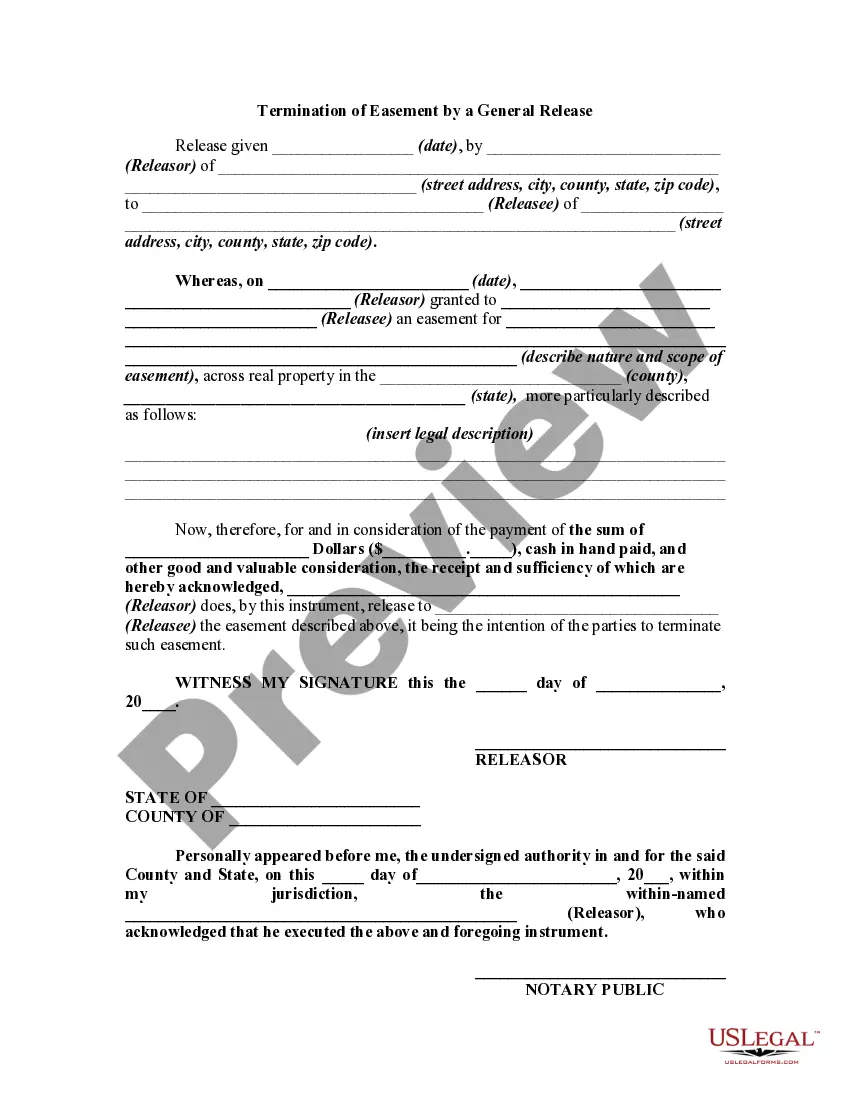
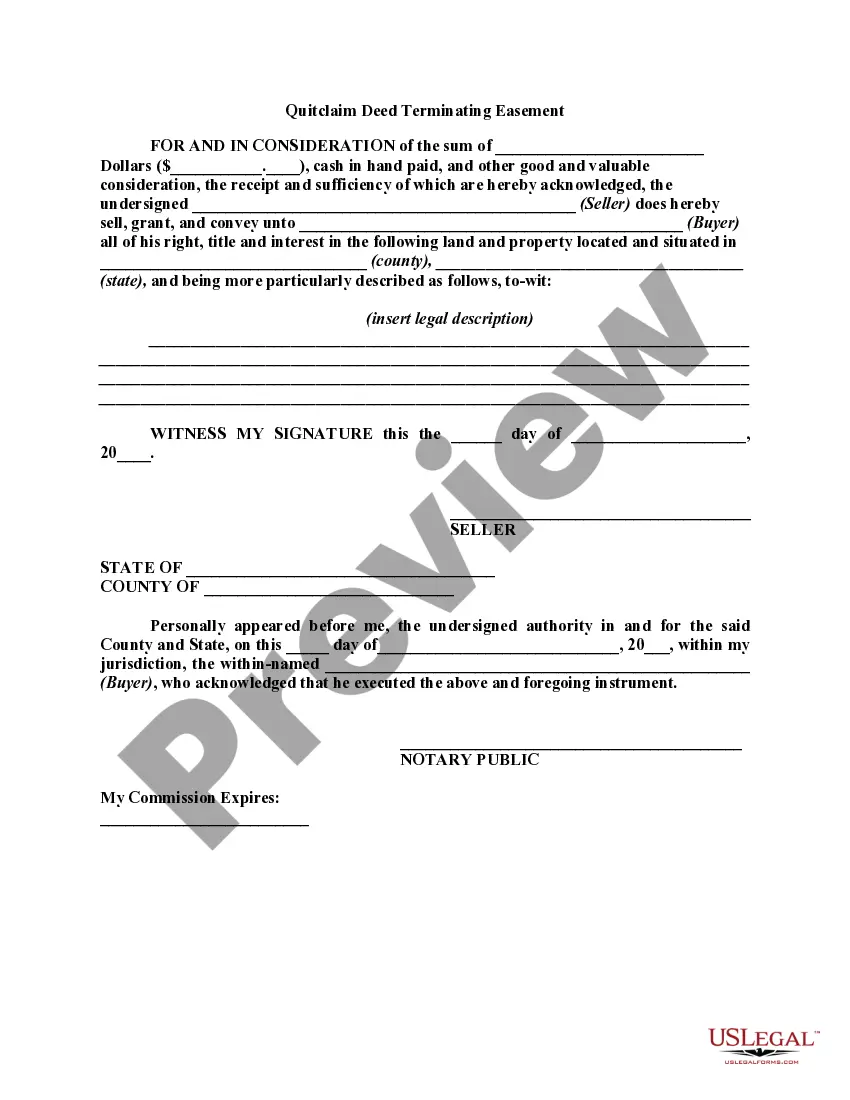
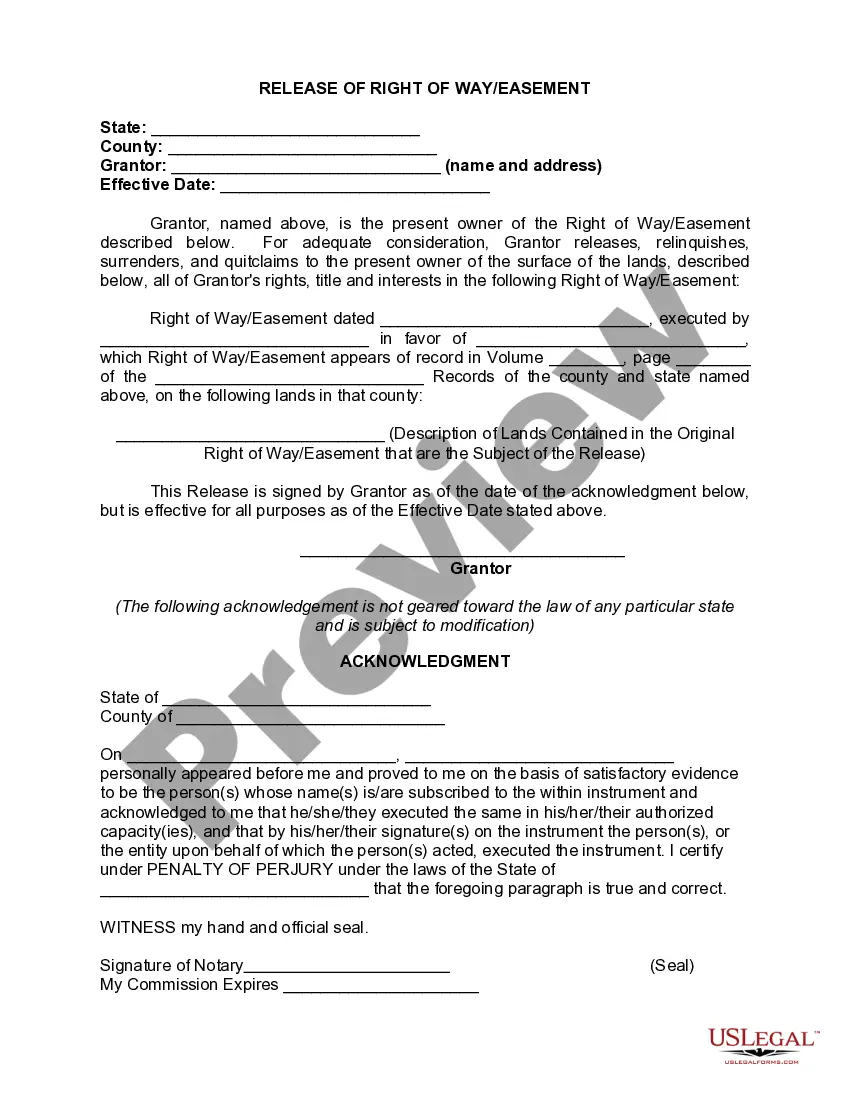
Termination Easement Form For Property
Description

Get your form ready online
Our built-in tools help you complete, sign, share, and store your documents in one place.
Make edits, fill in missing information, and update formatting in US Legal Forms—just like you would in MS Word.
Download a copy, print it, send it by email, or mail it via USPS—whatever works best for your next step.
Sign and collect signatures with our SignNow integration. Send to multiple recipients, set reminders, and more. Go Premium to unlock E-Sign.
If this form requires notarization, complete it online through a secure video call—no need to meet a notary in person or wait for an appointment.
We protect your documents and personal data by following strict security and privacy standards.

Make edits, fill in missing information, and update formatting in US Legal Forms—just like you would in MS Word.

Download a copy, print it, send it by email, or mail it via USPS—whatever works best for your next step.

Sign and collect signatures with our SignNow integration. Send to multiple recipients, set reminders, and more. Go Premium to unlock E-Sign.

If this form requires notarization, complete it online through a secure video call—no need to meet a notary in person or wait for an appointment.

We protect your documents and personal data by following strict security and privacy standards.
Looking for another form?










How to fill out Terminating Or Termination Of Easement By A General Release?
It’s clear that you cannot transform into a legal authority instantly, nor can you acquire the ability to swiftly draft a Termination Easement Form For Property without possessing a specialized background.
Drafting legal paperwork is a lengthy process that necessitates specific knowledge and expertise. So why not entrust the creation of the Termination Easement Form For Property to the professionals.
With US Legal Forms, one of the most extensive legal document repositories, you can find everything from court filings to templates for workplace correspondence. We recognize how crucial compliance and adherence to federal and state laws and regulations are. That’s why, on our platform, all forms are location-specific and current.
Select Buy now. After the payment is processed, you can obtain the Termination Easement Form For Property, fill it out, print it, and send or mail it to the appropriate individuals or organizations.
You can re-access your documents from the My documents tab at any time. If you’re a returning customer, you can simply Log In, and find and download the template from the same tab. Regardless of the intent behind your documents—whether they’re financial, legal, or personal—our website has you covered. Try US Legal Forms now!
- Begin with our website and acquire the document you require in just a few minutes.
- Locate the form you need using the search bar at the top of the page.
- Preview it (if this feature is available) and review the accompanying description to ascertain whether the Termination Easement Form For Property meets your needs.
- Initiate a new search if you require any other template.
- Create a free account and select a subscription plan to purchase the form.
Form popularity
FAQ
Release. An easement once granted may be ended by a release in writing stating that the owner of the easement gives away all rights and remedies including the ability to sue under the easement.
If that is not the case, it is important to remember that easements are permanent. However, they can be extinguished where: There is unity of ownership of the dominant and servient tenements. Express release by deed by the dominant owner.
An easement can be created by: Express grant, which means it will be written down in a legal document. Prescription, which means someone has exercised the right continuously for a period of at least 20 years.
A successful claimant of a prescriptive right must be able to demonstrate the following: 1. Continuous use for at least 20 years. This means that during the 20 year period, the third party's use or enjoyment of the land has not been obstructed and the third party must not have made any intention to abandon that right.
These methods of termination are abandonment, merger, prescription, end of necessity, demolition or destruction, marketable title statutes, misuse, estoppel, and death of the holder of an easement in gross.