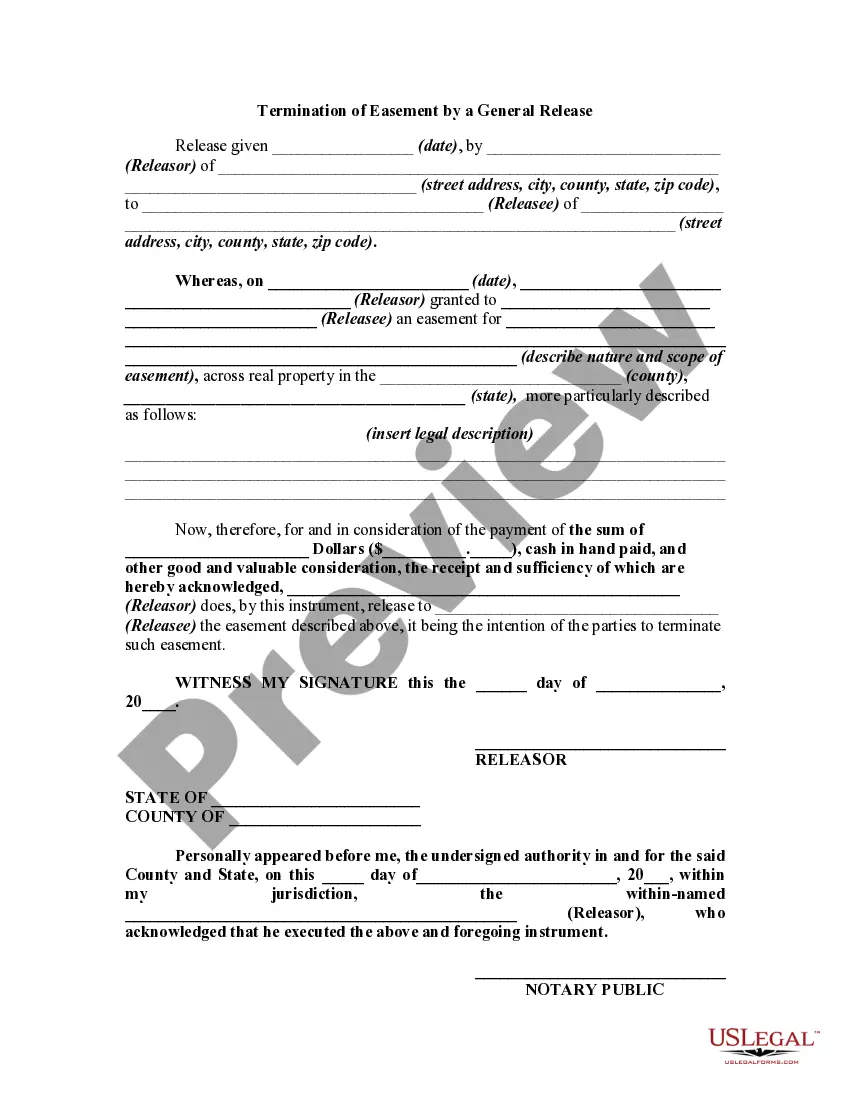
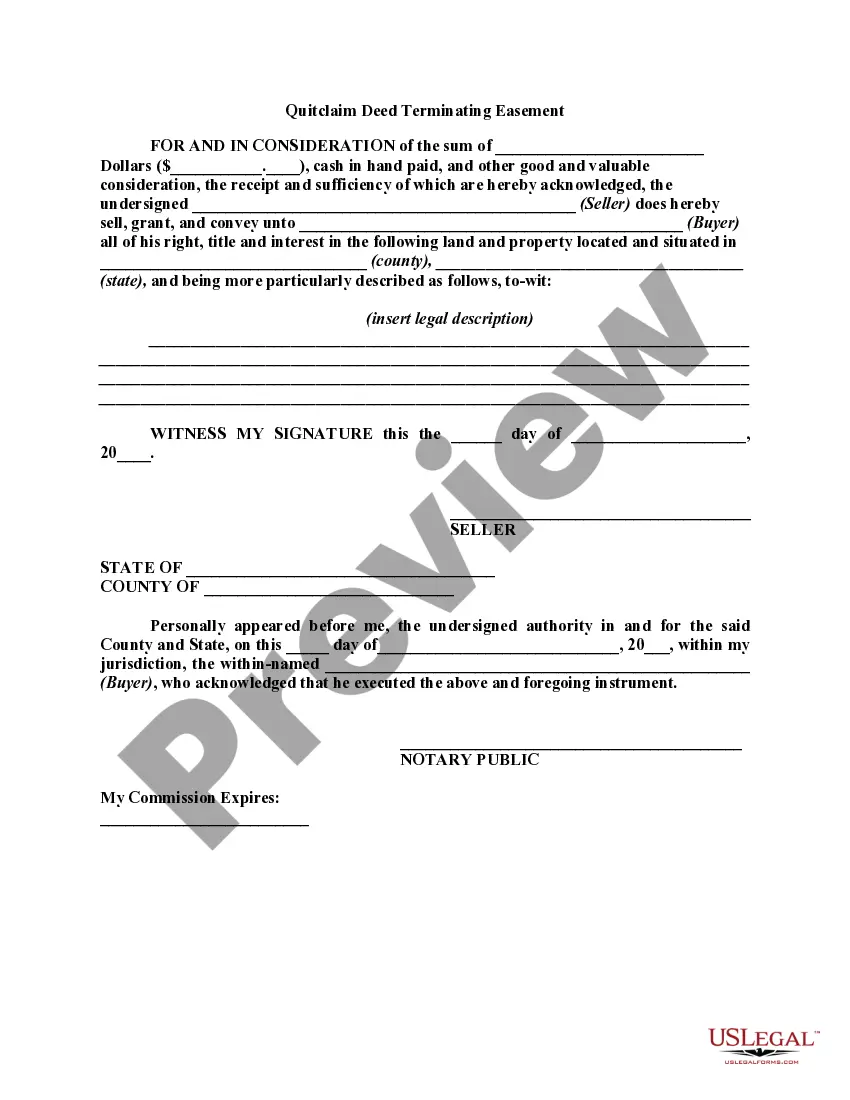
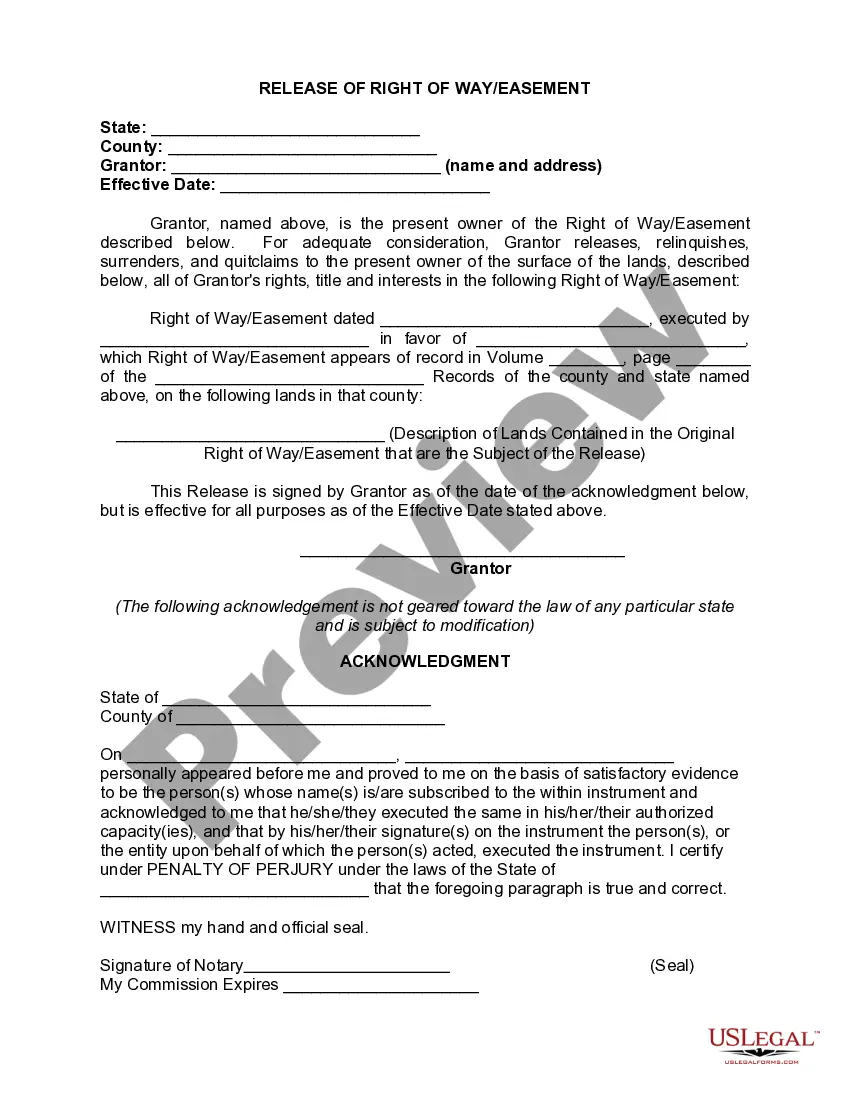
Easement Termination Form For Sale
Description

Get your form ready online
Our built-in tools help you complete, sign, share, and store your documents in one place.
Make edits, fill in missing information, and update formatting in US Legal Forms—just like you would in MS Word.
Download a copy, print it, send it by email, or mail it via USPS—whatever works best for your next step.
Sign and collect signatures with our SignNow integration. Send to multiple recipients, set reminders, and more. Go Premium to unlock E-Sign.
If this form requires notarization, complete it online through a secure video call—no need to meet a notary in person or wait for an appointment.
We protect your documents and personal data by following strict security and privacy standards.

Make edits, fill in missing information, and update formatting in US Legal Forms—just like you would in MS Word.

Download a copy, print it, send it by email, or mail it via USPS—whatever works best for your next step.

Sign and collect signatures with our SignNow integration. Send to multiple recipients, set reminders, and more. Go Premium to unlock E-Sign.

If this form requires notarization, complete it online through a secure video call—no need to meet a notary in person or wait for an appointment.

We protect your documents and personal data by following strict security and privacy standards.
Looking for another form?



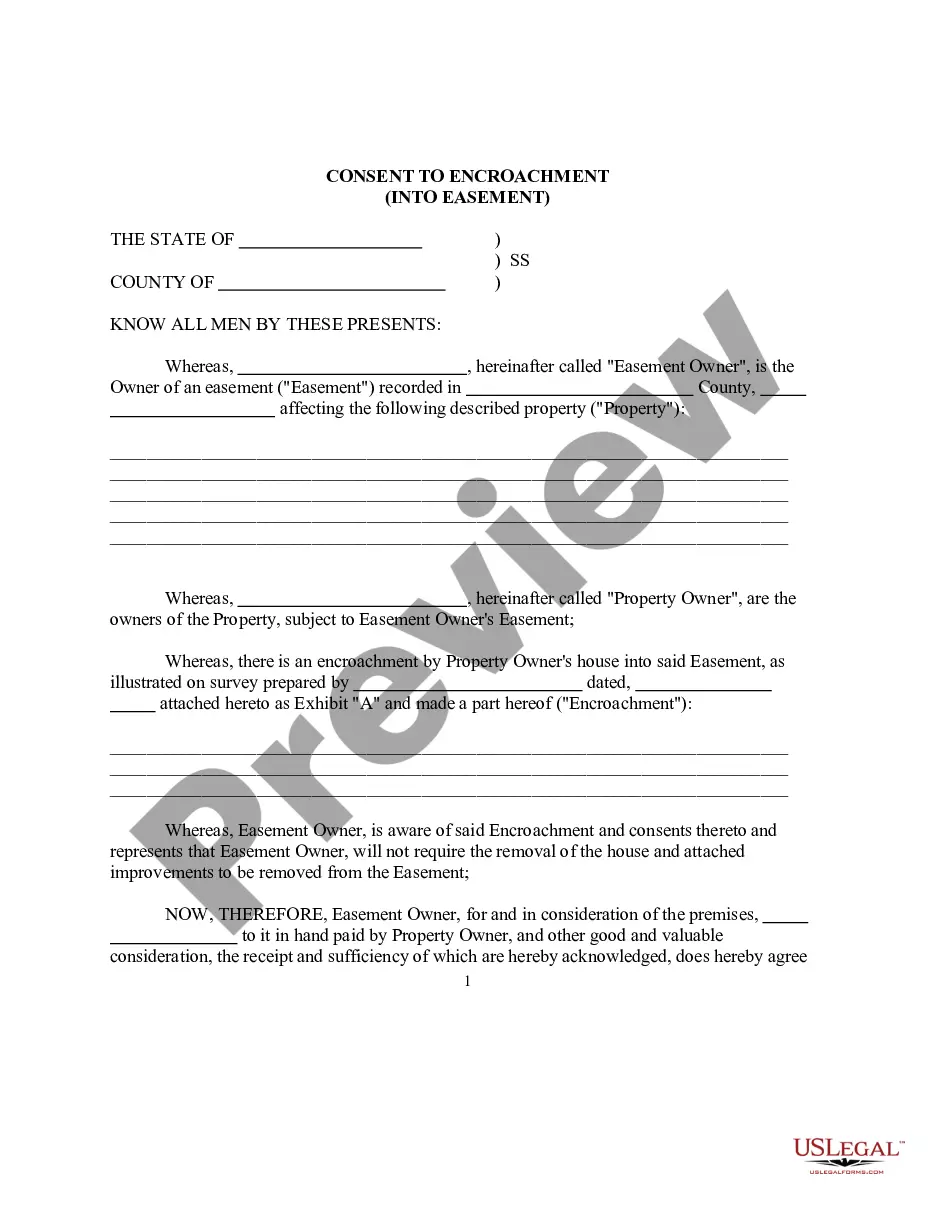
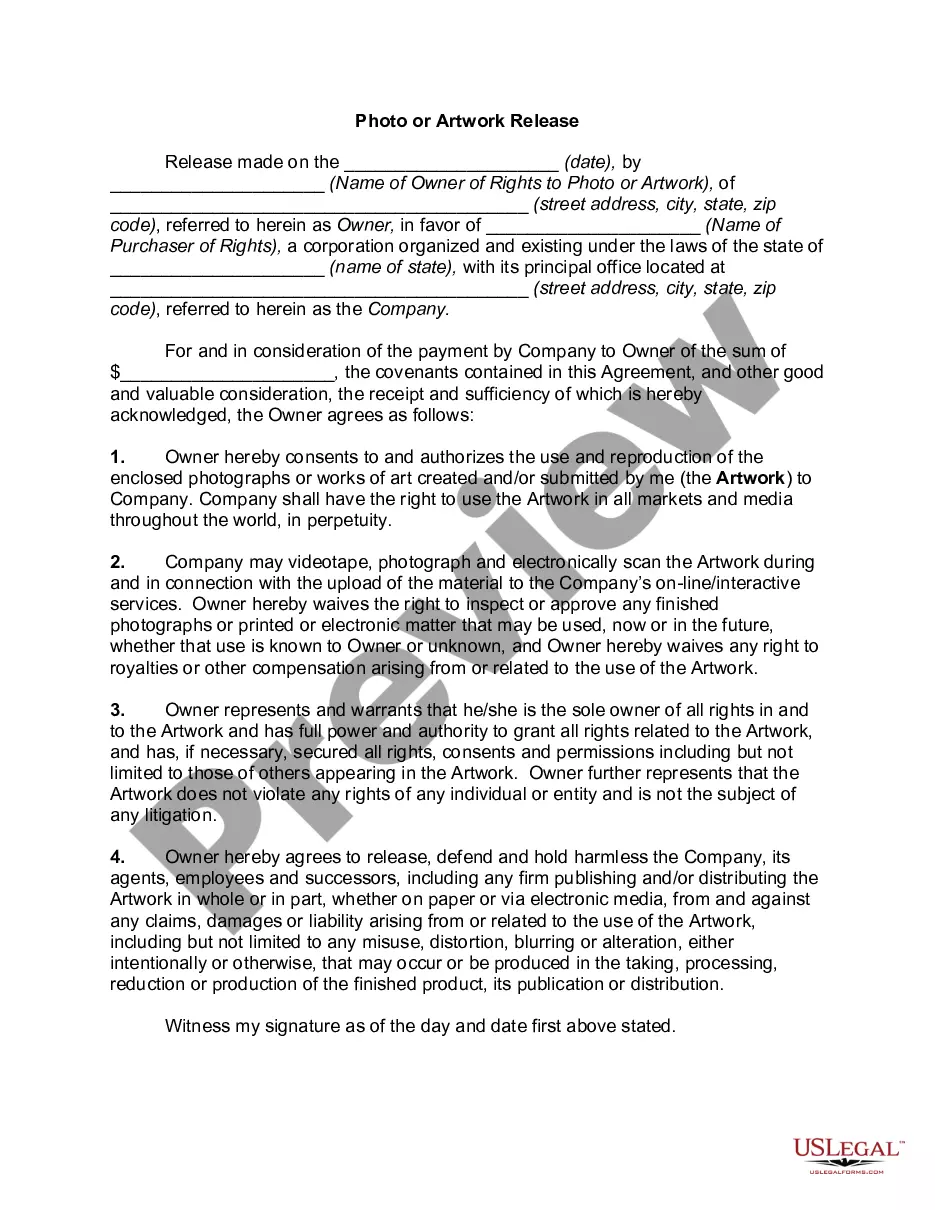

How to fill out Terminating Or Termination Of Easement By A General Release?
Regardless of whether for corporate reasons or personal matters, everyone must confront legal issues at some stage in their existence.
Filling out legal documentation requires meticulous care, beginning with choosing the correct form template.
After the file is saved, you can fill out the form using editing software or print it out and complete it manually. With an extensive US Legal Forms catalog available, you need not waste time searching for the right sample online. Utilize the library’s convenient navigation to secure the proper template for any circumstance.
- For instance, if you select an incorrect version of an Easement Termination Form For Sale, it will be rejected once submitted.
- Thus, it is vital to have a trustworthy source for legal documents like US Legal Forms.
- If you require an Easement Termination Form For Sale template, adhere to these straightforward steps.
- Obtain the sample you need by utilizing the search bar or catalog browsing.
- Review the form’s description to ensure it aligns with your case, state, and county.
- Click on the form’s preview to examine it.
- If it is the wrong document, return to the search tool to find the Easement Termination Form For Sale sample you need.
- Download the file if it satisfies your needs.
- If you possess a US Legal Forms account, click Log in to access previously stored documents in My documents.
- If you do not yet have an account, you can obtain the form by clicking Buy now.
- Select the appropriate pricing option.
- Complete the profile registration form.
- Choose your payment method: use a credit card or PayPal account.
Form popularity
FAQ
If that is not the case, it is important to remember that easements are permanent. However, they can be extinguished where: There is unity of ownership of the dominant and servient tenements. Express release by deed by the dominant owner.
If the easement is a problem, it is possible to have them removed in extreme cases. There are eight legal ways to terminate an easement: abandonment, merger, end of necessity, demolition, recording act, condemnation, adverse possession, and release, which a solicitor can give further advice if needed.
Release. An easement once granted may be ended by a release in writing stating that the owner of the easement gives away all rights and remedies including the ability to sue under the easement.
An equitable easement when the servient tenement is unregistered is enforceable against a purchaser for value only when properly registered under the terms of the Land Charges Act 1972.
If there is a right of way over your land you must not block or otherwise obstruct it but generally you are not obliged to take positive steps to keep the surface in good repair. The neighbour who has the right of way can repair the surface but does not have to.