Types Of Adverse Possession
Description
Get your form ready online
Our built-in tools help you complete, sign, share, and store your documents in one place.
Make edits, fill in missing information, and update formatting in US Legal Forms—just like you would in MS Word.
Download a copy, print it, send it by email, or mail it via USPS—whatever works best for your next step.
Sign and collect signatures with our SignNow integration. Send to multiple recipients, set reminders, and more. Go Premium to unlock E-Sign.
If this form requires notarization, complete it online through a secure video call—no need to meet a notary in person or wait for an appointment.
We protect your documents and personal data by following strict security and privacy standards.

Make edits, fill in missing information, and update formatting in US Legal Forms—just like you would in MS Word.

Download a copy, print it, send it by email, or mail it via USPS—whatever works best for your next step.

Sign and collect signatures with our SignNow integration. Send to multiple recipients, set reminders, and more. Go Premium to unlock E-Sign.

If this form requires notarization, complete it online through a secure video call—no need to meet a notary in person or wait for an appointment.

We protect your documents and personal data by following strict security and privacy standards.
Looking for another form?

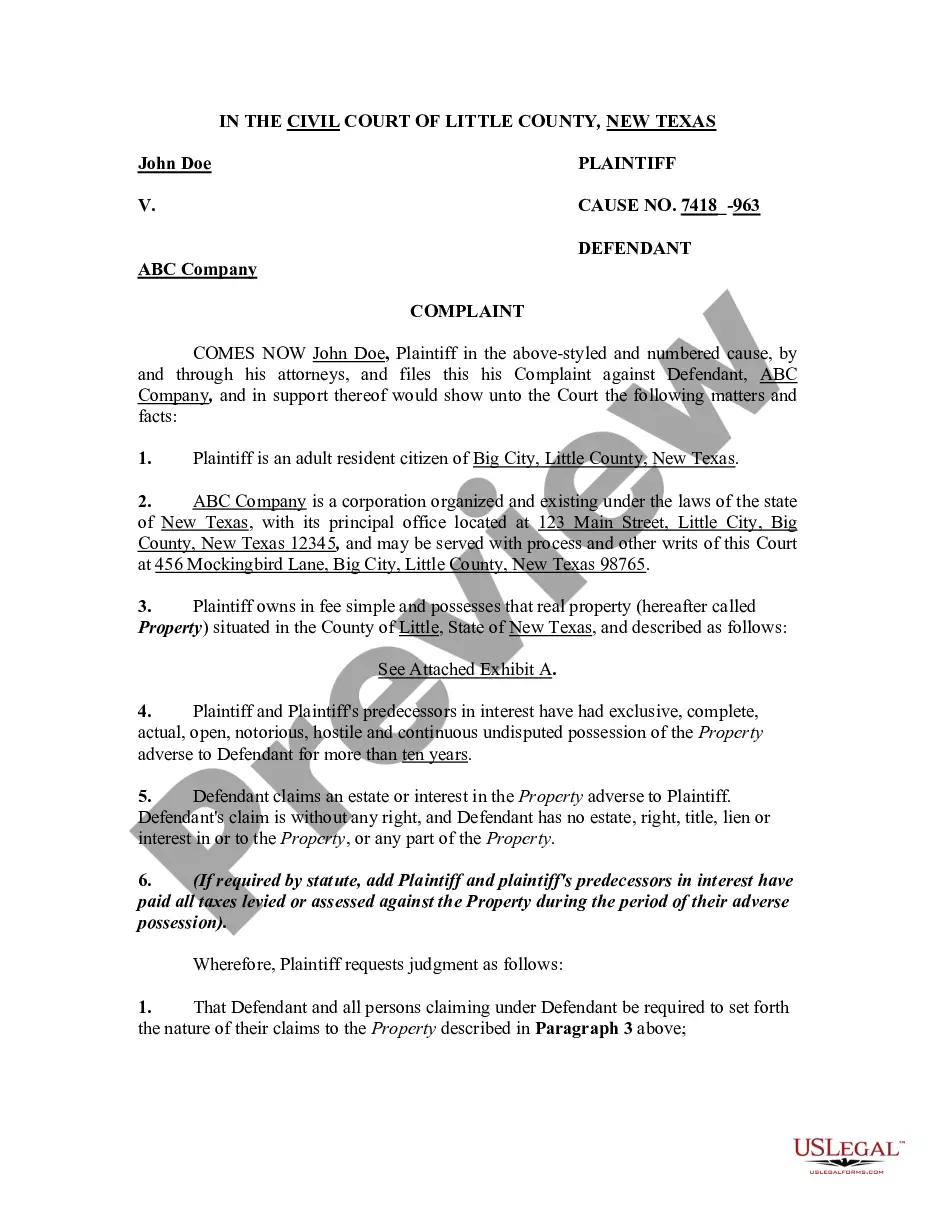
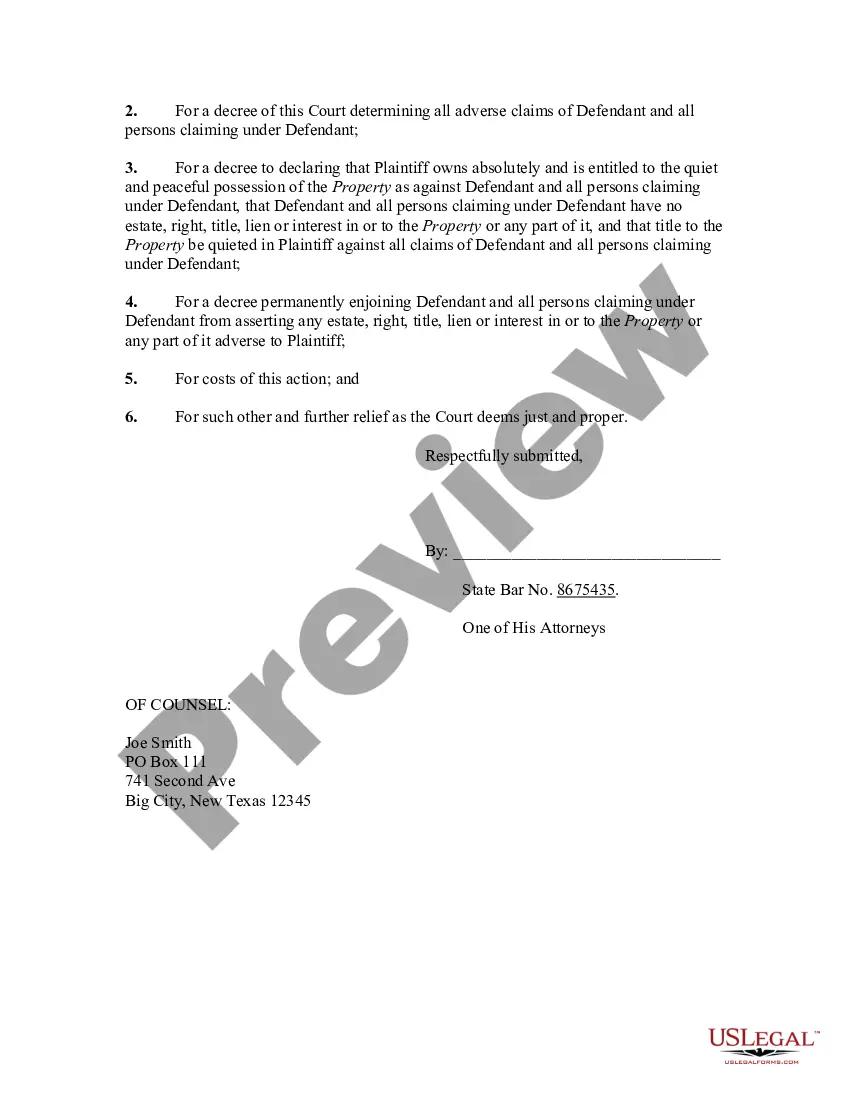
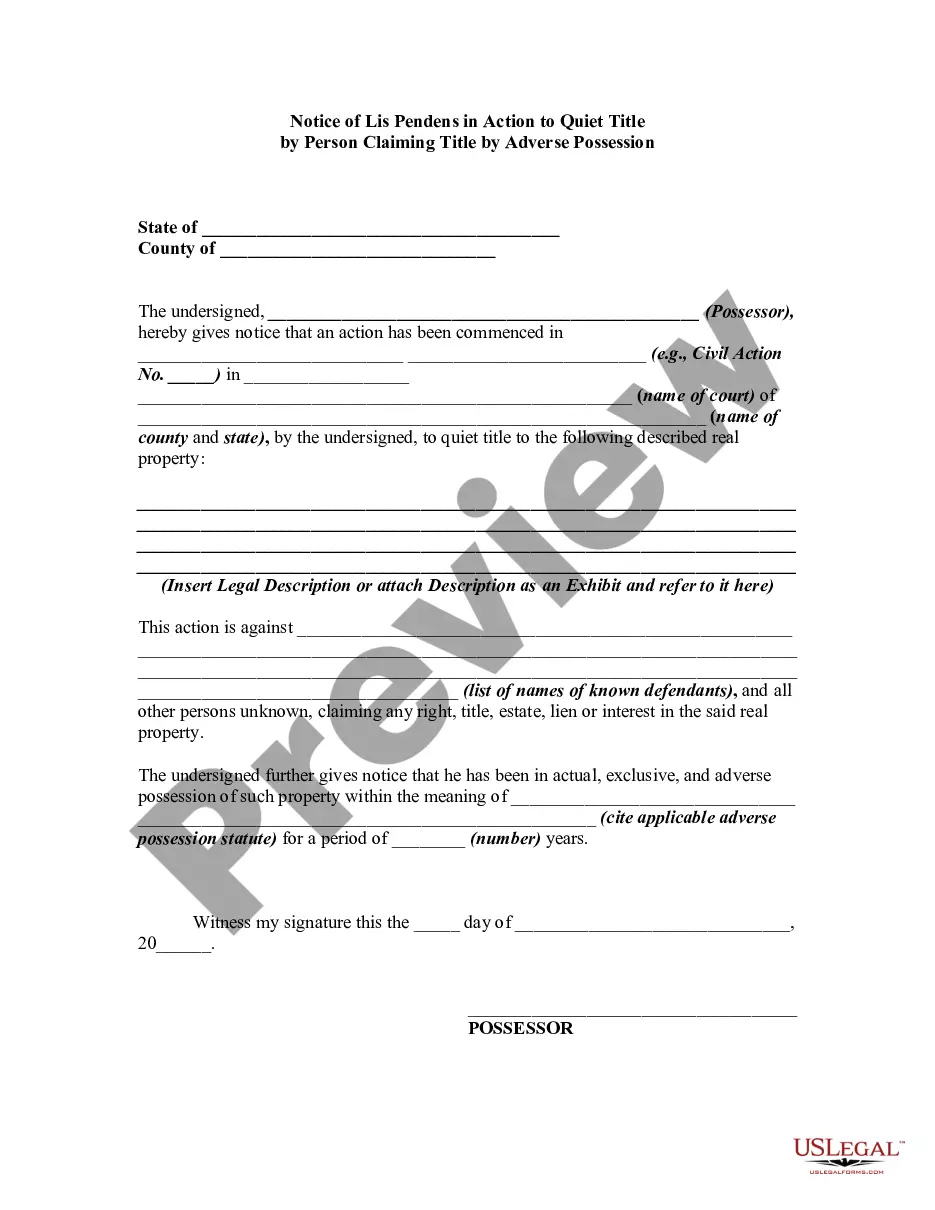
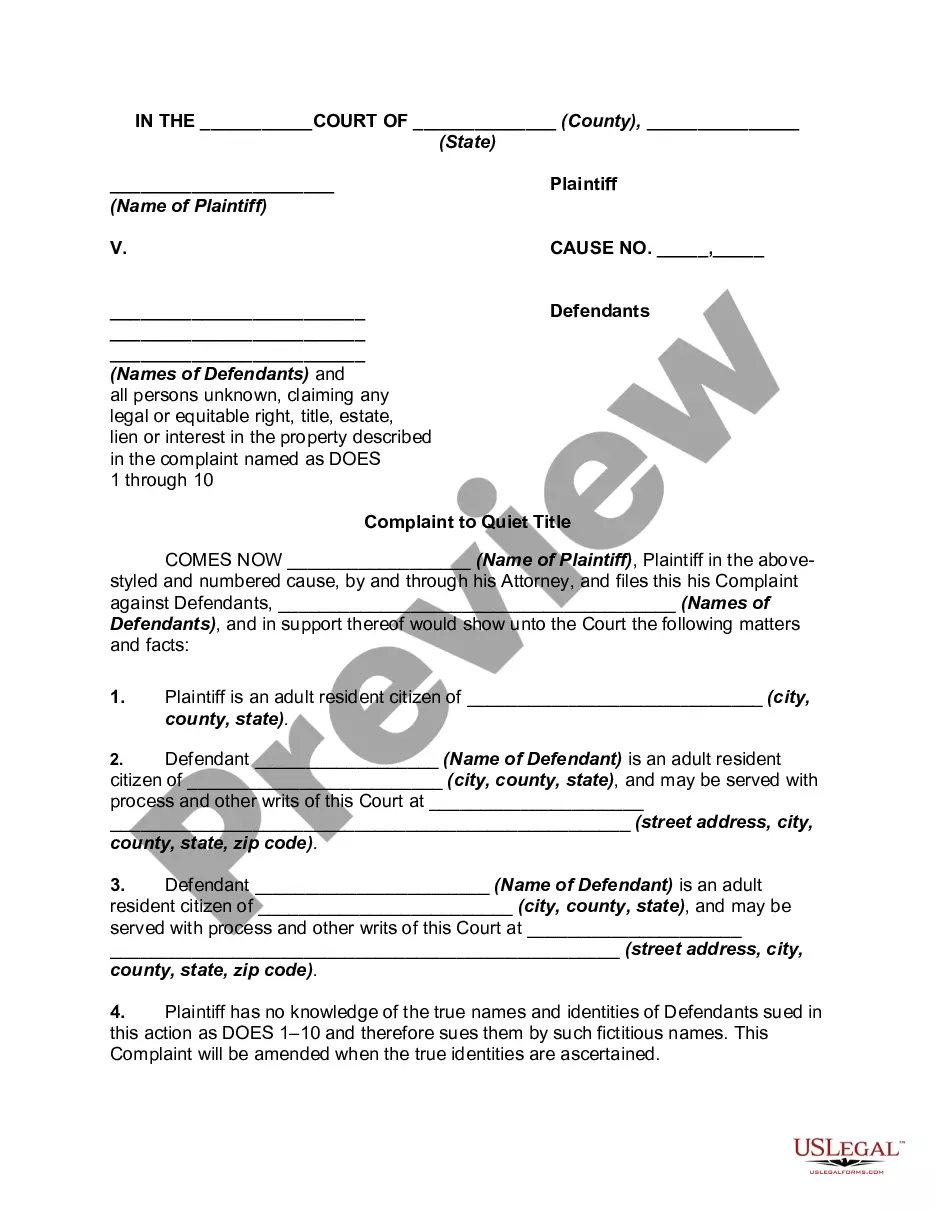
How to fill out Complaint To Quiet Title By Person Claiming Adverse Possession - Squatters Rights?
It’s clear that you cannot become a legal expert instantly, nor can you understand how to swiftly compose Types Of Adverse Possession without a specialized education.
Producing legal documentation is a lengthy process that demands specific training and expertise. So why not leave the development of the Types Of Adverse Possession to the specialists.
With US Legal Forms, one of the most extensive legal document collections, you can access everything from court filings to templates for internal business communication. We recognize how essential it is to comply with federal and state regulations. That’s why, on our platform, all templates are region-specific and current.
Choose Buy now. After the transaction is completed, you can download the Types Of Adverse Possession, fill it out, print it, and deliver it or send it by post to the appropriate individuals or organizations.
You can regain access to your documents from the My documents section at any time. If you’re a current client, you can simply Log In, and find and download the template from the same section.
Regardless of the intent of your documents—whether financial, legal, or personal—our website has you covered. Give US Legal Forms a try now!
- Begin your journey with our website and acquire the form you require in just minutes.
- Locate the document you seek using the search feature at the top of the page.
- Preview it (if this feature is available) and review the accompanying description to see if Types Of Adverse Possession is what you need.
- If you require another form, restart your search.
- Sign up for a complimentary account and select a subscription plan to purchase the template.
Form popularity
FAQ
To establish a claim of adverse possession, you must meet specific requirements that vary by state. Generally, the possession must be actual, open, notorious, exclusive, and hostile to the true owner's interests. Additionally, the possession must be continuous for a statutory period, which can range from a few years to several decades depending on the jurisdiction. Understanding the types of adverse possession in your state can help you navigate this complex legal area, and platforms like US Legal Forms provide resources to guide you through the process.
The five essential elements of types of adverse possession are actual possession, continuous possession, open and notorious possession, exclusive possession, and hostile possession. Each element must be proven to establish a valid claim. Familiarizing yourself with these elements can aid in navigating the legal landscape effectively.
Proving types of adverse possession can be challenging, as you must meet specific legal requirements and provide sufficient evidence. The burden of proof lies with you, which means you need to clearly demonstrate that all elements of adverse possession are met. Seeking legal guidance can simplify this process and improve your chances of success.
Common types of adverse possession claims often involve vacant land, abandoned properties, or disputes between neighbors over property boundaries. These claims can arise when one party uses another’s land without permission for an extended period. Understanding the common scenarios can help you assess whether your situation might qualify.
To substantiate your claim for types of adverse possession, you will need various forms of proof, such as documentation of your continuous use, witness statements, photographs, or any records that demonstrate your occupation of the property. Additionally, evidence showing that your use has been open and notorious can bolster your case. Gathering comprehensive proof is vital for a successful claim.
The five main elements essential for obtaining types of adverse possession are actual possession, continuous use, open and notorious use, exclusive possession, and hostile claim. Each element has specific legal implications that must be satisfied. Understanding these elements can help you navigate the complexities of adverse possession successfully.
To prove types of adverse possession, you generally need to demonstrate five key elements: actual possession, continuous possession, open and notorious possession, exclusive possession, and hostile possession. Each element plays a crucial role in establishing your claim to the property. Meeting all these criteria can significantly strengthen your case.
The hostile requirement refers to the need for your possession to be without the permission of the original owner. Essentially, you must treat the property as your own, disregarding the rights of the actual owner. This does not mean hostility in the aggressive sense but rather a challenge to the owner's claim.
To establish types of adverse possession, you typically need to meet three conditions: continuous use of the property, open and notorious use, and exclusive possession. Continuous use means you must occupy the property without interruption for a specific period, often ranging from 5 to 20 years, depending on state laws. Open and notorious use indicates that your occupation is visible and obvious, while exclusive possession means you are the only one using the property.
To prove adverse possession, you will need various documents demonstrating your use of the property. These may include photographs, witness statements, utility bills, and any correspondence related to the property. It is also beneficial to have a property description and maps to support your claim. By understanding the types of adverse possession, you can better prepare the necessary documentation to present your case effectively.