Contracting Parties Of Madrid Protocol
Description
Get your form ready online
Our built-in tools help you complete, sign, share, and store your documents in one place.
Make edits, fill in missing information, and update formatting in US Legal Forms—just like you would in MS Word.
Download a copy, print it, send it by email, or mail it via USPS—whatever works best for your next step.
Sign and collect signatures with our SignNow integration. Send to multiple recipients, set reminders, and more. Go Premium to unlock E-Sign.
If this form requires notarization, complete it online through a secure video call—no need to meet a notary in person or wait for an appointment.
We protect your documents and personal data by following strict security and privacy standards.

Make edits, fill in missing information, and update formatting in US Legal Forms—just like you would in MS Word.

Download a copy, print it, send it by email, or mail it via USPS—whatever works best for your next step.

Sign and collect signatures with our SignNow integration. Send to multiple recipients, set reminders, and more. Go Premium to unlock E-Sign.

If this form requires notarization, complete it online through a secure video call—no need to meet a notary in person or wait for an appointment.

We protect your documents and personal data by following strict security and privacy standards.
Looking for another form?

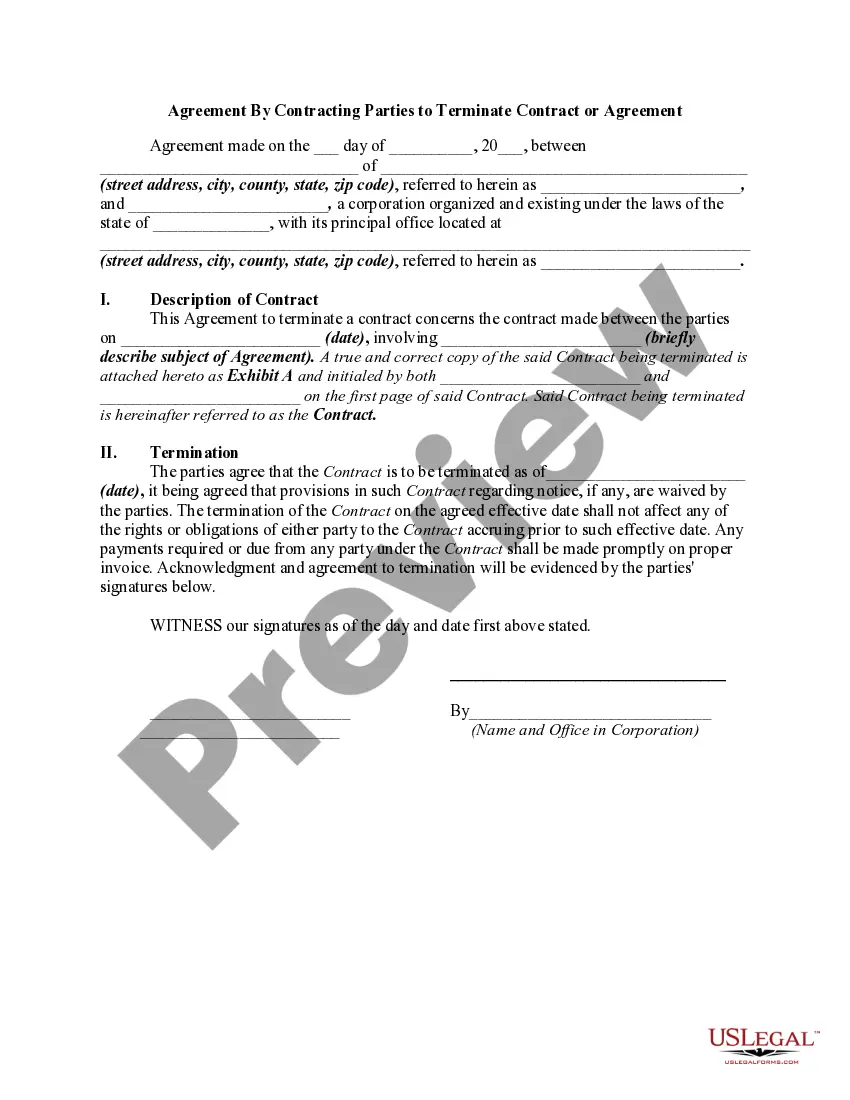
How to fill out Agreement By Contracting Parties To Terminate Contract Or Agreement?
It’s clear that you cannot transform into a legal authority instantly, nor can you comprehend how to swiftly prepare the Contracting Parties Of Madrid Protocol without a dedicated expertise.
Drafting legal documents is a prolonged endeavor that demands specific training and abilities. So why not entrust the creation of the Contracting Parties Of Madrid Protocol to the professionals.
With US Legal Forms, one of the most extensive legal document repositories, you can discover everything from court documents to templates for internal communication.
Select Buy now. After payment is processed, you can download the Contracting Parties Of Madrid Protocol, complete it, print it, and forward it by mail to the relevant parties or organizations.
You can re-access your documents from the My documents section at any point. If you’re a current customer, just Log In, and find and download the template from the same section.
Regardless of the reason for your documents—financial, legal, or personal—our website has you covered. Experience US Legal Forms today!
- Initiate your journey on our website and obtain the document you need in just a few moments.
- Locate the form you need using the search feature at the top of the page.
- View it (if this option is available) and peruse the accompanying description to ascertain if Contracting Parties Of Madrid Protocol is what you’re after.
- Restart your search if you require a different document.
- Create a free account and choose a subscription plan to acquire the template.
Form popularity
FAQ
The Madrid Protocol has many contracting parties, but several notable countries are not included. For example, the United States and Canada do not participate in this international agreement. This absence means that businesses in these countries may face different trademark registration processes compared to those in countries that are contracting parties of the Madrid Protocol. If you're looking to protect your trademark internationally, consider using US Legal Forms to navigate the complexities of trademark laws effectively.
The Madrid Protocol is a treaty administered by the World Intellectual Property Organization (WIPO), which is an agency of the United Nations. While the Madrid Protocol specifically deals with the international registration of trademarks, WIPO provides a broader range of intellectual property services and support. Familiarizing yourself with both helps businesses navigate the complexities of trademark protection. By leveraging the resources from uslegalforms, you can efficiently manage your applications under both systems.
The Madrid Protocol provides a period of 12 months for the examination of the application by the designated contracting parties. This timeline allows countries to assess and respond to the trademark registration. However, it is essential to note that some jurisdictions may take longer, depending on their review processes. Understanding this timeline helps businesses plan their trademark strategy effectively.
As of now, there are over 100 contracting parties of the Madrid Protocol, which includes countries across all continents. This extensive network provides businesses with a streamlined process for protecting their trademarks internationally. The growing number of parties reflects the importance of global trademark protection in today's interconnected marketplace. With this robust support, businesses can confidently expand their brand reach.
A registration under the Madrid Protocol lasts for ten years from the date of registration. This period can be renewed indefinitely for additional ten-year terms, ensuring that your trademark protection remains intact. Given the large number of contracting parties of the Madrid Protocol, this longevity allows businesses to secure their trademarks in various markets. Regular renewal helps businesses maintain their rights effectively.
Article 7 of the Madrid Protocol provides a framework for how the contracting parties of the Madrid Protocol handle the registration process of trademarks. It outlines the procedures for filing and the requirements that must be met by applicants. Understanding this article is crucial for businesses looking to protect their brand across different countries. By knowing the nuances of Article 7, you can streamline your registration process.
The Madrid Agreement and the Madrid Protocol are two legal treaties that govern international trademark registration. While both aim to simplify protection across multiple countries, the Madrid Protocol allows for a more flexible approach regarding the filing and management of trademark applications. Many countries are now contracting parties of the Madrid Protocol, providing additional options for trademark owners. For detailed guidance on either treaty, consider using US Legal Forms to ensure optimal compliance.
The main purpose of the Madrid Protocol is to provide a streamlined and efficient process for registering trademarks internationally. By allowing businesses to file a single application for multiple countries, the protocol simplifies the global trademark landscape. This arrangement benefits the contracting parties of the Madrid Protocol, fostering international trade and brand recognition. Ultimately, it aids businesses in expanding their footprint while protecting their trademarks effectively.
To claim priority under the Madrid Protocol, you must file your application within six months of your initial application in your home country. This timeframe allows you to secure an earlier filing date in member countries. Make sure to include relevant documentation to support your claim. Using platforms like USLegalForms can assist in preparing your application to ensure compliance and a smoother process.
Yes, the United States is a member of the Madrid Protocol. This membership enables American businesses to extend their trademark protections to other member countries efficiently. By leveraging the system, U.S. companies can simplify their international trademark pursuit. Thus, businesses should consider the contracting parties of the Madrid Protocol to maximize their global presence.