Issued Stock For Cash Journal Entry
Description
Get your form ready online
Our built-in tools help you complete, sign, share, and store your documents in one place.
Make edits, fill in missing information, and update formatting in US Legal Forms—just like you would in MS Word.
Download a copy, print it, send it by email, or mail it via USPS—whatever works best for your next step.
Sign and collect signatures with our SignNow integration. Send to multiple recipients, set reminders, and more. Go Premium to unlock E-Sign.
If this form requires notarization, complete it online through a secure video call—no need to meet a notary in person or wait for an appointment.
We protect your documents and personal data by following strict security and privacy standards.

Make edits, fill in missing information, and update formatting in US Legal Forms—just like you would in MS Word.

Download a copy, print it, send it by email, or mail it via USPS—whatever works best for your next step.

Sign and collect signatures with our SignNow integration. Send to multiple recipients, set reminders, and more. Go Premium to unlock E-Sign.

If this form requires notarization, complete it online through a secure video call—no need to meet a notary in person or wait for an appointment.

We protect your documents and personal data by following strict security and privacy standards.
Looking for another form?



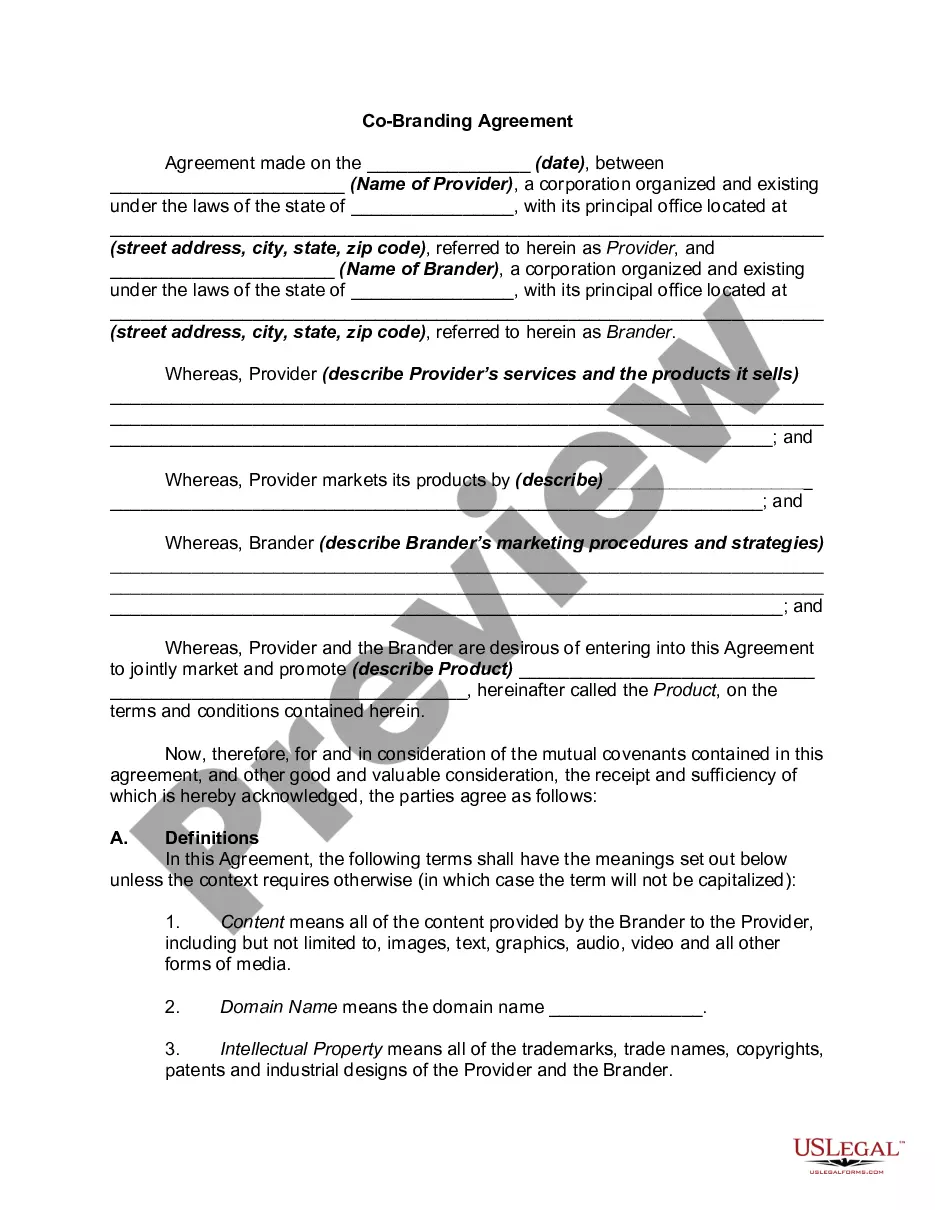





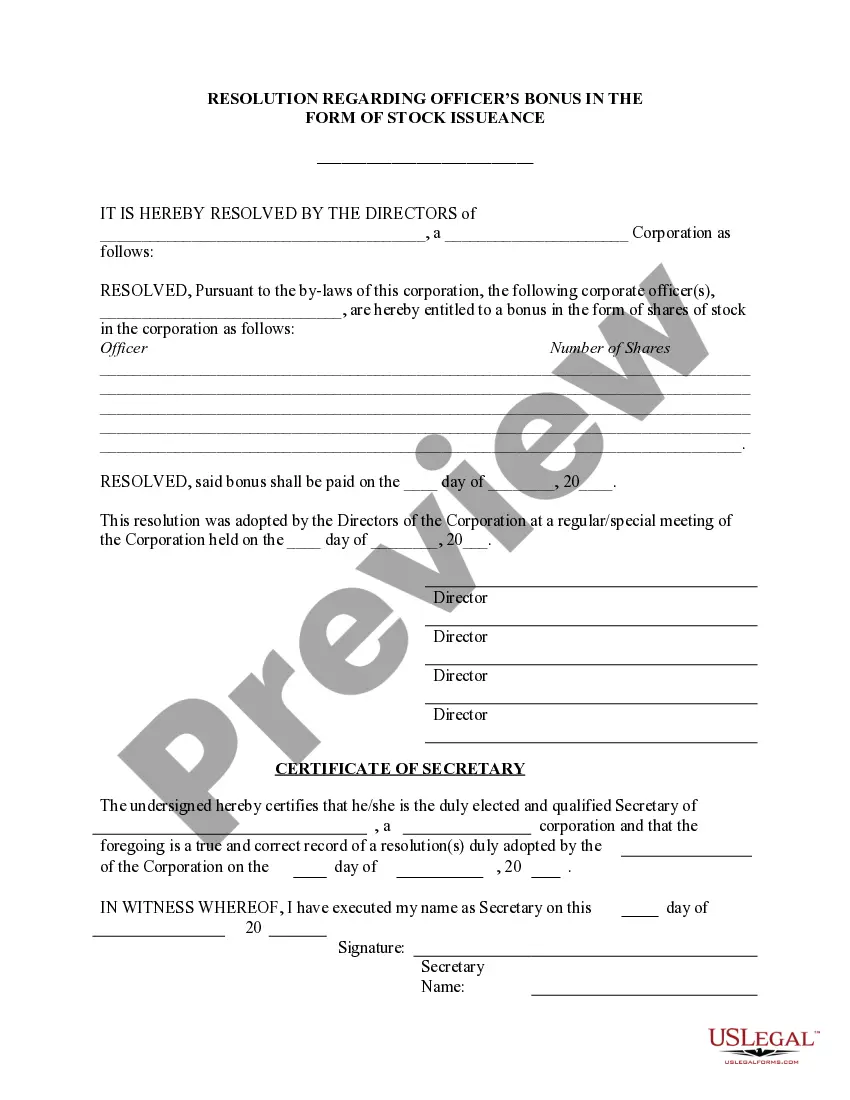
How to fill out Officers Bonus In Form Of Stock Issuance - Resolution Form?
Legal governance can be overwhelming, even for experienced practitioners.
If you're seeking an Issued Stock For Cash Journal Entry and lack the time to suss out the correct and current version, the process can be taxing.
Leverage a repository of articles, guides, handbooks, and resources related to your situation and requirements.
Conserve time and effort searching for the documents you need, and utilize US Legal Forms’ advanced search and Review feature to locate and acquire Issued Stock For Cash Journal Entry.
Capitalize on the US Legal Forms online catalog, backed by 25 years of experience and trustworthiness. Streamline your daily document management into a straightforward and user-friendly process today.
- If you possess a membership, Log In to your US Legal Forms account, search for the form, and obtain it.
- Visit the My documents section to view the documents you have previously saved and manage your folders as necessary.
- If this is your first experience with US Legal Forms, create an account and gain unrestricted access to all platform benefits.
- Following obtaining the desired form, confirm it is the correct one by previewing it and reviewing its description.
- Ensure that the template is accepted in your state or county.
- Click Buy Now when you are ready.
- Choose a subscription plan.
- Select the format you prefer, then Download, complete, sign, print, and send your document.
- Access state- or county-specific legal and business paperwork.
- US Legal Forms addresses any requirements you may have, from personal to corporate documents, all in a single place.
- Utilize sophisticated tools to complete and manage your Issued Stock For Cash Journal Entry.
Form popularity
FAQ
In the new changes to Regulation F, the frequency at which a collections agency can contact a consumer has changed. This change, presented in Section 1006.14B21A, addresses telephone call frequency and restricts agencies to contacting a consumer seven times within seven consecutive days.
The amended FDCPA allows debt collectors to use newer technologies, such as email and text messages, to communicate with consumers regarding their debts, subject to certain limitations, which protect consumers against harassment or abuse.
A statement that, upon the consumer's written request within the thirty-day period, the debt collector will provide the consumer with the name and address of the original creditor, if different from the current creditor.
If you don't receive a validation notice within 10 days of the first contact, request one from the debt collector the next time you're contacted. Ask for the debt collector's mailing address at this time as well, in case you decide to request a debt verification letter.
Effective January 1, the small loan act applies to loans under $10,000 and not just $5,000 and certain other restrictions on scope are loosened. The anti-evasion provisions are also expanded. § 58-15-3(D). As of January 1, 2023, a fee of 5% of the principal may be charged for a loan of $500 or less.
One such recent development impacting consumer debt collections is the newly enacted Regulation F. Effective November 30, 2021, the Consumer Financial Protection Bureau (?CFPB?) enacted Regulation F to the Fair Debt Collection Practice Act (FDCPA). The full text of the Rule can be found here.
Under this Act (Title VIII of the Consumer Credit Protection Act), third-party debt collectors are prohibited from using deceptive or abusive conduct in the collection of consumer debts incurred for personal, family, or household purposes.
How can you remove collections from a credit report? Step 1: Ask for proof. There needs to be evidence that the debt is genuinely yours to pay for it to stay on your credit report. ... Step 2: Look for and report inaccuracies. ... Step 3: Ask for a pay-for-delete agreement. ... Step 4: Write a goodwill letter to your creditor.