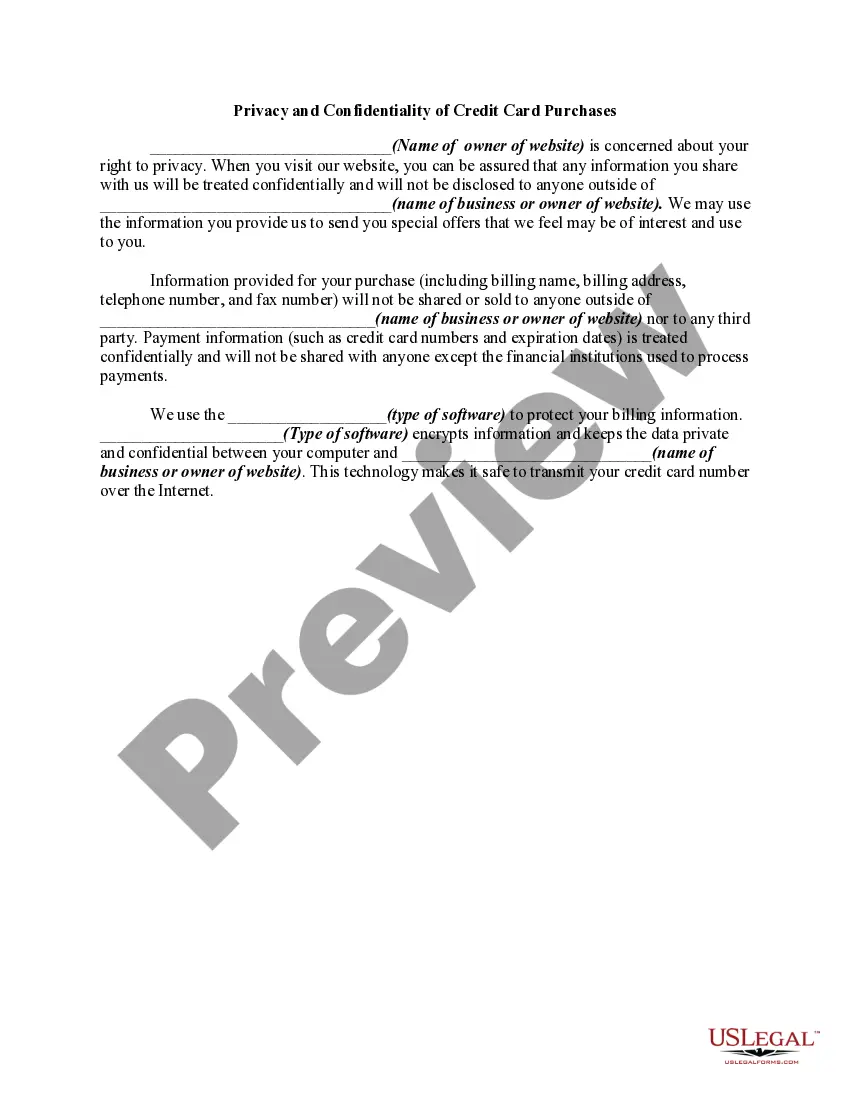
Privacy Confidentiality Statement With Ai
Description
Get your form ready online
Our built-in tools help you complete, sign, share, and store your documents in one place.
Make edits, fill in missing information, and update formatting in US Legal Forms—just like you would in MS Word.
Download a copy, print it, send it by email, or mail it via USPS—whatever works best for your next step.
Sign and collect signatures with our SignNow integration. Send to multiple recipients, set reminders, and more. Go Premium to unlock E-Sign.
If this form requires notarization, complete it online through a secure video call—no need to meet a notary in person or wait for an appointment.
We protect your documents and personal data by following strict security and privacy standards.

Make edits, fill in missing information, and update formatting in US Legal Forms—just like you would in MS Word.

Download a copy, print it, send it by email, or mail it via USPS—whatever works best for your next step.

Sign and collect signatures with our SignNow integration. Send to multiple recipients, set reminders, and more. Go Premium to unlock E-Sign.

If this form requires notarization, complete it online through a secure video call—no need to meet a notary in person or wait for an appointment.

We protect your documents and personal data by following strict security and privacy standards.
Looking for another form?









How to fill out Privacy And Confidentiality Of Credit Card Purchases?
The Privacy Confidentiality Statement With Ai displayed on this site is a versatile legal document crafted by expert attorneys in accordance with federal and local regulations.
For over 25 years, US Legal Forms has supplied individuals, businesses, and legal practitioners with over 85,000 confirmed, state-specific documents for any corporate and personal situation. It’s the quickest, easiest, and most reliable method to acquire the forms you require, as the service ensures banking-grade data security and anti-malware safeguards.
Subscribe to US Legal Forms to have verified legal templates for all of life's scenarios at your fingertips.
- Examine the document you require and review it.
- Look through the file you searched and preview it or check the form description to verify it meets your requirements. If it doesn’t, utilize the search bar to find the correct one. Click Buy Now once you have found the template you desire.
- Register and Log In.
- Select the pricing plan that fits your needs and create an account. Use PayPal or a credit card to make a swift payment. If you already possess an account, Log In and check your subscription to proceed.
- Acquire the editable template.
- Choose the format you prefer for your Privacy Confidentiality Statement With Ai (PDF, DOCX, RTF) and download the example to your device.
- Fill out and sign the documents.
- Print the template to complete it manually. Alternatively, use an online multifunctional PDF editor to quickly and accurately fill out and sign your form with a legally-binding electronic signature.
- Re-download your documents.
- Utilize the same document again whenever needed. Access the My documents section in your profile to redownload any previously downloaded documents.
Form popularity
FAQ
It is not advisable to input confidential information into AI systems. AI platforms often require data input for processing, which can risk exposing sensitive details. Instead, focus on using AI for general tasks while maintaining your privacy confidentiality statement with AI. Always prioritize data security and consider using trusted platforms, like US Legal Forms, which can help guide you in safeguarding your information.
Writing an AI disclaimer involves clearly stating the role of AI in your content creation. Begin by explaining that AI assisted in generating certain parts of the text. Additionally, you should inform users about how you handle their data, reinforcing your commitment to a strong privacy confidentiality statement with AI. This transparency builds trust and ensures users feel secure while engaging with your content.
Yes, you can create a personal statement with AI. By utilizing AI tools, you can generate a draft that reflects your thoughts and experiences. However, it is essential to review and customize the output to ensure it aligns with your unique voice. This process can help streamline your writing while maintaining the integrity of your privacy confidentiality statement with AI.
When using AI with confidential data, it's crucial to implement robust security measures to protect sensitive information. Start by limiting access to authorized personnel and encrypting data during processing. Additionally, create a comprehensive Privacy confidentiality statement with AI that details your data handling practices. Utilizing tools from US Legal Forms can help you develop legally compliant documents that safeguard your data while leveraging AI technology.
To add an AI disclaimer, begin by clearly stating the role of AI in your processes. Highlight how AI contributes to your operations while emphasizing the importance of human oversight. This is essential for crafting a solid Privacy confidentiality statement with AI. You can use templates from platforms like US Legal Forms to ensure your disclaimer is legally sound and easy to understand for your audience.
The 30% rule for AI suggests that when using AI technologies, you should ensure that at least 30% of the content is generated or reviewed by a human. This helps maintain the quality and confidentiality of sensitive information. By adhering to this rule, you can create a Privacy confidentiality statement with AI that reflects both human judgment and AI efficiency. It's a useful guideline for companies looking to balance automation with responsible data handling.
AI can be used to minimise the risk of privacy breaches by encrypting personal data, reducing human error and detecting potential cybersecurity incidents.
A confidentiality agreement should include a clear definition of the confidential information, scope of the agreement, obligations of the receiving party, the duration of the contract, any exceptions to confidentiality, and the consequences of a breach of the contract.
A typical confidentiality clause might say, "The phrases and circumstances of this Agreement are completely confidential between the parties and shall not be disclosed to anybody else. Any disclosure in violation shall be deemed a breach of this Agreement."
I agree that: a) I shall not share this information, material or documents (information) with persons within or outside of the ________ who are not authorized to have this information. b) I shall not publish such information. c) I shall not communicate such information without authority.