Privacy Confidentiality Statement For Email
Description
Get your form ready online
Our built-in tools help you complete, sign, share, and store your documents in one place.
Make edits, fill in missing information, and update formatting in US Legal Forms—just like you would in MS Word.
Download a copy, print it, send it by email, or mail it via USPS—whatever works best for your next step.
Sign and collect signatures with our SignNow integration. Send to multiple recipients, set reminders, and more. Go Premium to unlock E-Sign.
If this form requires notarization, complete it online through a secure video call—no need to meet a notary in person or wait for an appointment.
We protect your documents and personal data by following strict security and privacy standards.

Make edits, fill in missing information, and update formatting in US Legal Forms—just like you would in MS Word.

Download a copy, print it, send it by email, or mail it via USPS—whatever works best for your next step.

Sign and collect signatures with our SignNow integration. Send to multiple recipients, set reminders, and more. Go Premium to unlock E-Sign.

If this form requires notarization, complete it online through a secure video call—no need to meet a notary in person or wait for an appointment.

We protect your documents and personal data by following strict security and privacy standards.
Looking for another form?










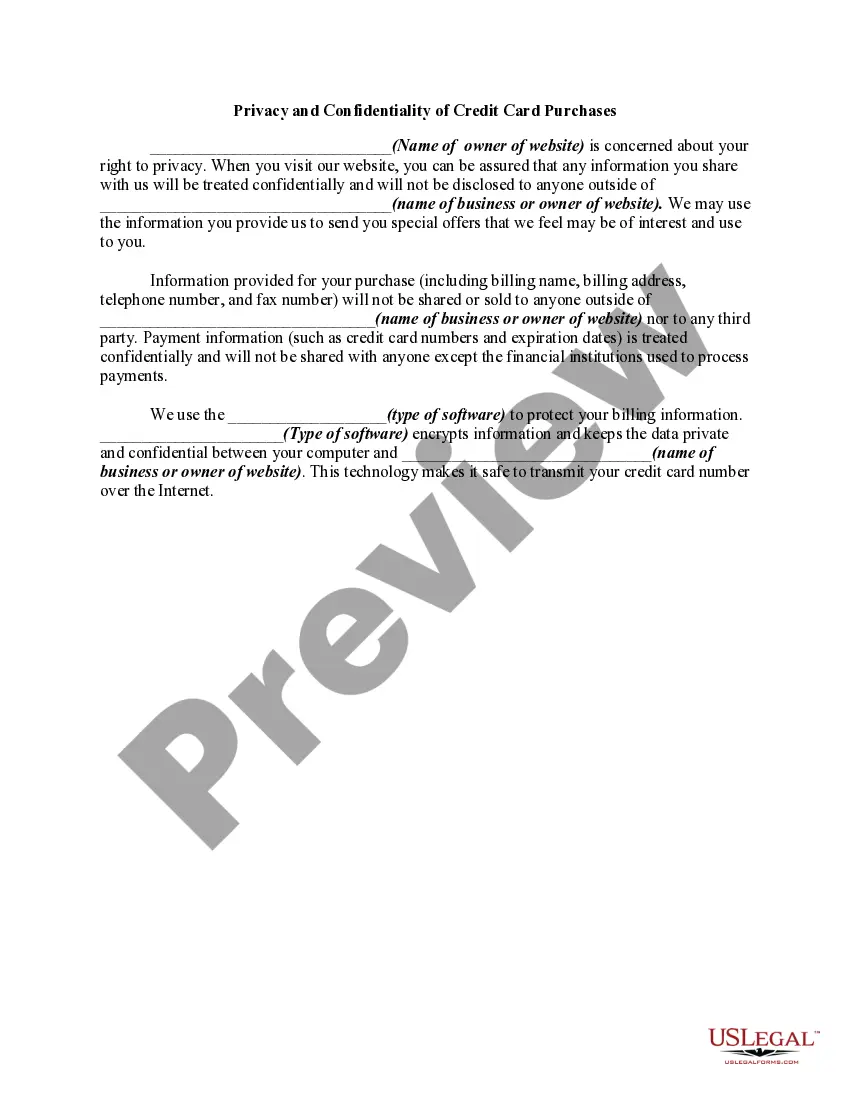
How to fill out Privacy And Confidentiality Of Credit Card Purchases?
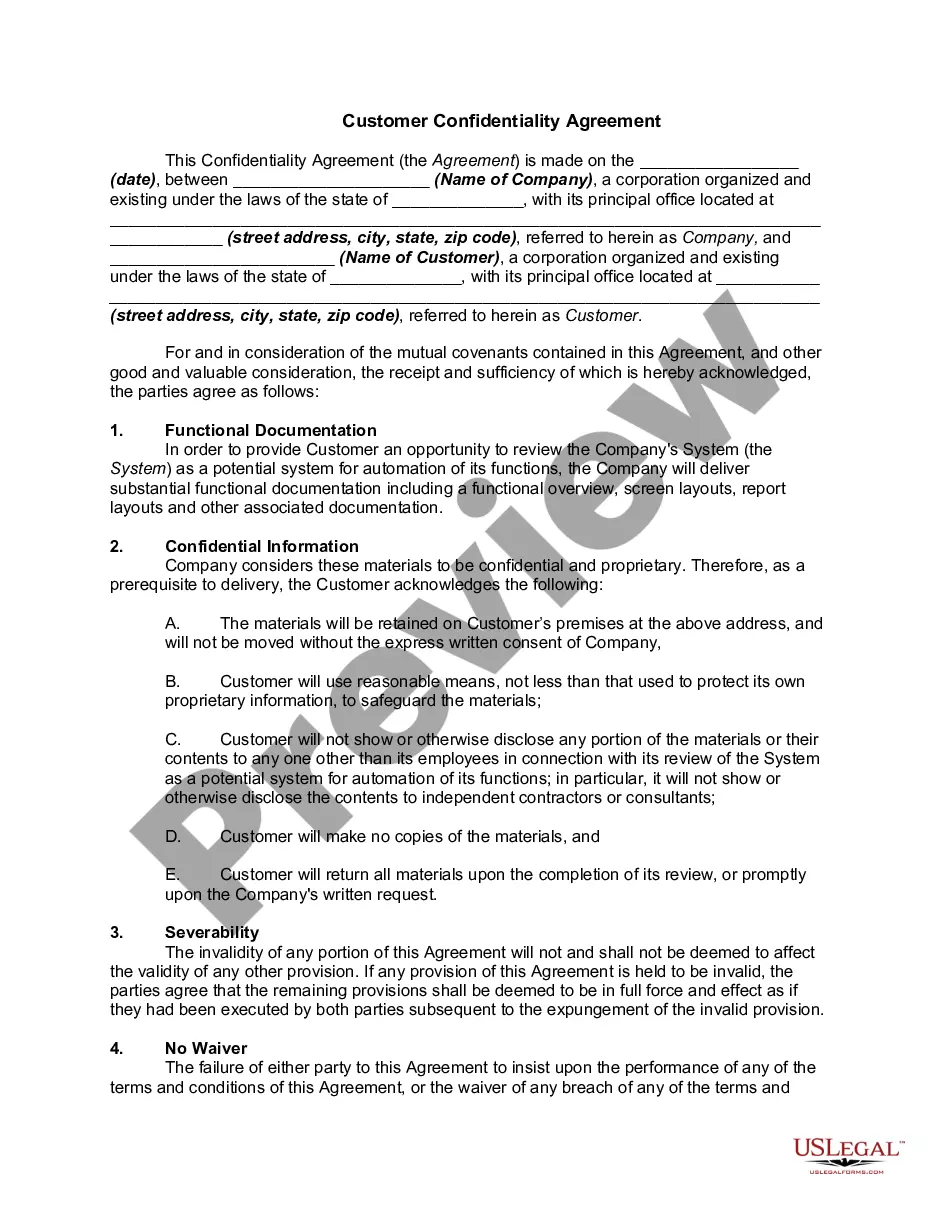
The Privacy Confidentiality Statement For Email present on this webpage is a versatile legal template crafted by expert attorneys in accordance with federal and state regulations.
For over 25 years, US Legal Forms has supplied individuals, businesses, and lawyers with over 85,000 validated, state-specific documents for any corporate and personal circumstance. It’s the most rapid, simplest, and most dependable method to acquire the documentation you require, as the service ensures bank-grade data protection and anti-malware safeguards.
Access the editable template. Choose the format you prefer for your Privacy Confidentiality Statement For Email (PDF, Word, RTF) and download the document to your device.
- Search for the document you require and verify it.
- Browse through the example you queried and preview it or examine the form description to ensure it meets your needs. If it does not, use the search bar to find the correct one.
- Click Buy Now when you have found the template you desire.
- Select and Log Into your account.
- Pick the pricing option that fits you and sign up for an account. Use PayPal or a credit card to make a swift payment. If you already possess an account, Log In and review your subscription to continue.
Form popularity
FAQ
An example of a confidentiality disclaimer for email could be: 'This email and any attachments may contain confidential information. If you are not the intended recipient, please notify the sender and delete this email. Any unauthorized use, disclosure, or distribution is prohibited.' This privacy confidentiality statement for email helps establish the importance of confidentiality and protects your communications.
To put a confidentiality notice on an email, draft your message and then append a notice at the end. Your privacy confidentiality statement for email should clearly communicate the confidential nature of the email's contents. This practice is essential for protecting sensitive information and is a standard protocol in professional communication.
To add a confidentiality statement to an Outlook email, first, open a new email message. In the message body or your signature settings, insert your privacy confidentiality statement for email. This feature allows you to automatically include the statement in every email you send, ensuring that your recipients are aware of the confidentiality terms.
Inserting a confidentiality statement in an email is straightforward. Open your email client and compose your message. Then, type your privacy confidentiality statement for email at the bottom of the email body or in the signature section. This will ensure that every email you send includes the necessary information to protect confidential content.
To add a disclosure statement on an email, start by composing your message. At the end of your email, include a brief note that outlines your privacy confidentiality statement for email. This statement should inform recipients about the confidentiality of the information shared and the intended audience. By doing this, you help protect sensitive information and clarify its usage.
A privacy confidentiality statement for email typically includes a notice indicating that the content of the email is confidential and intended only for the recipient. For example, you might see a statement like, 'This email contains confidential information intended solely for the recipient. If you are not the intended recipient, please notify the sender and delete this email.' Including such statements helps protect sensitive information and clarifies the expectations for handling the email's content.
To convey the message of confidentiality in your email, you can use a Privacy confidentiality statement for email. Start by clearly stating that the content of your email is private and should not be shared with others. Phrases like 'This email contains confidential information' or 'Please treat this information as private' can effectively communicate your intention. Using such statements not only protects sensitive information but also establishes trust in your communication.
An example of a confidentiality statement in an email could be, 'Confidentiality Notice: This email and its contents are confidential and may be protected by legal privilege. If you are not the intended recipient, please notify the sender and delete this message.' Including such a statement emphasizes the significance of privacy and helps protect sensitive information.
An effective privacy confidentiality statement for email could read, 'This email, including any attachments, is confidential and intended for the specified recipient only. If you have received this in error, please notify the sender and delete the email immediately.' This example clearly conveys the intent and importance of confidentiality in communications.
To write a privacy confidentiality statement for email, first, consider the context of your message. Position your statement either at the beginning or the end of your email. For example, conclude with, 'Please do not share this email or its contents without my permission, as it contains confidential information.' This helps reinforce the importance of maintaining confidentiality.