Employee Disciplinary Policy
Description
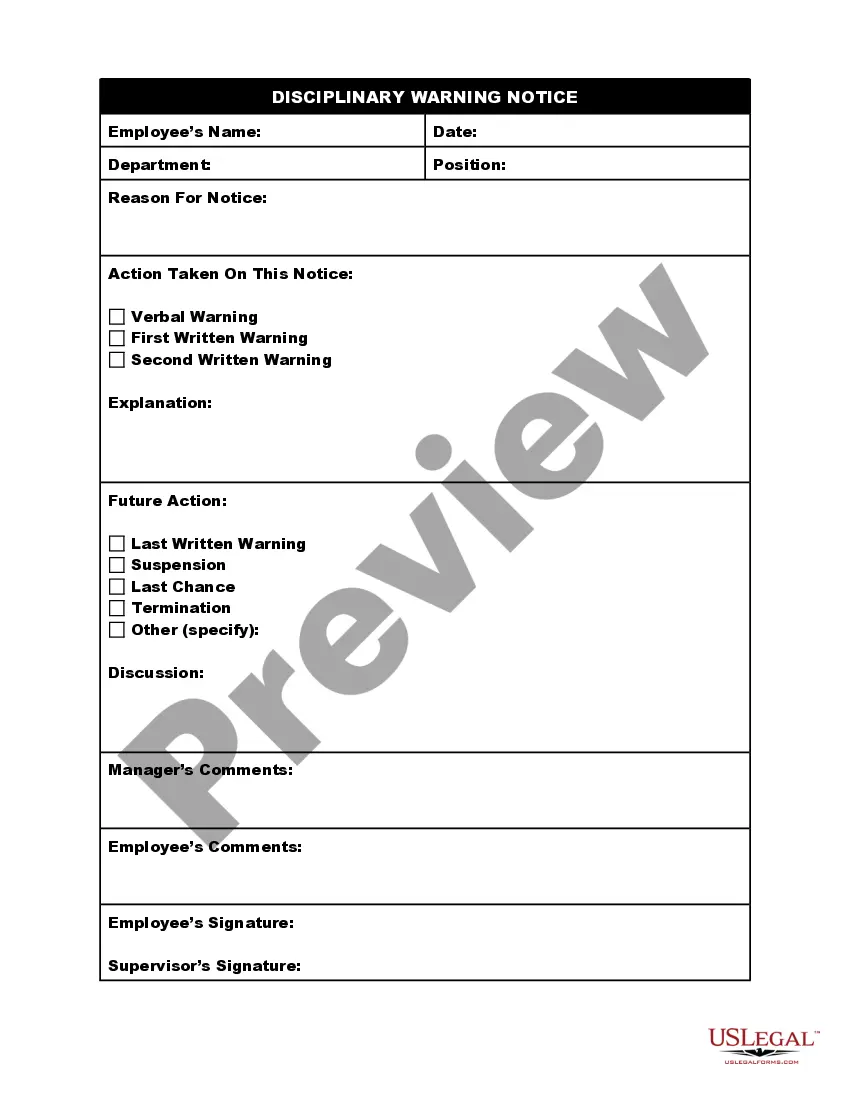
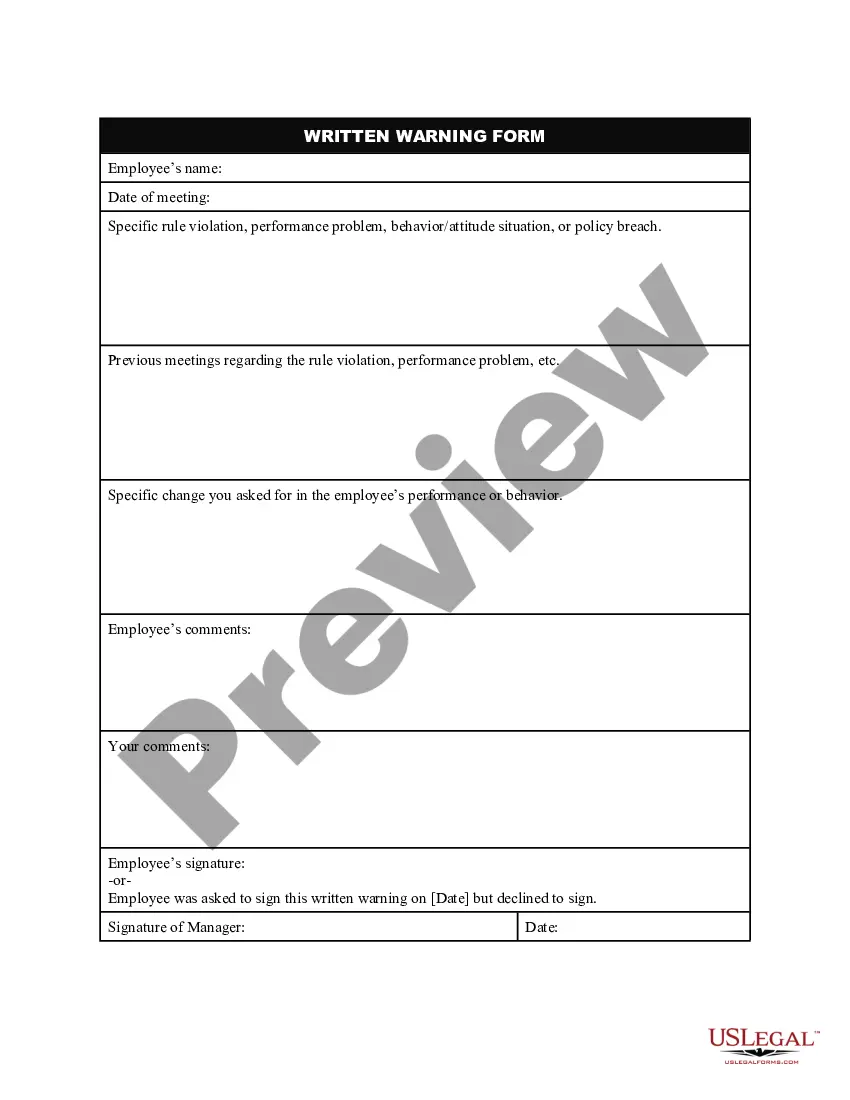
Get your form ready online
Our built-in tools help you complete, sign, share, and store your documents in one place.
Make edits, fill in missing information, and update formatting in US Legal Forms—just like you would in MS Word.
Download a copy, print it, send it by email, or mail it via USPS—whatever works best for your next step.
Sign and collect signatures with our SignNow integration. Send to multiple recipients, set reminders, and more. Go Premium to unlock E-Sign.
If this form requires notarization, complete it online through a secure video call—no need to meet a notary in person or wait for an appointment.
We protect your documents and personal data by following strict security and privacy standards.

Make edits, fill in missing information, and update formatting in US Legal Forms—just like you would in MS Word.

Download a copy, print it, send it by email, or mail it via USPS—whatever works best for your next step.

Sign and collect signatures with our SignNow integration. Send to multiple recipients, set reminders, and more. Go Premium to unlock E-Sign.

If this form requires notarization, complete it online through a secure video call—no need to meet a notary in person or wait for an appointment.

We protect your documents and personal data by following strict security and privacy standards.
Looking for another form?
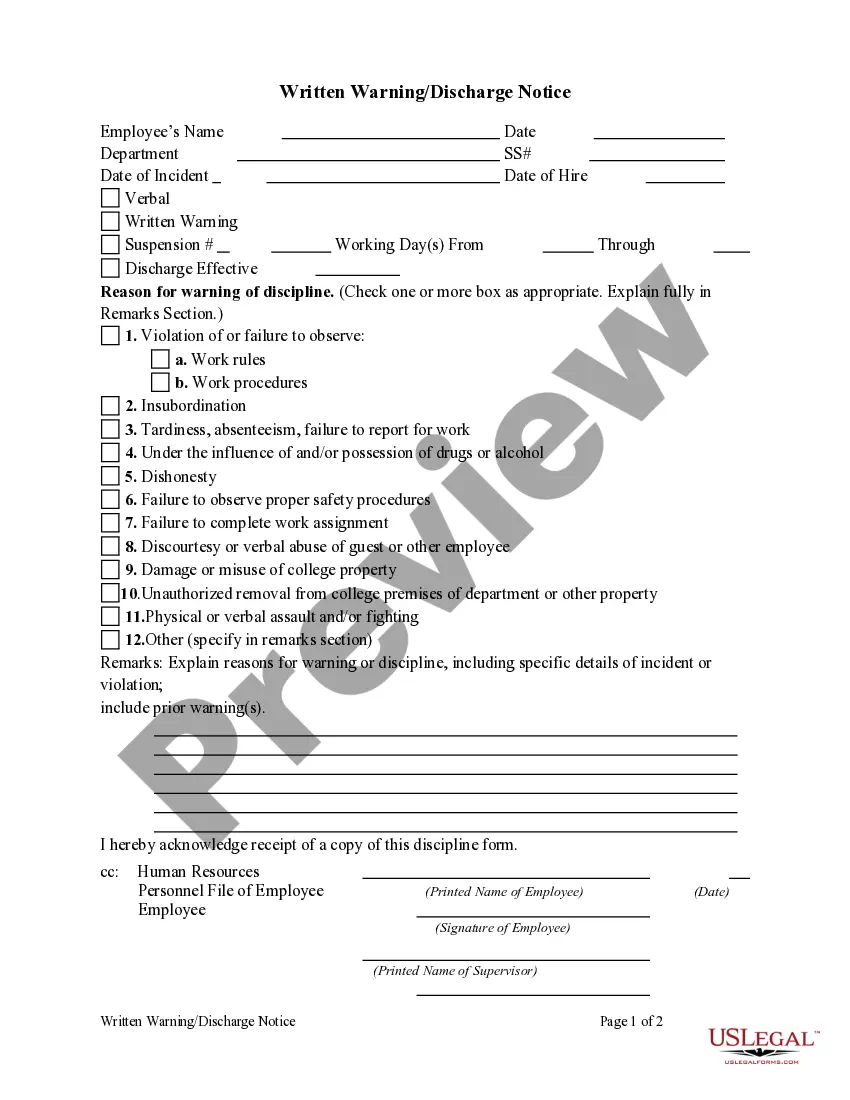
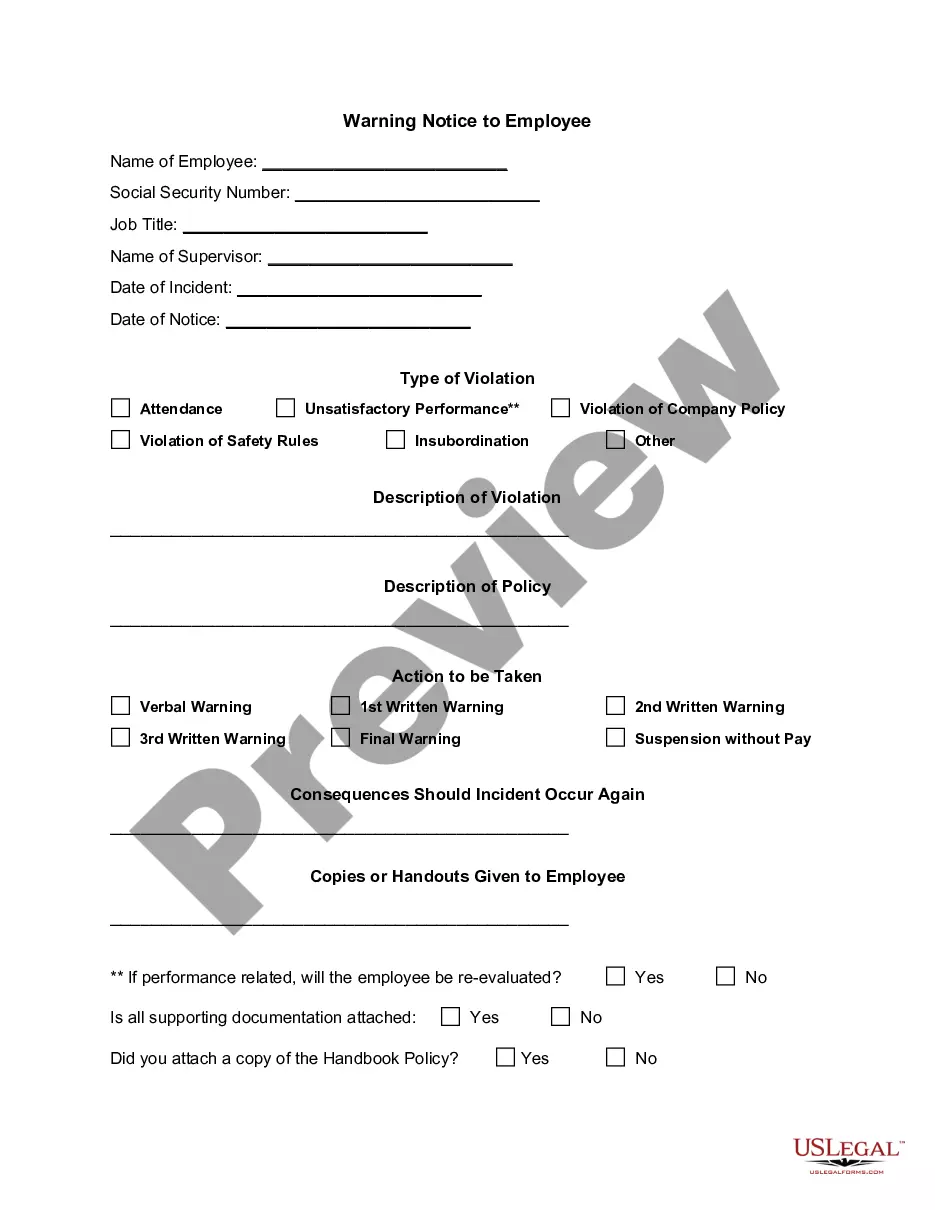
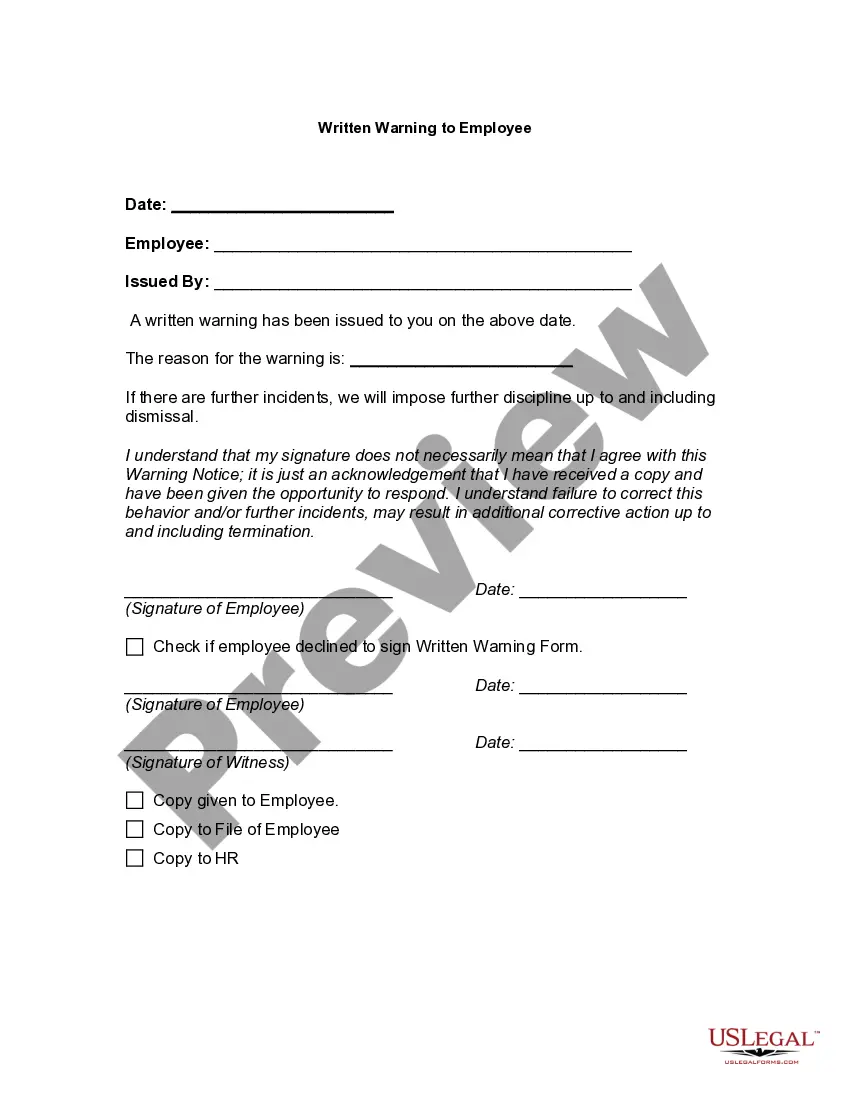
How to fill out Written Warning/Discharge Notice?
Regardless of whether it's for corporate objectives or personal issues, everyone must confront legal matters at some point in their lives.
Finalizing legal documentation necessitates meticulous care, beginning with selecting the correct template format.
With an extensive US Legal Forms catalog available, you don’t have to waste time searching for the right template online. Utilize the library’s user-friendly navigation to find the appropriate template for any circumstance.
- Acquire the template you require using the search bar or catalog navigation.
- Review the form’s details to verify it aligns with your needs, state, and region.
- Click on the form’s preview to inspect it.
- If it is the incorrect document, revert to the search option to locate the Employee Disciplinary Policy example you need.
- Download the file if it satisfies your requirements.
- If you already possess a US Legal Forms account, click Log in to retrieve previously stored documents in My documents.
- If you do not have an account yet, you can acquire the form by clicking Buy now.
- Select the suitable pricing option.
- Complete the profile registration form.
- Choose your payment method: you can opt for a credit card or PayPal account.
- Select the document format you desire and download the Employee Disciplinary Policy.
- After it's downloaded, you can fill out the form using editing software or print it and complete it by hand.
Form popularity
FAQ
A progressive discipline policy outlines a series of steps that escalate in severity, depending on the frequency and seriousness of violations. Begin by defining the types of offenses and the corresponding disciplinary actions for each step. By implementing a clear employee disciplinary policy, you help employees understand the importance of improvement while also fostering a fair and supportive workplace.
Writing a disciplinary policy requires clarity and precision. Start by outlining the purpose of the policy, followed by the behaviors that may result in discipline and the steps for addressing these behaviors. A strong employee disciplinary policy typically includes a progression of consequences, ensuring employees understand the process and feel treated equitably.
Creating a disciplinary policy begins with identifying the key behaviors that require discipline and the corresponding consequences. Collaborate with your HR team to ensure alignment with legal standards and company values. A comprehensive employee disciplinary policy not only outlines procedures but also establishes expectations, helping to prevent misunderstandings among staff.
Filling out a disciplinary form involves documenting specific details about the incident that led to the disciplinary action. Start by including the employee’s name, the date of the incident, and a description of the behavior that prompted the action. A well-structured employee disciplinary policy will guide you on the necessary information to include, helping ensure clarity and transparency.
A disciplinary policy outlines the procedures and guidelines an organization follows when addressing employee misconduct. This policy ensures that all employees understand acceptable behaviors and the consequences of violations. By having a clear employee disciplinary policy, companies can maintain a fair and consistent approach to discipline, promoting a positive work environment.
Writing a discipline policy involves several important steps. First, define the purpose and scope of the policy, then outline specific behaviors that are subject to discipline. Include the procedures for handling violations, such as investigation and appeal options. Utilizing a platform like US Legal Forms can assist you in drafting a comprehensive employee disciplinary policy that meets legal standards and aligns with your organization's values.
The disciplinary process typically involves six key steps: identification of the issue, investigation, documentation of findings, notification to the employee, a meeting to discuss the issue, and finally, implementation of consequences if necessary. Each step is crucial to ensure that the process is fair and transparent. Following a structured employee disciplinary policy can facilitate this process effectively.
An example of a discipline policy may include a series of progressive steps, such as a verbal warning for first-time minor infractions, followed by written warnings for repeated issues, and culminating in suspension or termination for serious violations. This structure allows employees to understand the consequences of their actions while giving them opportunities to improve. A comprehensive employee disciplinary policy can help maintain order and fairness in the workplace.
A discipline policy is a formal document that outlines how an organization handles employee misconduct or performance issues. It details the steps involved in the disciplinary process, including investigation, communication, and potential consequences. By having a clear employee disciplinary policy in place, businesses can manage issues effectively while maintaining a respectful workplace.
Generally, providing notice before a disciplinary meeting is considered best practice, although the specific time frame can vary by company policy. While some organizations may aim for 48 hours, others might have different requirements. An employee disciplinary policy should clarify these expectations to ensure transparency and fairness during the process.