Water Sharing Agreement With Us
Description
Get your form ready online
Our built-in tools help you complete, sign, share, and store your documents in one place.
Make edits, fill in missing information, and update formatting in US Legal Forms—just like you would in MS Word.
Download a copy, print it, send it by email, or mail it via USPS—whatever works best for your next step.
Sign and collect signatures with our SignNow integration. Send to multiple recipients, set reminders, and more. Go Premium to unlock E-Sign.
If this form requires notarization, complete it online through a secure video call—no need to meet a notary in person or wait for an appointment.
We protect your documents and personal data by following strict security and privacy standards.

Make edits, fill in missing information, and update formatting in US Legal Forms—just like you would in MS Word.

Download a copy, print it, send it by email, or mail it via USPS—whatever works best for your next step.

Sign and collect signatures with our SignNow integration. Send to multiple recipients, set reminders, and more. Go Premium to unlock E-Sign.

If this form requires notarization, complete it online through a secure video call—no need to meet a notary in person or wait for an appointment.

We protect your documents and personal data by following strict security and privacy standards.
Looking for another form?





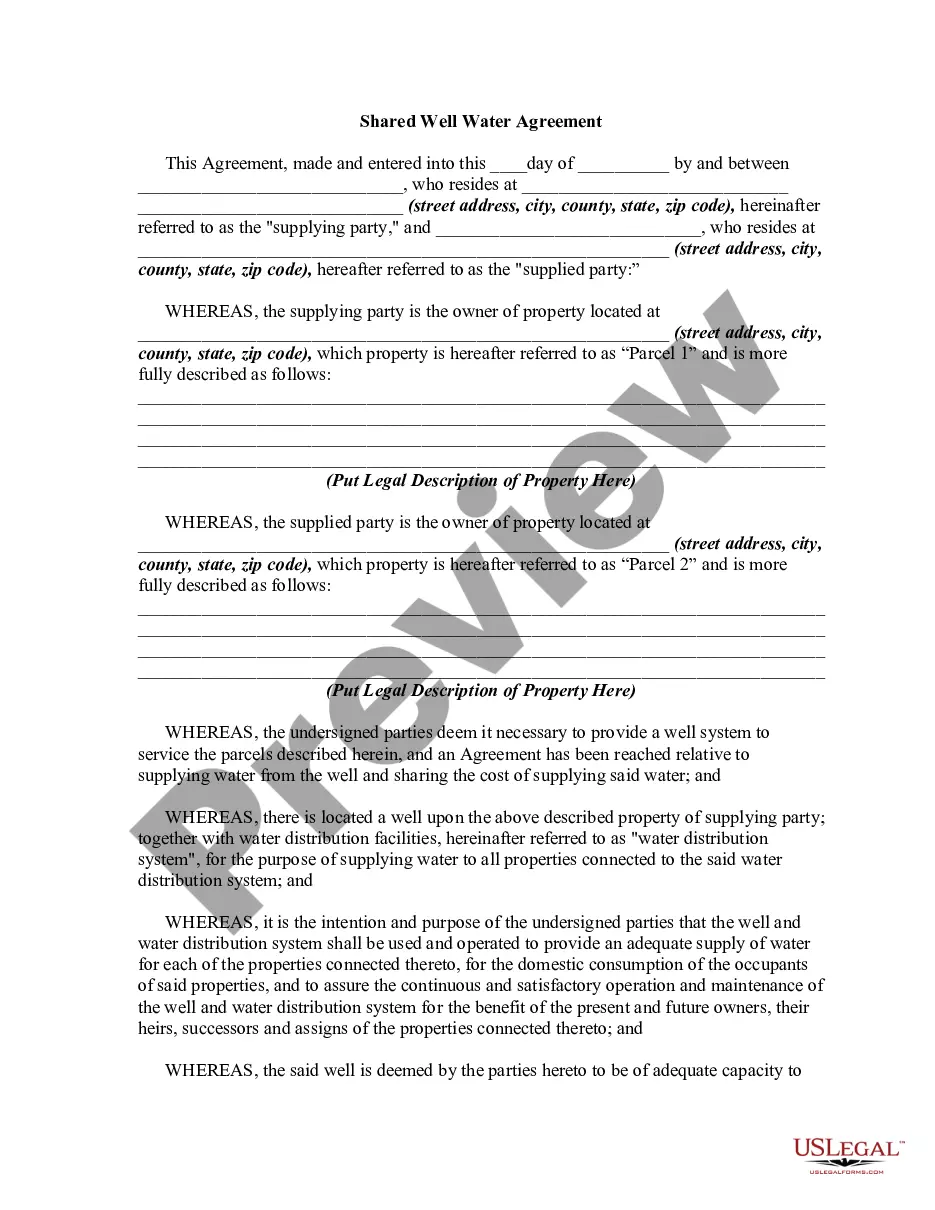
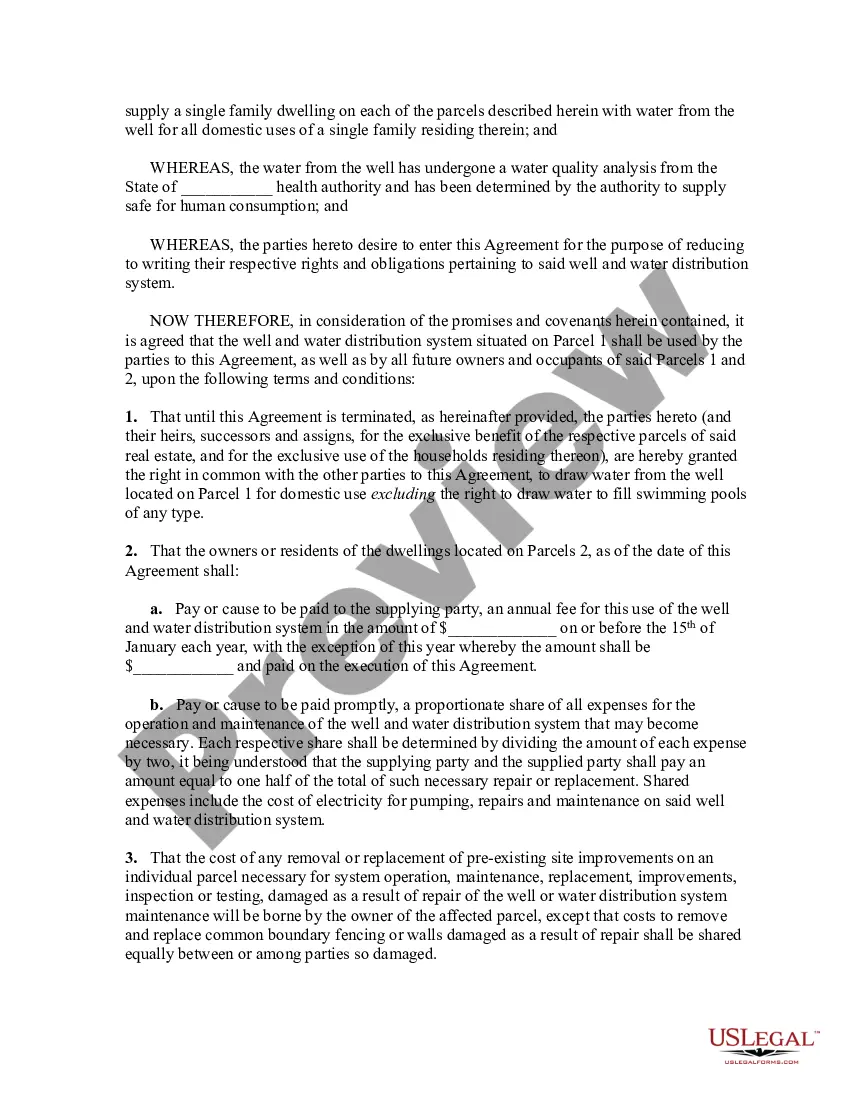
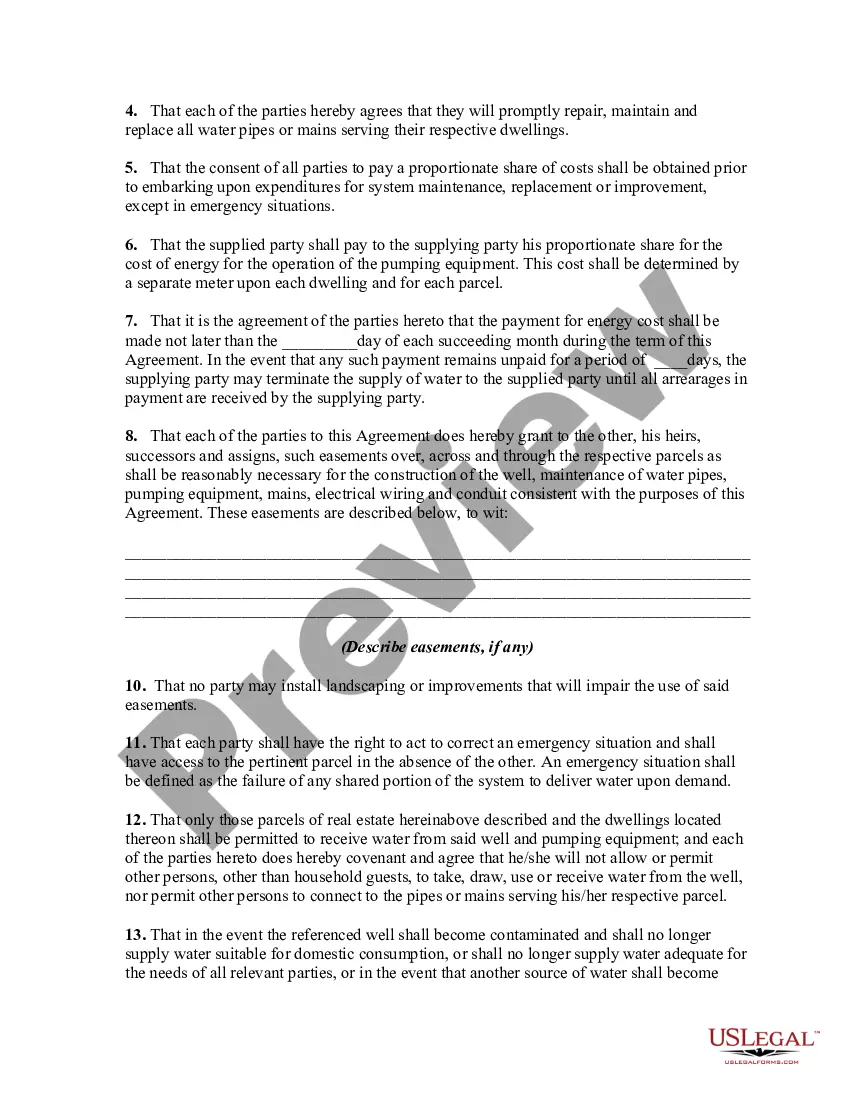
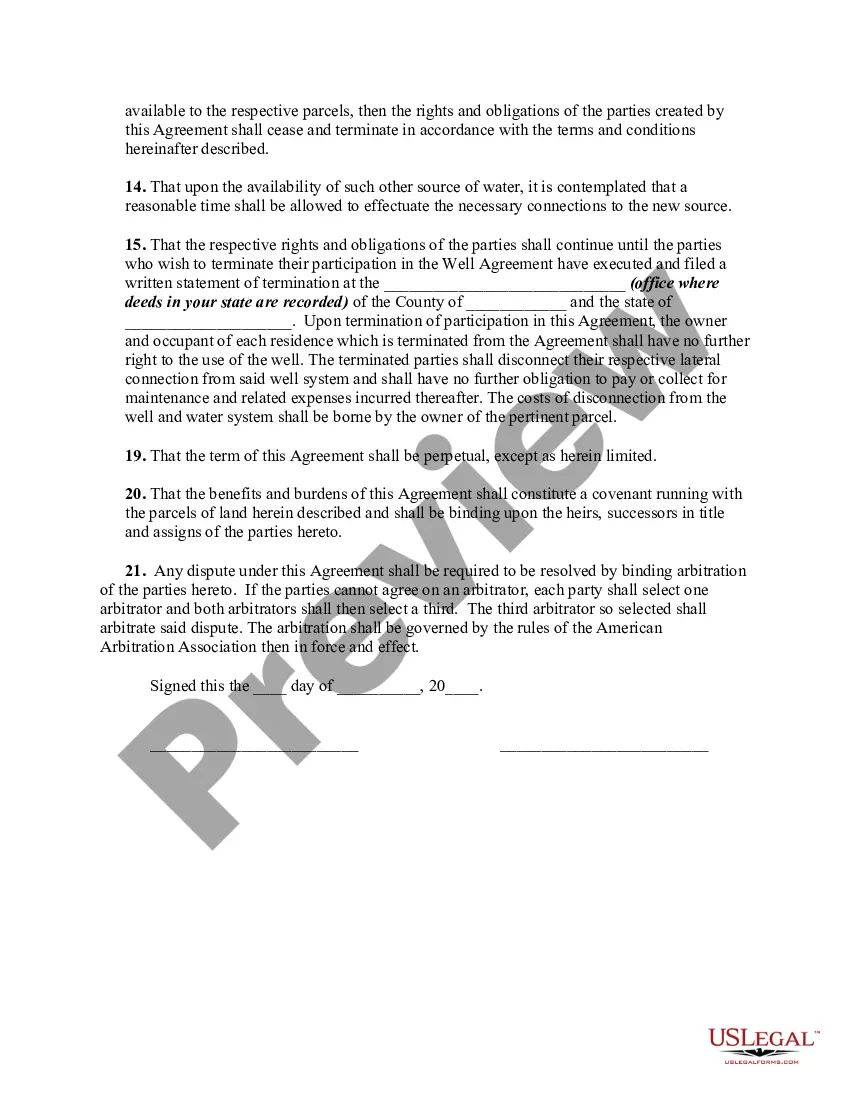
How to fill out Shared Well Water Agreement?
The Water Sharing Agreement With Us that you observe on this page is a versatile legal template composed by expert attorneys in compliance with federal and local legislation.
For over 25 years, US Legal Forms has offered individuals, entities, and legal practitioners with more than 85,000 validated, state-specific documents for any business and personal situation. It is the quickest, simplest, and most reliable method to acquire the forms you require, as the service ensures the utmost level of data security and anti-malware safeguards.
Subscribe to US Legal Forms to have verified legal templates for all of life’s situations readily available to you.
- Search for the document you require and review it.
- Browse through the file you searched and preview it or examine the form details to ensure it meets your needs. If it doesn’t, use the search bar to locate the correct one. Click Buy Now once you have found the template you require.
- Subscribe and Log In.
- Select the pricing option that best fits you and create an account. Use PayPal or a credit card to make an immediate payment. If you already possess an account, Log In and verify your subscription to proceed.
- Acquire the editable template.
- Choose the format you prefer for your Water Sharing Agreement With Us (PDF, DOCX, RTF) and save the sample onto your device.
- Complete and sign the document.
- Print the template to fill it out manually. Alternatively, use an online multi-functional PDF editor to swiftly and correctly fill out and sign your form with a legally-binding electronic signature.
- Re-download your documents anytime.
- Utilize the same document again whenever necessary. Access the My documents tab in your account to redownload any forms you previously downloaded.
Form popularity
FAQ
The Major Issues with the Colorado River Compact Drought conditions reduce the amount of water available. Also, climate change decreases snowpack in the Rocky Mountains that feed the Colorado River. Additionally, increased evaporation in reservoirs leads to even lesser supplies of water.
The Mexican Water Treaty of 1944 allotted to Mexico a guaranteed annual quantity of 1.5 million acre feet of water from the Colorado River, plus additional or less deliveries in specific circumstances. In 1944, the State of Arizona finally ratified the Colorado River Compact of 1922.
The Rio Grande's headwaters are in the United States, its significant tributaries lie in both the United States and Mexico,1 and its riverbed is the U.S.-Mexico border in Texas. These shared surface waters, which are shown in Table 1, are important to many border community economies and water supplies.
Clash With Mexico Signals Future Water Conflict The two countries share the waters of the cross-border Colorado and Rio Grande rivers as part of a landmark treaty signed in 1944. Mexico receives four times more water from the Colorado than it gives to the United States via the Rio Grande.
The Colorado River dispute is a long-running dispute between the United States and Mexico over water rights to the Colorado River.