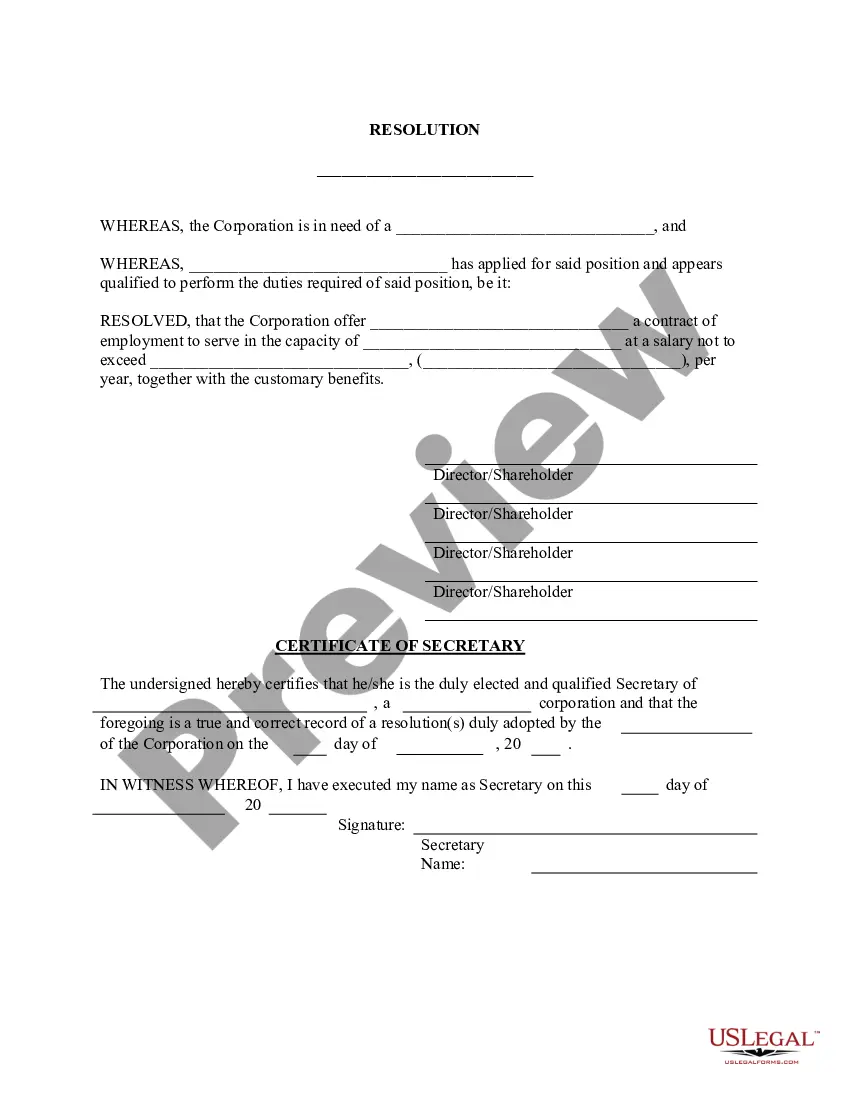
Corporate Officer With Responsibilities
Description

Get your form ready online
Our built-in tools help you complete, sign, share, and store your documents in one place.
Make edits, fill in missing information, and update formatting in US Legal Forms—just like you would in MS Word.
Download a copy, print it, send it by email, or mail it via USPS—whatever works best for your next step.
Sign and collect signatures with our SignNow integration. Send to multiple recipients, set reminders, and more. Go Premium to unlock E-Sign.
If this form requires notarization, complete it online through a secure video call—no need to meet a notary in person or wait for an appointment.
We protect your documents and personal data by following strict security and privacy standards.

Make edits, fill in missing information, and update formatting in US Legal Forms—just like you would in MS Word.

Download a copy, print it, send it by email, or mail it via USPS—whatever works best for your next step.

Sign and collect signatures with our SignNow integration. Send to multiple recipients, set reminders, and more. Go Premium to unlock E-Sign.

If this form requires notarization, complete it online through a secure video call—no need to meet a notary in person or wait for an appointment.

We protect your documents and personal data by following strict security and privacy standards.
Looking for another form?
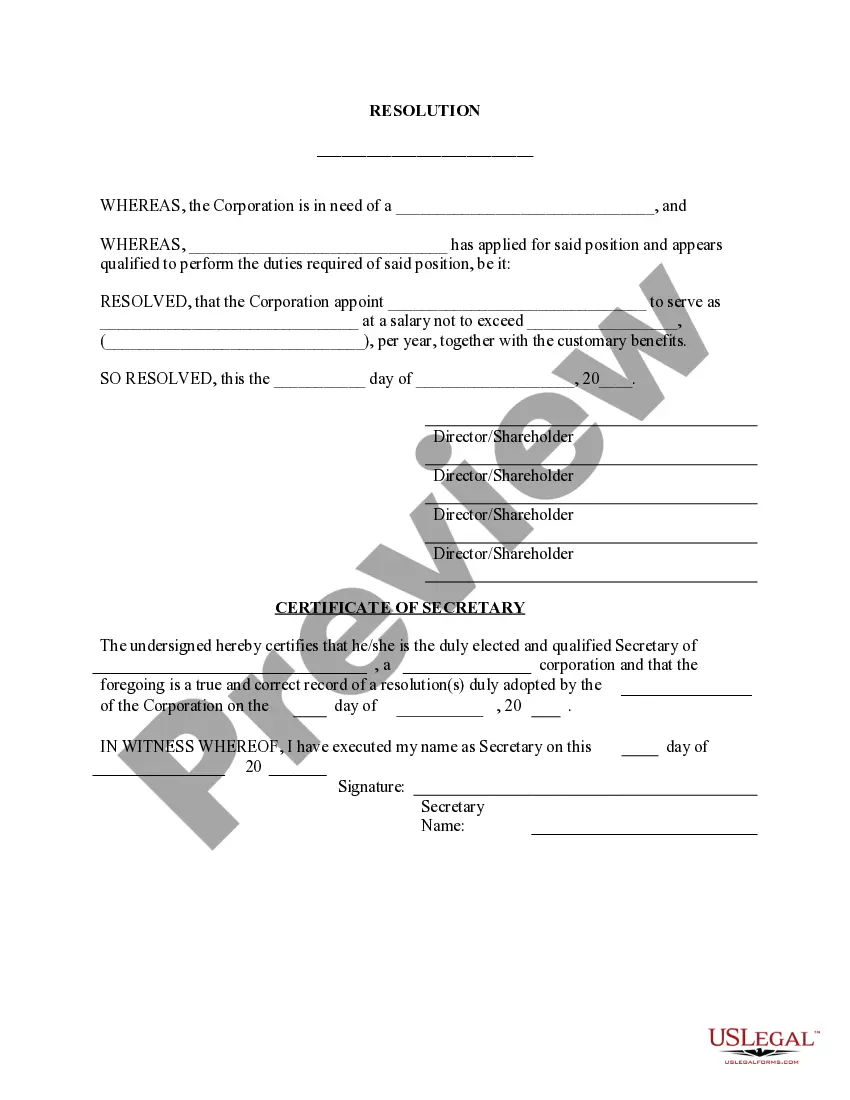
How to fill out Appointment Of Director Or Officer - Resolution Form - Corporate Resolutions?
The Executive Officer With Duties displayed on this page is a versatile legal template crafted by experienced attorneys adhering to federal and local regulations.
For over 25 years, US Legal Forms has supplied individuals, institutions, and legal professionals with over 85,000 validated, state-specific documents for any business and personal event. It’s the fastest, simplest, and most reliable method to acquire the paperwork you require, as the service assures the utmost level of data security and anti-malware safeguards.
Register for US Legal Forms to have authenticated legal templates for all of life's situations readily available.
- Examine the document you require and assess it.
- Navigate through the example you searched for and preview it or review the form description to confirm it meets your requirements. If it does not, utilize the search feature to find the correct one. Click Buy Now once you have identified the template you need.
- Select a subscription and Log In.
- Choose the pricing option that fits you and set up an account. Use PayPal or a credit card for immediate payment. If you already possess an account, Log In and verify your subscription to proceed.
- Acquire the editable template.
- Choose the format you prefer for your Executive Officer With Duties (PDF, Word, RTF) and save the document on your device.
- Complete and sign the documents.
- Print the template to fill it out manually. Alternatively, use an online multi-functional PDF editor to quickly and accurately complete and sign your form with an eSignature.
- Re-download your documents as needed.
- Utilize the same document again whenever required. Access the My documents tab in your profile to retrieve any previously saved forms.
Form popularity
FAQ
A Connecticut durable statutory power of attorney form lets a principal appoint an agent to handle their financial affairs during their lifetime. The term ?durable? refers to the form remaining legal for use even if the principal can no longer make conscious decisions or think with a clear mind.
If you have not given the document to anyone, you can revoke it by destroying it. If the power of attorney has already been recorded in the land records, or given to an institution, you should sign a statement revoking the power of attorney and have it witnessed by two people and notarized.
Notarization Requirement While Connecticut does not technically require you to get your POA notarized, notarization is very strongly recommended. Under Connecticut law, when you sign your POA in the presence of a notary public, you signature is presumed to be genuine?meaning your POA is more ironclad.
A Power of Attorney is a legal document you use to allow another person to act for you. You create a legal relationship in which you are the principal and the person you appoint is the agent. A Power of Attorney specifies the powers you give to your agent. The powers can be limited or broad.
A Connecticut tax power of attorney (LGL-001) designates an agent to represent the principal in front of the Connecticut Department of Revenue Services. The agent, usually a trusted accountant or tax advisor, can file returns, obtain information, or ask the agency representatives for answers on behalf of the principal.
A medical power of attorney, also called a durable power of attorney for health care, is a legal document. In it, you grant another person the authority to make medical decisions for you if you become unable to do so. The person you choose is your health care agent (health care proxy, health care surrogate).
A Power of Attorney is not valid once you die?it ?dies? with you and then your Executor or Trustee take over. A POA is durable if it states that it will remain in effect regardless of your subsequent incapacity.
A Power of Attorney (POA) is a document whereby you give someone (referred to as your ?agent?) written permission to help you now or in the future regarding financial decisions while you are living. A Power of Attorney is not valid once you die?it ?dies? with you and then your Executor or Trustee take over.