What Does A Shareholders Agreement Cover
Description
Get your form ready online
Our built-in tools help you complete, sign, share, and store your documents in one place.
Make edits, fill in missing information, and update formatting in US Legal Forms—just like you would in MS Word.
Download a copy, print it, send it by email, or mail it via USPS—whatever works best for your next step.
Sign and collect signatures with our SignNow integration. Send to multiple recipients, set reminders, and more. Go Premium to unlock E-Sign.
If this form requires notarization, complete it online through a secure video call—no need to meet a notary in person or wait for an appointment.
We protect your documents and personal data by following strict security and privacy standards.

Make edits, fill in missing information, and update formatting in US Legal Forms—just like you would in MS Word.

Download a copy, print it, send it by email, or mail it via USPS—whatever works best for your next step.

Sign and collect signatures with our SignNow integration. Send to multiple recipients, set reminders, and more. Go Premium to unlock E-Sign.

If this form requires notarization, complete it online through a secure video call—no need to meet a notary in person or wait for an appointment.

We protect your documents and personal data by following strict security and privacy standards.
Looking for another form?
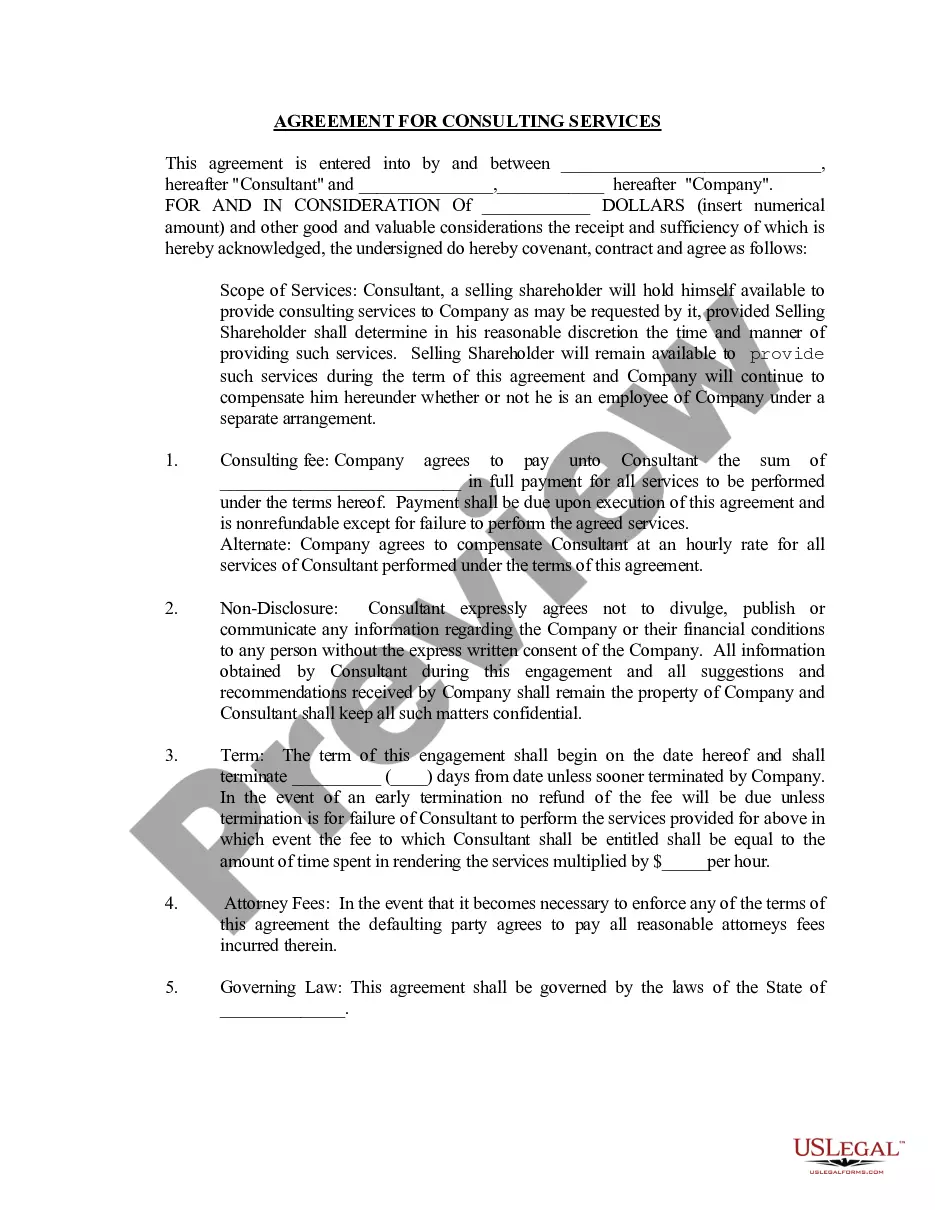
How to fill out Consulting Agreement - With Former Shareholder?
- Start by visiting the US Legal Forms website.
- If you're an existing user, log in to your account to easily download necessary templates.
- For new users, browse through the extensive library of over 85,000 legal forms to find the shareholders agreement that fits your needs.
- Use the Preview mode to ensure the form meets your local jurisdiction requirements.
- Select and click the Buy Now button to choose your preferred subscription plan.
- Complete the registration process to access the full library.
- Provide payment details via credit card or PayPal to finalize your purchase.
- Once your payment is processed, click Download to save the form on your device for immediate use.
With US Legal Forms, you not only gain access to a robust collection of over 85,000 editable legal documents but also the support of premium experts to guarantee your forms are completed accurately and legally.
Don't wait to protect your business interests. Visit US Legal Forms today to discover the advantages of having the right legal documents at your fingertips!
Form popularity
FAQ
You can certainly write your own shareholders agreement, but you should know what a shareholders agreement covers to do it effectively. It's important to include key elements like governance structures, decision-making processes, and conflict resolution methods. However, drafting it without proper guidance may lead to gaps or ambiguities that could cause issues in the future. Using platforms like US Legal Forms can provide you with templates and resources to help create a solid agreement.
Understanding what a shareholders agreement covers is crucial to avoid potential pitfalls. Many agreements may overlook important details, such as the process for resolving disputes or the criteria for selling shares. Without clarity on these points, disputes can arise, leading to conflicts among shareholders. It is wise to consult a professional to ensure your agreement comprehensively addresses these issues.
Being a shareholder can come with several disadvantages, including limited control if there are many shareholders or poor management decisions that impact your investment. Additionally, shareholders may be at risk from diluted value if new shares are issued without proper agreements in place. Understanding what does a shareholders agreement cover helps mitigate these risks and promotes a more favorable shareholder experience.
A breach of a shareholders' agreement occurs when a shareholder fails to uphold any terms outlined in the agreement, such as failing to abide by voting protocols or unauthorized transfer of shares. Breaches may lead to legal actions, requiring resolution through negotiation or possibly litigation. By knowing what does a shareholders agreement cover, you are better equipped to identify and address potential breaches before they escalate.
In many cases, a shareholders agreement can supplement and clarify the articles of incorporation but does not necessarily override them. If there is a conflict between the two, the articles generally take precedence unless the agreement specifically states otherwise. Therefore, it is crucial to understand what does a shareholders agreement cover to ensure alignment with your company’s governing documents.
A shareholders agreement typically includes critical elements such as shareholder rights, obligations, and the process for resolving disputes. It also defines share transfer procedures and stipulates voting rights, which are essential for governance. Knowing what does a shareholders agreement cover allows you to clarify expectations among parties, fostering better communication and cooperation.
A shareholders agreement sets out specific restrictions that govern the actions of shareholders. This may include limitations on the transfer of shares, requiring that shareholders obtain consent before selling their interests. Additionally, it may outline conditions for decision-making processes or outline circumstances leading to the termination of rights. Understanding what does a shareholders agreement cover helps you navigate these important restrictions.
A Shareholders Agreement requires clear definitions of shareholder roles, terms for share issuance, and provisions for conflicts. Additionally, there should be clauses that outline how company decisions will be made and how shares can be sold or transferred. Each section of the agreement must adhere to legal standards to ensure its validity. Knowing what is required in a shareholders agreement can save you time and resources during the drafting process.
The basics of a shareholder agreement include defining the roles of shareholders, outlining voting rights, and establishing guidelines for share transfers. It typically addresses issues such as dispute resolutions and dividend distribution. These fundamental elements protect both individual shareholders and the company as a whole. Learning about the basics of a shareholders agreement is essential for anyone involved in corporate governance.
A shareholder is entitled to a variety of information, including financial statements, details about significant company decisions, and insights into overall company performance. They have the right to be informed about matters that affect their investments. This transparency is critical for maintaining trust among shareholders and supporting informed decision-making. Understanding what information a shareholder is entitled to ensures that you stay engaged and informed.