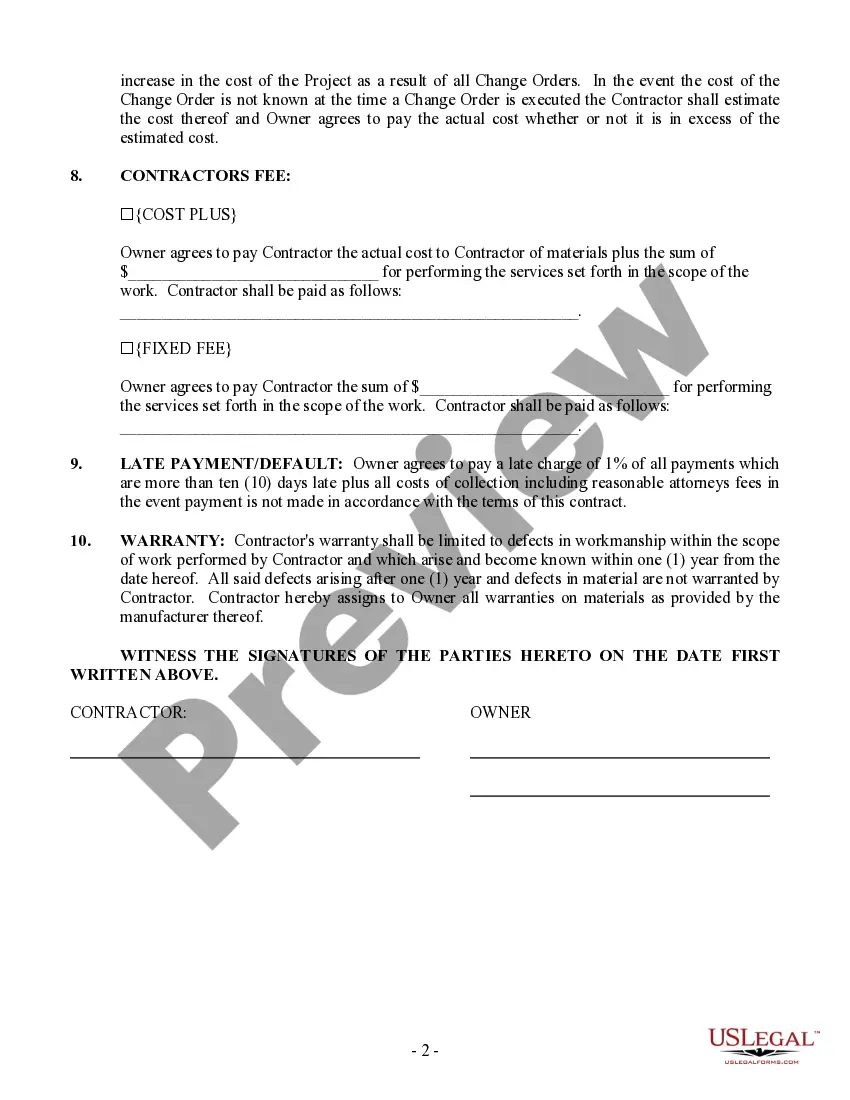
Contract Cost Plus Form For Construction In Utah
Description

Get your form ready online
Our built-in tools help you complete, sign, share, and store your documents in one place.
Make edits, fill in missing information, and update formatting in US Legal Forms—just like you would in MS Word.
Download a copy, print it, send it by email, or mail it via USPS—whatever works best for your next step.
Sign and collect signatures with our SignNow integration. Send to multiple recipients, set reminders, and more. Go Premium to unlock E-Sign.
If this form requires notarization, complete it online through a secure video call—no need to meet a notary in person or wait for an appointment.
We protect your documents and personal data by following strict security and privacy standards.

Make edits, fill in missing information, and update formatting in US Legal Forms—just like you would in MS Word.

Download a copy, print it, send it by email, or mail it via USPS—whatever works best for your next step.

Sign and collect signatures with our SignNow integration. Send to multiple recipients, set reminders, and more. Go Premium to unlock E-Sign.

If this form requires notarization, complete it online through a secure video call—no need to meet a notary in person or wait for an appointment.

We protect your documents and personal data by following strict security and privacy standards.
Looking for another form?






Form popularity
FAQ
How To Write A Construction Contract With 7 Steps Step 1: Define the Parties Involved. Step 2: Outline the Scope of Work. Step 3: Establish the Timeline. Step 4: Determine the Payment Terms. Step 5: Include Necessary Legal Clauses. Step 6: Address Change Orders and Modifications. Step 7: Sign and Execute the Contract.
The following are the general contractor classifications: B100 General Contractor. R100 Residential/Small Commercial Contractor.
Can I be my own Contractor? Pursuant to Utah State Code 55-55-305 a property owner is exempt from licensure and may engage in acts or practices included within the practice of construction trades subject to the stated circumstances and limitations within the Code.
RMO License One of the most common, and often easiest ways that people without any prior experience can gain access to a contractor license is by utilizing either an “RMO” or “RME.”
How to draft a contract between two parties: A step-by-step checklist Know your parties. Agree on the terms. Set clear boundaries. Spell out the consequences. Specify how you will resolve disputes. Cover confidentiality. Check the legality of the contract. Open it up to negotiation.
R101 - Residential and Small Commercial Non Structural Remodeling and Repair.
The state mandates that any individual or business performing construction work valued at $3,000 or more must hold a valid contractor's license. This requirement applies across various classifications, including general contracting, residential/small commercial work, and specialty trades like electrical and plumbing.
The S220 Carpentry and Flooring Contractor License is essential for professionals who engage in carpentry or flooring projects in Utah. This license is required for contractors who work on tasks such as framing, finishing carpentry, wood floor installation, and similar activities.
