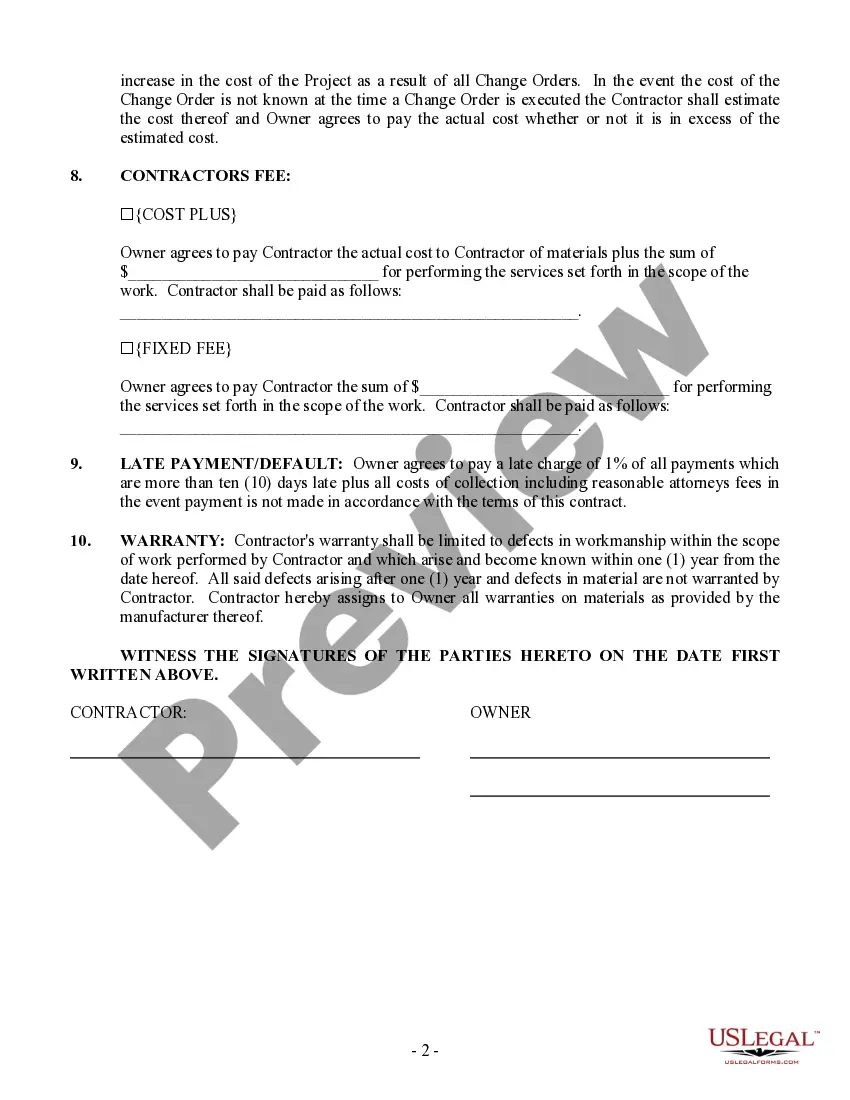
Cost Plus Fee Construction Contract In Minnesota
Description

Get your form ready online
Our built-in tools help you complete, sign, share, and store your documents in one place.
Make edits, fill in missing information, and update formatting in US Legal Forms—just like you would in MS Word.
Download a copy, print it, send it by email, or mail it via USPS—whatever works best for your next step.
Sign and collect signatures with our SignNow integration. Send to multiple recipients, set reminders, and more. Go Premium to unlock E-Sign.
If this form requires notarization, complete it online through a secure video call—no need to meet a notary in person or wait for an appointment.
We protect your documents and personal data by following strict security and privacy standards.

Make edits, fill in missing information, and update formatting in US Legal Forms—just like you would in MS Word.

Download a copy, print it, send it by email, or mail it via USPS—whatever works best for your next step.

Sign and collect signatures with our SignNow integration. Send to multiple recipients, set reminders, and more. Go Premium to unlock E-Sign.

If this form requires notarization, complete it online through a secure video call—no need to meet a notary in person or wait for an appointment.

We protect your documents and personal data by following strict security and privacy standards.
Looking for another form?









Form popularity
FAQ
An indemnification agreement contained in, or executed in connection with, a building and construction contract is unenforceable except to the extent that: (1) the underlying injury or damage is attributable to the negligent or otherwise wrongful act or omission, including breach of a specific contractual duty, of the ...
No person shall hereafter carry on or conduct or transact a commercial business in this state under any designation, name, or style, which does not set forth the true name of every person interested in such business unless such person shall file in the Office of the Secretary of State, a certificate setting forth the ...
Minnesota first passed the Anti-indemnity Statute in 1984. The purpose of the statute was to try to make each party responsible for their own conduct. The Anti-indemnity Statute prohibited agreements in “building and construction contracts” where one party agreed to indemnify another for the other's own fault.
Does Minnesota limit the amount of retainage that can be withheld from a contractor? Retainage cannot exceed 5%. During the project, this may be reduced/eliminated if progress is satisfactory.
In the State of Minnesota, as in other states, the statutes of limitations vary for different types of crimes. For example, misdemeanors carry a three-year statute of limitations, while the time limits for felonies range from three to nine years.
