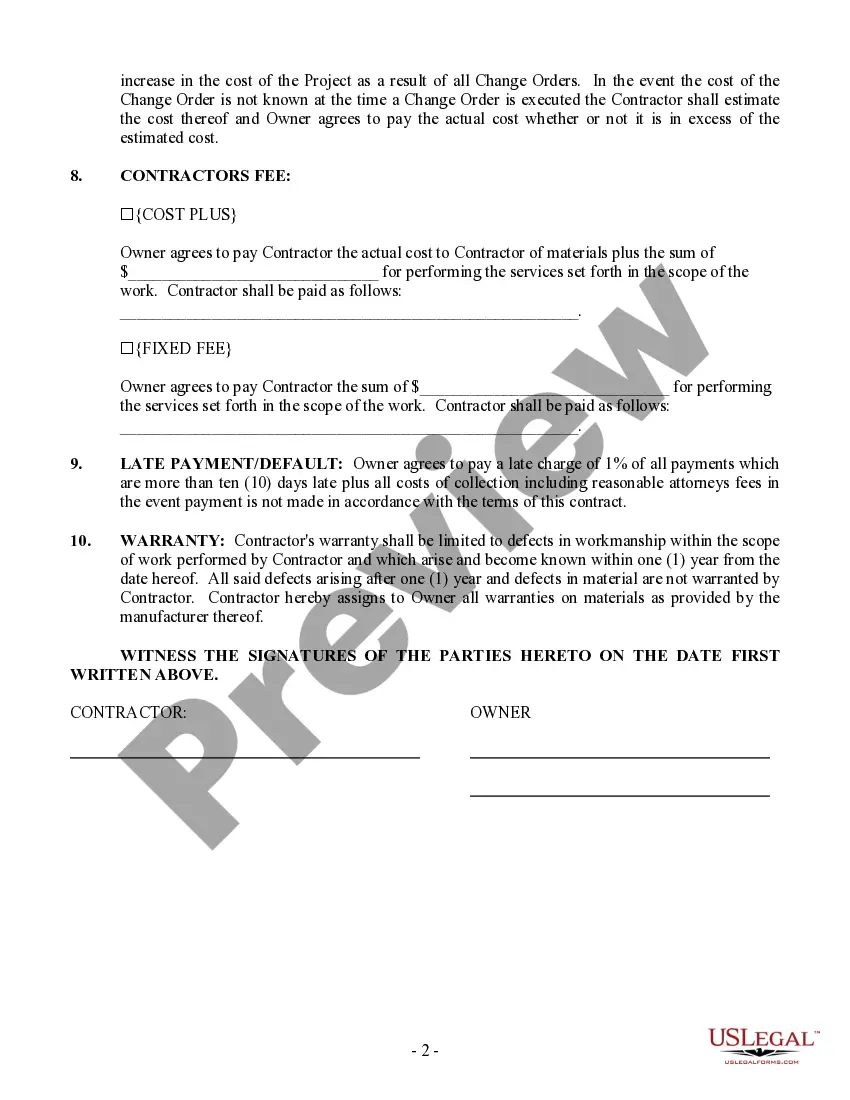
Construction Contract Form With Decimals In Middlesex
Description

Get your form ready online
Our built-in tools help you complete, sign, share, and store your documents in one place.
Make edits, fill in missing information, and update formatting in US Legal Forms—just like you would in MS Word.
Download a copy, print it, send it by email, or mail it via USPS—whatever works best for your next step.
Sign and collect signatures with our SignNow integration. Send to multiple recipients, set reminders, and more. Go Premium to unlock E-Sign.
If this form requires notarization, complete it online through a secure video call—no need to meet a notary in person or wait for an appointment.
We protect your documents and personal data by following strict security and privacy standards.

Make edits, fill in missing information, and update formatting in US Legal Forms—just like you would in MS Word.

Download a copy, print it, send it by email, or mail it via USPS—whatever works best for your next step.

Sign and collect signatures with our SignNow integration. Send to multiple recipients, set reminders, and more. Go Premium to unlock E-Sign.

If this form requires notarization, complete it online through a secure video call—no need to meet a notary in person or wait for an appointment.

We protect your documents and personal data by following strict security and privacy standards.
Looking for another form?





Form popularity
FAQ
What is a standard form contract? While many contracts are entirely purpose made, standard form contracts consist of standardised, pre-written terms and conditions. Because standard form contracts are familiar to people in an industry, they often function effectively without the need for much negotiation.
Ing to Boundy (2012), typically, a written contract will include: Date of agreement. Names of parties to the agreement. Preliminary clauses. Defined terms. Main contract clauses. Schedules/appendices and signature provisions (para. 5).
How To Write A Construction Contract With 7 Steps Step 1: Define the Parties Involved. Step 2: Outline the Scope of Work. Step 3: Establish the Timeline. Step 4: Determine the Payment Terms. Step 5: Include Necessary Legal Clauses. Step 6: Address Change Orders and Modifications. Step 7: Sign and Execute the Contract.
To be legally enforceable, an agreement must contain all of the following criteria: An offer and acceptance; Certainty of terms; Consideration; An intention to create legal relations; Capacity of the parties; and, Legality of purpose.
The Works are typically described in very basic terms. The Articles reflect whether quantities form part of the Contract or not. As noted above, the 'Yellow Form' is used where quantities form part of the Contract and in these instances the Contract Documents include a priced Bill of Quantities.
How to draft a contract in 13 simple steps Start with a contract template. Understand the purpose and requirements. Identify all parties involved. Outline key terms and conditions. Define deliverables and milestones. Establish payment terms. Add termination conditions. Incorporate dispute resolution.
When it comes to business, understanding the 4 elements of a contract business law is essential. A valid contract is built on these cornerstones: Offer, Acceptance, Consideration, and Intention to Create Legal Relations. Here's a quick look: Offer: A clear proposal to make a deal.
