Contract Form For Construction In Miami-Dade
Description

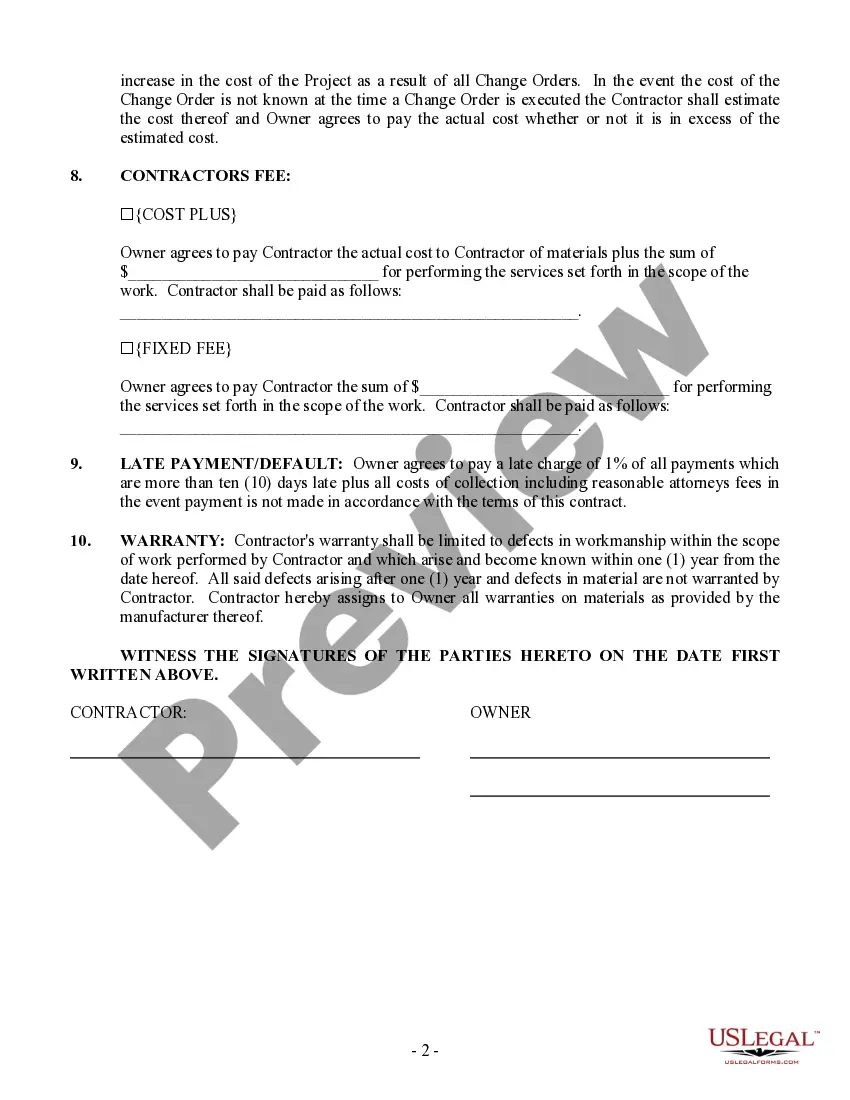
Get your form ready online
Our built-in tools help you complete, sign, share, and store your documents in one place.
Make edits, fill in missing information, and update formatting in US Legal Forms—just like you would in MS Word.
Download a copy, print it, send it by email, or mail it via USPS—whatever works best for your next step.
Sign and collect signatures with our SignNow integration. Send to multiple recipients, set reminders, and more. Go Premium to unlock E-Sign.
If this form requires notarization, complete it online through a secure video call—no need to meet a notary in person or wait for an appointment.
We protect your documents and personal data by following strict security and privacy standards.

Make edits, fill in missing information, and update formatting in US Legal Forms—just like you would in MS Word.

Download a copy, print it, send it by email, or mail it via USPS—whatever works best for your next step.

Sign and collect signatures with our SignNow integration. Send to multiple recipients, set reminders, and more. Go Premium to unlock E-Sign.

If this form requires notarization, complete it online through a secure video call—no need to meet a notary in person or wait for an appointment.

We protect your documents and personal data by following strict security and privacy standards.
Looking for another form?





Form popularity
FAQ
How To Write A Construction Contract With 7 Steps Step 1: Define the Parties Involved. Step 2: Outline the Scope of Work. Step 3: Establish the Timeline. Step 4: Determine the Payment Terms. Step 5: Include Necessary Legal Clauses. Step 6: Address Change Orders and Modifications. Step 7: Sign and Execute the Contract.
The 'main contract' is generally that which is awarded by the client (sometimes referred to as the employer) to the general contractor, or main contractor, whose tender has been accepted.
Bilateral contracts are agreements in which both parties exchange mutual promises to perform certain obligations, making this type of contract the most common in business transactions.
The (), ConsensusDocs, Design Build Institute of America (DBIA) and Engineers Joint Contract Documents Committee publish the most common forms used in the United States, while international projects often use forms available from the International Federation of Consulting Engineers ( ...
What is a standard form contract? While many contracts are entirely purpose made, standard form contracts consist of standardised, pre-written terms and conditions. Because standard form contracts are familiar to people in an industry, they often function effectively without the need for much negotiation.
How To Write A Construction Contract With 7 Steps Step 1: Define the Parties Involved. Step 2: Outline the Scope of Work. Step 3: Establish the Timeline. Step 4: Determine the Payment Terms. Step 5: Include Necessary Legal Clauses. Step 6: Address Change Orders and Modifications. Step 7: Sign and Execute the Contract.
To be legally enforceable, an agreement must contain all of the following criteria: An offer and acceptance; Certainty of terms; Consideration; An intention to create legal relations; Capacity of the parties; and, Legality of purpose.
Lesson Summary. A contract is a legal agreement between two or more parties in which they agree to each other's rights and responsibilities. Offer, acceptance, awareness, consideration, and capacity are the five elements of an enforceable contract.
A legally enforceable contract must include an offer, acceptance, consideration, capacity, legality, and mutual assent.
