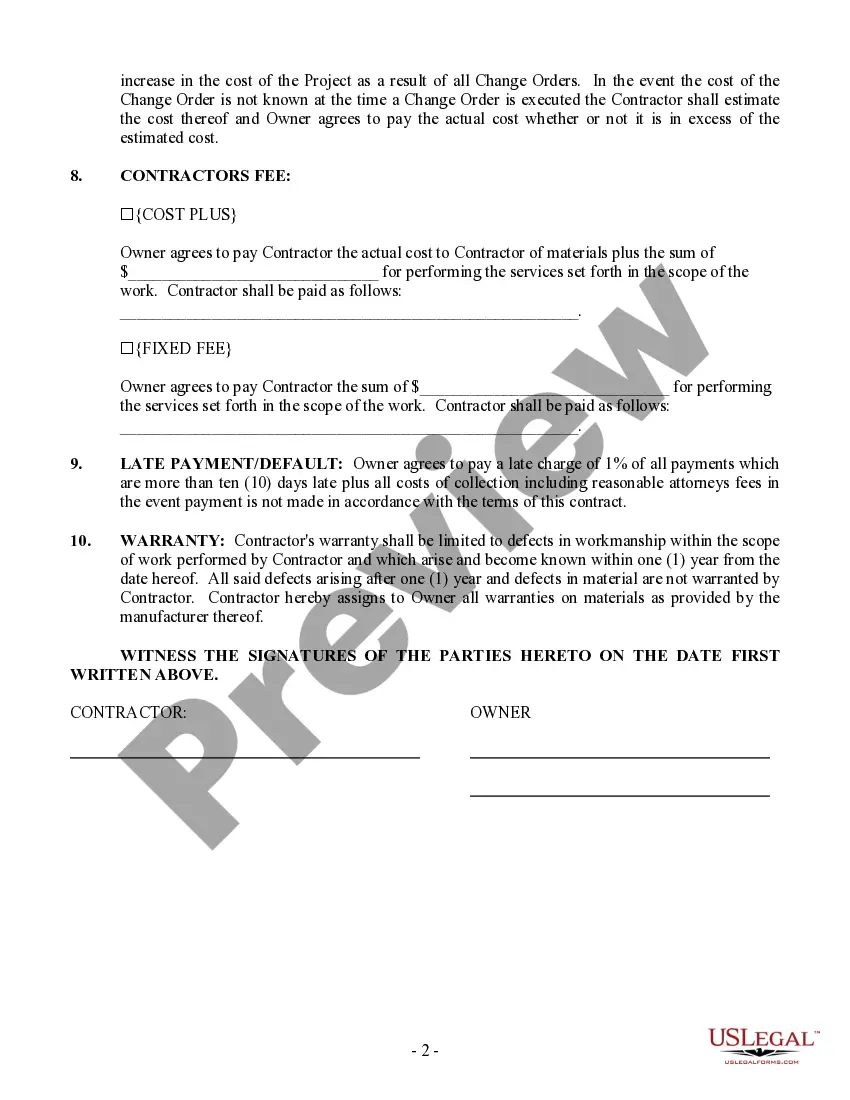
Contract Contractor Building For Work Over $20 000 In Maricopa
Description

Get your form ready online
Our built-in tools help you complete, sign, share, and store your documents in one place.
Make edits, fill in missing information, and update formatting in US Legal Forms—just like you would in MS Word.
Download a copy, print it, send it by email, or mail it via USPS—whatever works best for your next step.
Sign and collect signatures with our SignNow integration. Send to multiple recipients, set reminders, and more. Go Premium to unlock E-Sign.
If this form requires notarization, complete it online through a secure video call—no need to meet a notary in person or wait for an appointment.
We protect your documents and personal data by following strict security and privacy standards.

Make edits, fill in missing information, and update formatting in US Legal Forms—just like you would in MS Word.

Download a copy, print it, send it by email, or mail it via USPS—whatever works best for your next step.

Sign and collect signatures with our SignNow integration. Send to multiple recipients, set reminders, and more. Go Premium to unlock E-Sign.

If this form requires notarization, complete it online through a secure video call—no need to meet a notary in person or wait for an appointment.

We protect your documents and personal data by following strict security and privacy standards.
Looking for another form?






Form popularity
FAQ
When is a contract legally binding? Typically, a document that includes an offer, acceptance, and appropriate consideration will be considered legally binding. In most cases, a contract is binding in Arizona even if the parties signed it in another state.
If your project has a well-defined scope of work, a lump sum contract is a straightforward solution since contractors should be able to accurately estimate costs. If the project scope is unclear, contractors can bid with time and materials contracts to mitigate risk.
How long is a contractor liable for work in Arizona? In Arizona, contractors are liable for their work for up to eight years from the project's completion date. The statute of limitations for filing a claim against a contractor in Arizona is two years from the discovery of the defect.
The qualifying party must possess at least four years of contracting experience and sit for two major trade examinations when applying for a general contractor license in Arizona. The state requires contractors to ace the AZ Statutes and Rules Training Course and Exam (SRE) and Trade exam in their specialty areas.
How does the transaction privilege tax (TPT) apply to prime contracting? The TPT is imposed on the business activity of performing contracting work as a prime contractor. The tax base is sixty-five percent of the gross receipts derived from the business.
It's not unusual. If you are not comfortable tell them you are willing to do 50% upon delivery of materials, balance upon completion.
As a general rule of thumb your contractor rate should be at least 50% more than you'd get for the same work as an employee.
To draft a contract from scratch, start by identifying the parties involved and clearly outlining the agreement. Include consideration (what is exchanged), define the terms and conditions, ensure all parties are legally competent, and finalise it with signatures. These essential elements make the contract enforceable.
