Contract Form For Construction In Contra Costa
Description

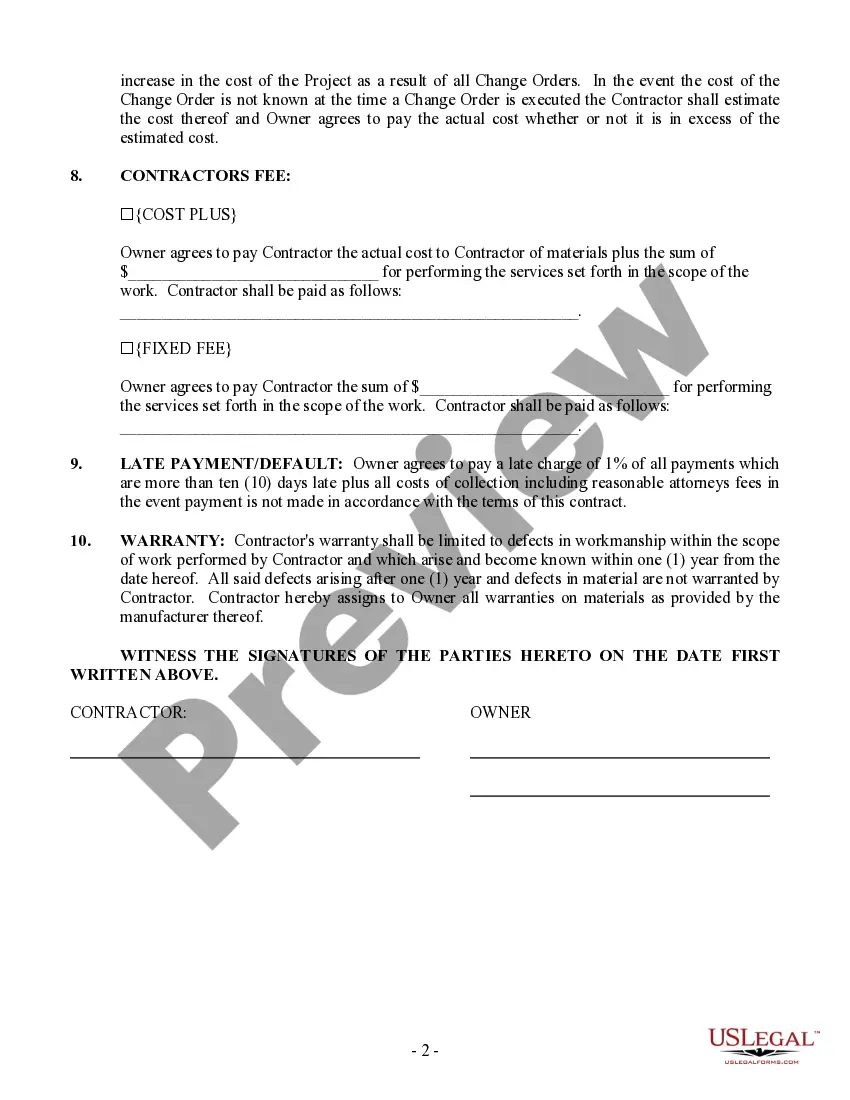
Get your form ready online
Our built-in tools help you complete, sign, share, and store your documents in one place.
Make edits, fill in missing information, and update formatting in US Legal Forms—just like you would in MS Word.
Download a copy, print it, send it by email, or mail it via USPS—whatever works best for your next step.
Sign and collect signatures with our SignNow integration. Send to multiple recipients, set reminders, and more. Go Premium to unlock E-Sign.
If this form requires notarization, complete it online through a secure video call—no need to meet a notary in person or wait for an appointment.
We protect your documents and personal data by following strict security and privacy standards.

Make edits, fill in missing information, and update formatting in US Legal Forms—just like you would in MS Word.

Download a copy, print it, send it by email, or mail it via USPS—whatever works best for your next step.

Sign and collect signatures with our SignNow integration. Send to multiple recipients, set reminders, and more. Go Premium to unlock E-Sign.

If this form requires notarization, complete it online through a secure video call—no need to meet a notary in person or wait for an appointment.

We protect your documents and personal data by following strict security and privacy standards.
Looking for another form?








Form popularity
FAQ
How To Write A Construction Contract With 7 Steps Step 1: Define the Parties Involved. Step 2: Outline the Scope of Work. Step 3: Establish the Timeline. Step 4: Determine the Payment Terms. Step 5: Include Necessary Legal Clauses. Step 6: Address Change Orders and Modifications. Step 7: Sign and Execute the Contract.
In California, you need a contractor license to do any work that costs more than $500. The easiest kind of contractor's license is a Class “B” Contractor's License. This license allows you to do general contracting work.
How to Get a California Contractor License Who Issues Contractor Licenses in California? Determine the Type of Contractor License You Need. Access California Contractor License Application Forms. Fulfill Requirements and Obtain Required Documents. Submit Your California Contractor License Application. Pass Your Examination.
These include, but are not limited to, new structures, demolitions, additions, alterations, interior/exterior remodels, running new electrical, water or gas lines, repairs, outdoor kitchens, pergolas, pavilions, decks, carports, garages, docks, pools, foundation repairs, ADUs, and Junior ADUs, solar, energy storage ...
In order to qualify for a license you are required to take and pass a test administered by the Contractor State License Board. The California contractor license exam is challenging and most people need some outside assistance or study material in order to pass it.
The rules of contract construction call on several different types of meaning. These include plain meaning, use meaning, subjective meaning, objective meaning, purpose, and belief and intent. The correct approach to contract interpretation differs ing to the facts of the case and the legal question at issue.
Standard Form Contracts are agreements that employ standardised, non-negotiated provisions, usually in pre-printed forms. These are sometimes referred to as 'boilerplate contracts', 'contracts of adhesion', or 'take it or leave it' contracts.
REQUIREMENTS FOR A CONTRACT A valid contract is a legally binding agreement and is enforceable in court by and against the contracting parties. In order for a contract to be valid, there must be an offer, an acceptance of the offer, an exchange between the parties of something of value, and an agreement to the terms.
A requirements contract is a contract in which one party agrees to supply as much of a good or service as is required by the other party, and in exchange the other party expressly or implicitly promises that it will obtain its goods or services exclusively from the first party.
