Condo Master Deed And Bylaws In Santa Clara
Description



Get your form ready online
Our built-in tools help you complete, sign, share, and store your documents in one place.
Make edits, fill in missing information, and update formatting in US Legal Forms—just like you would in MS Word.
Download a copy, print it, send it by email, or mail it via USPS—whatever works best for your next step.
Sign and collect signatures with our SignNow integration. Send to multiple recipients, set reminders, and more. Go Premium to unlock E-Sign.
If this form requires notarization, complete it online through a secure video call—no need to meet a notary in person or wait for an appointment.
We protect your documents and personal data by following strict security and privacy standards.

Make edits, fill in missing information, and update formatting in US Legal Forms—just like you would in MS Word.

Download a copy, print it, send it by email, or mail it via USPS—whatever works best for your next step.

Sign and collect signatures with our SignNow integration. Send to multiple recipients, set reminders, and more. Go Premium to unlock E-Sign.

If this form requires notarization, complete it online through a secure video call—no need to meet a notary in person or wait for an appointment.

We protect your documents and personal data by following strict security and privacy standards.
Looking for another form?









Form popularity
FAQ
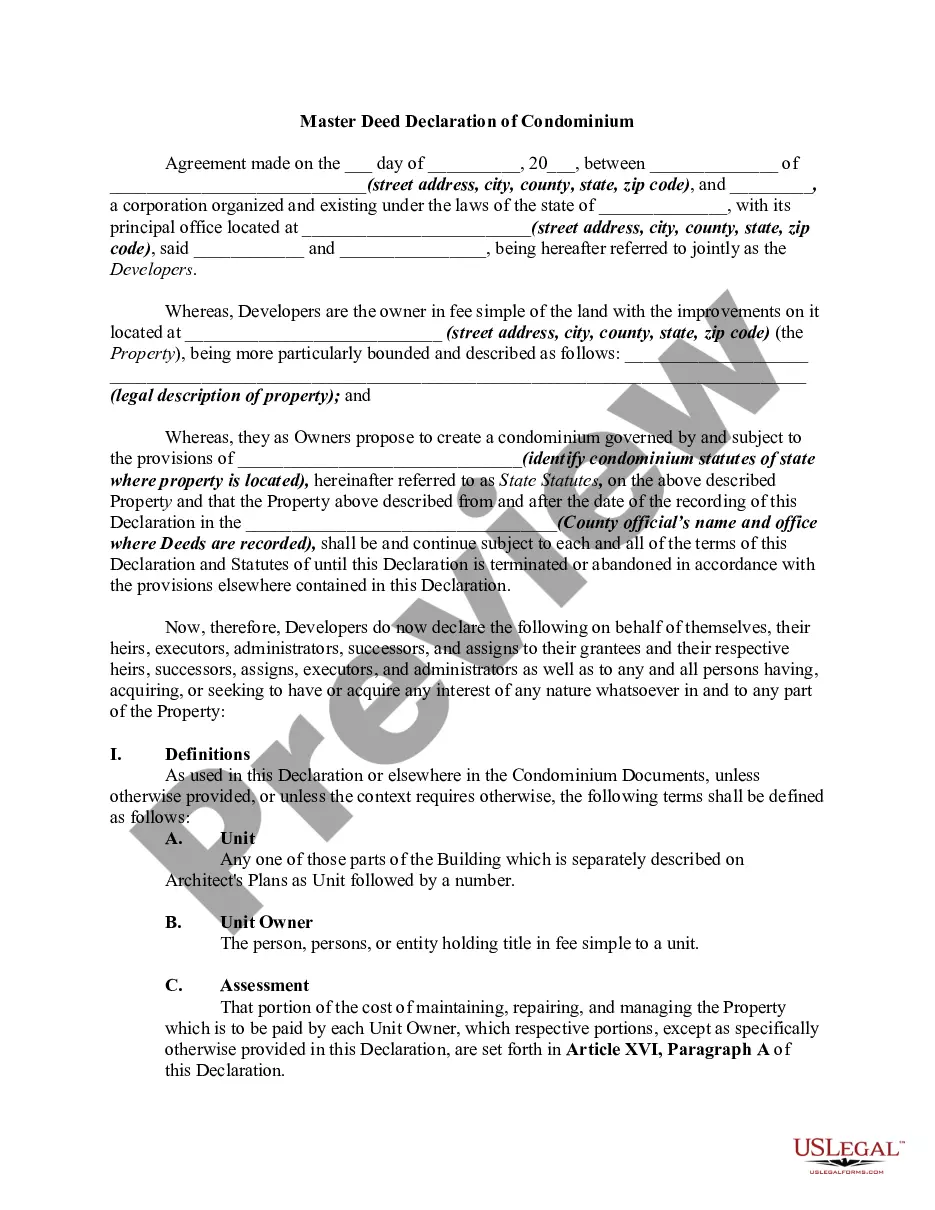
A master deed is a legal document that a condiminium owner must file with the local government agency when a property is being divided in to condo units. The master deed contains details regarding where the inium property is located, how many units it will be divided into, and what the value of the property is.
A Master Deed is a legal document that outlines the rules and regulations for a inium or cooperative property. It's a document that's created by the developer of the property and it's used to govern how the property is managed and maintained.
Any restrictions on the use of the units and common areas. The bylaws are actually a part of the Master Deed itself. Most often, in the case of such an inconsistency, the Master Deed provision would prevail.
The ByLaws is the corporate governance: The bylaws describe among other things, how the common expenses will be shared to maintain the building. Any restrictions on the use of the units and common areas. The bylaws are actually a part of the Master Deed itself.
House Rules are different from Bylaws in that they can be implemented and changed by the Board of Directors without the need for unit owner approval – which means that they can be changed more easily. Bylaws will very often set forth restrictions on the use of units in the condo.
An HOA's governing documents are usually in the form of a Declaration of Covenants, Conditions, and Restrictions (CC&Rs) and bylaws. The CC&Rs explain the rules of the HOA community, while the bylaws cover how the HOA operates.
The inium bylaws govern the structure and operation of the association. They contain information regarding board meetings, elections, board terms, voting procedures, and the like. The bylaws are more about the management of the association than the rules that govern it and its members.
Condos have a special type of ownership title called a CCT - inium certificate of title. iniums usually have amenities, like swimming pools, owned parking, a clubhouse, and a building for administration.
APNs can be determined through the Santa Clara County Assessor's Office Property Assessment Information System. Visit the assessor's website for more information or contact their office at (408) 299-5500. Enter the street address of the property.
C1 (Neighborhood Commercial) Zone permits neighborhood commercial activities and small-scale freestanding businesses. DEVELOPMENT REQUIREMENTS. Minimum lot size: N/A Minimum lot width: 40 feet Minimum lot depth: 70 feet Setbacks Principal Building: 1. Primary Frontage: 25 feet (min) 2.
