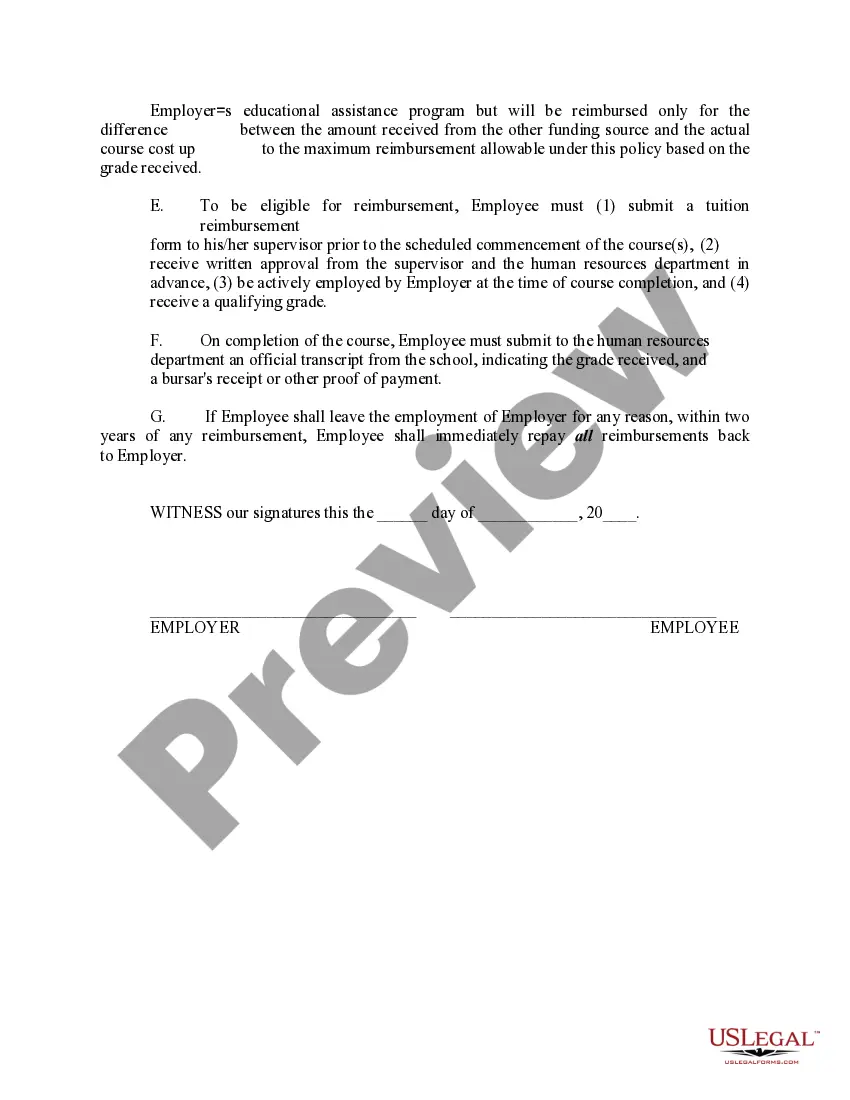
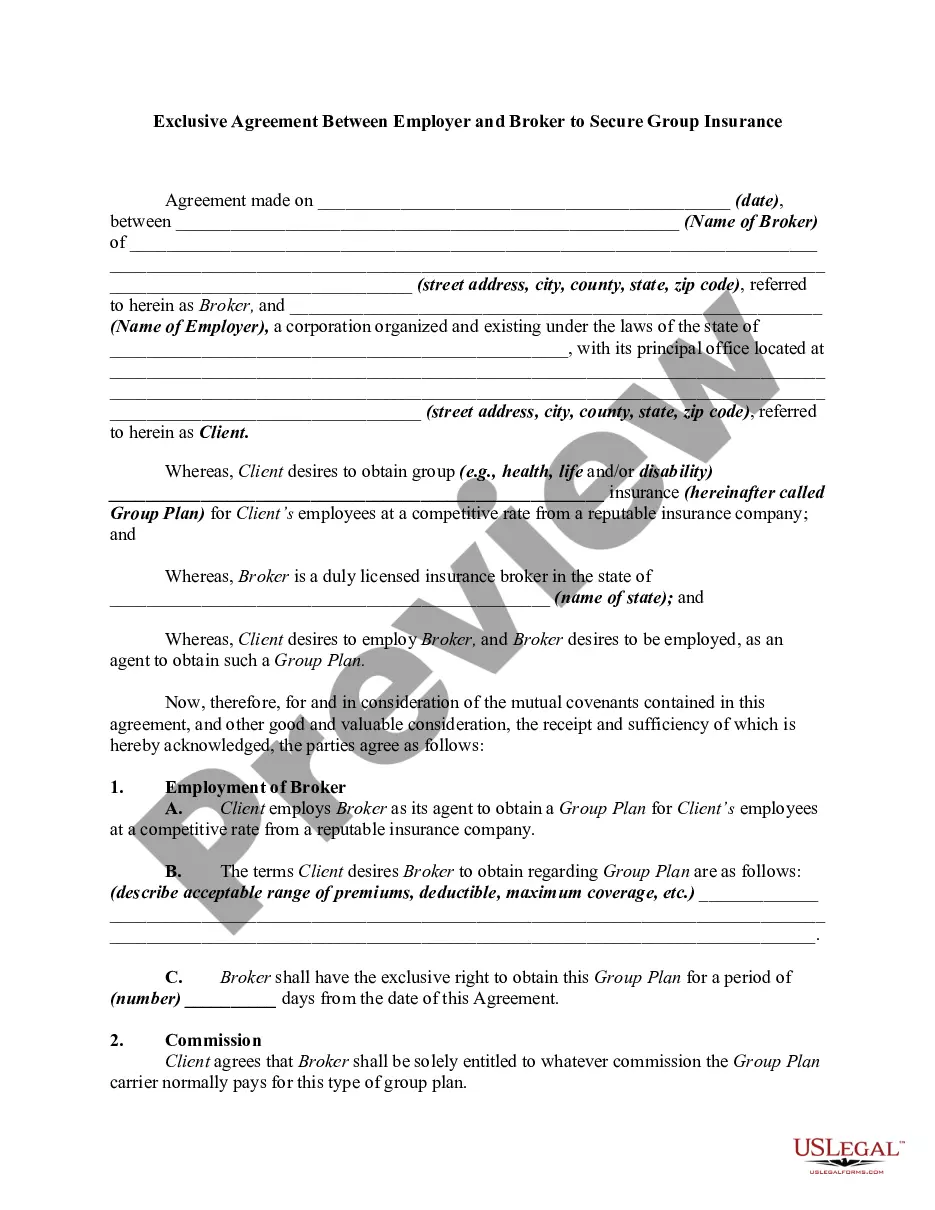
Educational Assistance Program Employees Without Money In Maryland
Description

Get your form ready online
Our built-in tools help you complete, sign, share, and store your documents in one place.
Make edits, fill in missing information, and update formatting in US Legal Forms—just like you would in MS Word.
Download a copy, print it, send it by email, or mail it via USPS—whatever works best for your next step.
Sign and collect signatures with our SignNow integration. Send to multiple recipients, set reminders, and more. Go Premium to unlock E-Sign.
If this form requires notarization, complete it online through a secure video call—no need to meet a notary in person or wait for an appointment.
We protect your documents and personal data by following strict security and privacy standards.

Make edits, fill in missing information, and update formatting in US Legal Forms—just like you would in MS Word.

Download a copy, print it, send it by email, or mail it via USPS—whatever works best for your next step.

Sign and collect signatures with our SignNow integration. Send to multiple recipients, set reminders, and more. Go Premium to unlock E-Sign.

If this form requires notarization, complete it online through a secure video call—no need to meet a notary in person or wait for an appointment.

We protect your documents and personal data by following strict security and privacy standards.
Looking for another form?









Form popularity
FAQ
The Educational Assistance Grant (EAG) is a need-based program. Annual award amounts range from $400 to $3,000 and are determined by student need. To be eligible for the EAG, a student must: File the FAFSA or MSFAA by March 1st each year.
Health Personnel Shortage Incentive Grant Program Legal residents of Maryland can enroll in these programs at the in-county tuition rate. Tuition benefits are also available to out-of-state students, but with additional conditions. These programs do not entitle out-of-county residents to in-county admissions benefits.
Be a Maryland resident (If you are a dependent student, your parent(s) must also have Maryland residency.) Enroll at a two-year or four-year Maryland college or university as a full-time, degree-seeking, undergraduate student. Demonstrate financial need as determined by the FAFSA/MSFAA and MHEC.
The Delegate Howard P. Rawlings Guaranteed Access (GA) Grant is a need-based grant thatprovides financial assistance to eligible applicants enrolled at postsecondary institutions for educational expenses. The Guaranteed Access Grant awards up to $18,000 towards a student's calculated financial need.
The Maryland Small Grants Program (MSGP) is intended to help smaller nonprofits more easily and efficiently apply for funding. Maryland organizations with an annual budget under $3 million a year are eligible to apply for an initial grant of up to $50K for two years ($100K total).
Apply online: Go to MyMDTHINK website Apply at your Local Department of Social Services in person. You may also file an application by mail, fax or other electronic means or someone may drop an application off for you.
The UMD grant is offered to full-time undergraduate students who are State of Maryland residents demonstrating financial need. To qualify for consideration, students must submit their completed 2024-25 FAFSA by the April 1 priority deadline.
The State of Maryland has established a Home Builder Guaranty Fund that is overseen by the Consumer Protection Division. This fund allows consumers to seek compensation for losses resulting from an act or omission by a registered builder who constructs a new home for a consumer.
