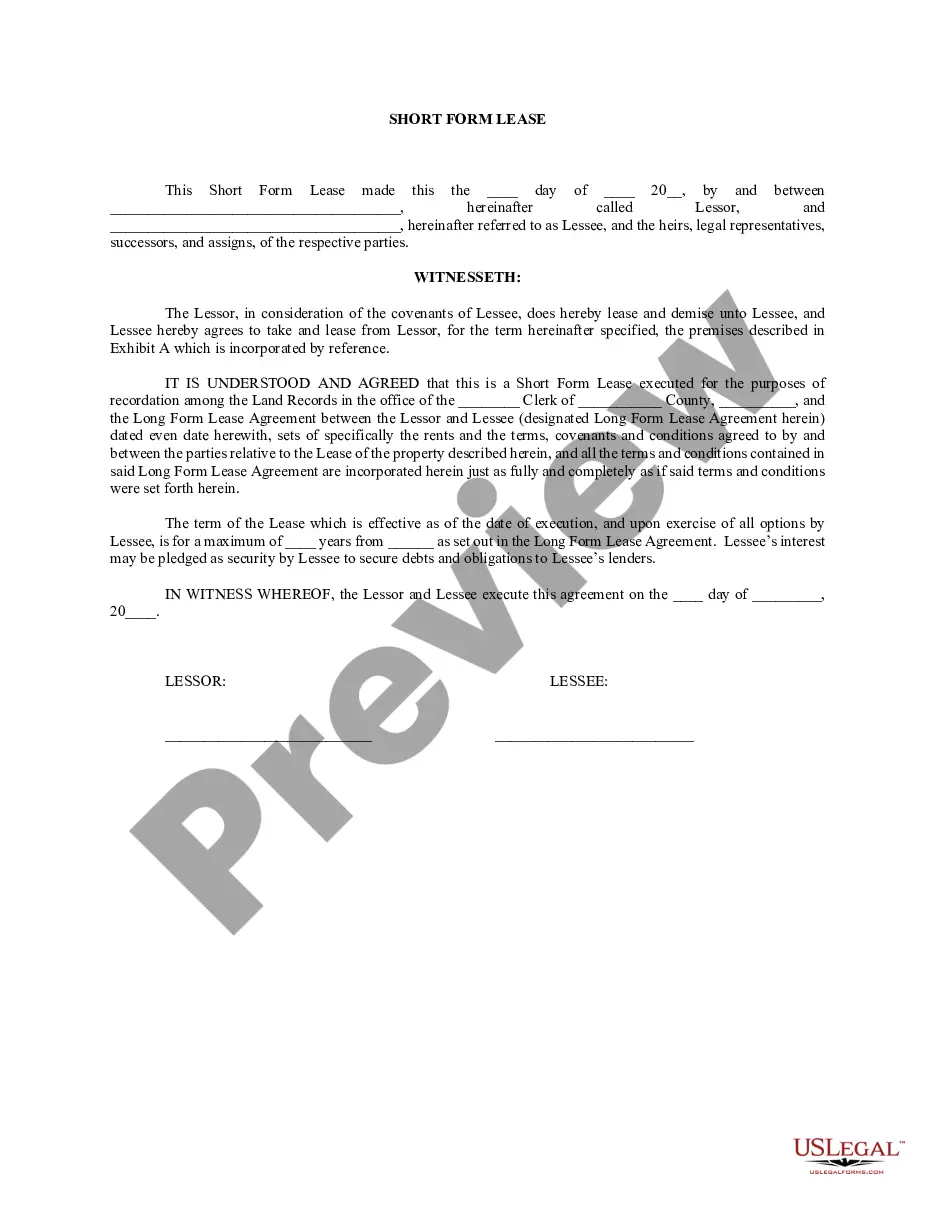
Long Term Lease For In Franklin
Description
Get your form ready online
Our built-in tools help you complete, sign, share, and store your documents in one place.
Make edits, fill in missing information, and update formatting in US Legal Forms—just like you would in MS Word.
Download a copy, print it, send it by email, or mail it via USPS—whatever works best for your next step.
Sign and collect signatures with our SignNow integration. Send to multiple recipients, set reminders, and more. Go Premium to unlock E-Sign.
If this form requires notarization, complete it online through a secure video call—no need to meet a notary in person or wait for an appointment.
We protect your documents and personal data by following strict security and privacy standards.

Make edits, fill in missing information, and update formatting in US Legal Forms—just like you would in MS Word.

Download a copy, print it, send it by email, or mail it via USPS—whatever works best for your next step.

Sign and collect signatures with our SignNow integration. Send to multiple recipients, set reminders, and more. Go Premium to unlock E-Sign.

If this form requires notarization, complete it online through a secure video call—no need to meet a notary in person or wait for an appointment.

We protect your documents and personal data by following strict security and privacy standards.
Looking for another form?







Form popularity
FAQ
Short-term rental regulations Franklin, Tennessee requires short term rental hosts to obtain a permit from the City Planning Department and to comply with certain regulations, such as limits on the number of guests and the frequency of rentals. Hosts must also collect and remit a hotel occupancy tax to the state.
Definition: A short-term lease is any lease with a term that's 12 months or less, including options to extend, with or without a reasonable certainty of being exercised.
Key Features of Long-Term Leases These leases typically extend beyond 5 years and can last up to 25 years or more. While these often require more front-end legal work, they offer tenants more certainty.
Generally, a tenant renting on shorter term contract (such as an AST) can be evicted without the landlord needing to prove a fault based ground for possession. In comparison, a leaseholder on a longer form contract has the rights to remain in the property for the full term assuming the lease is not breached.
What's the Difference Between Short-Term Leases and Long-Term Leases? A short-term lease agreement lasts anywhere from three to six months, or can go month-to-month until the tenant decides to move out. Long-term leases are anything longer than six months and can go up to 15 months before needing to make a new lease.
Long-term leases refer to leasing arrangements that are longer than one year. These leases require an extended commitment from the landlord and tenant, ensuring a stable and predictable tenancy arrangement for an extended period.
Limited Flexibility- Long-term leases aren't suitable for everyone, like those with uncertain future plans or frequent relocations. Long-Term Commitment- Committing to a longer lease can limit options if circumstances change unexpectedly.
In order to record the lease liability on the balance sheet, we need to know these 3 factors: Determine the lease term. Verify the lease payment. Know the discount rate that will be used to discount the lease liability.
The new lease accounting standard requires nearly all leases with terms that exceed one year to be recorded on the balance sheet as “right of use” assets with corresponding lease liabilities for the present value of future lease payments.
In the law of several US states, a 99-year lease will always be the longest possible contract for realty by statute, but many states have enacted shorter terms and some allow infinite terms.
