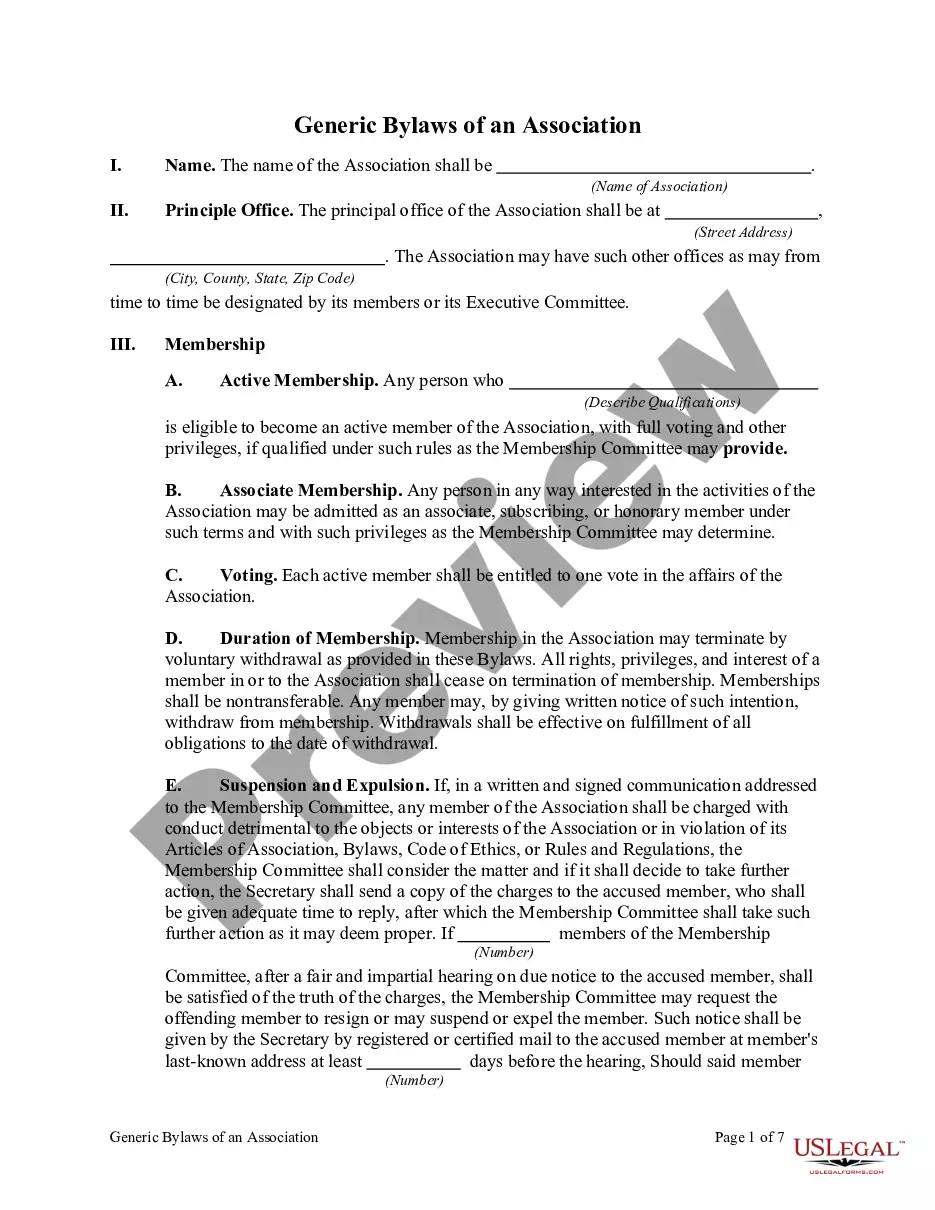
Hoa By Bylaws In Clark
Description


Get your form ready online
Our built-in tools help you complete, sign, share, and store your documents in one place.
Make edits, fill in missing information, and update formatting in US Legal Forms—just like you would in MS Word.
Download a copy, print it, send it by email, or mail it via USPS—whatever works best for your next step.
Sign and collect signatures with our SignNow integration. Send to multiple recipients, set reminders, and more. Go Premium to unlock E-Sign.
If this form requires notarization, complete it online through a secure video call—no need to meet a notary in person or wait for an appointment.
We protect your documents and personal data by following strict security and privacy standards.

Make edits, fill in missing information, and update formatting in US Legal Forms—just like you would in MS Word.

Download a copy, print it, send it by email, or mail it via USPS—whatever works best for your next step.

Sign and collect signatures with our SignNow integration. Send to multiple recipients, set reminders, and more. Go Premium to unlock E-Sign.

If this form requires notarization, complete it online through a secure video call—no need to meet a notary in person or wait for an appointment.

We protect your documents and personal data by following strict security and privacy standards.
Looking for another form?










Form popularity
FAQ
To create a homeowners' association, the initial board of directors or declarant must draft and adopt a community declaration. The declaration will include all the rules and regulations set forth by the association along with a map of all property within the community.
Although an HOA can't evict homeowners in the same way landlords can evict tenants, that doesn't mean homeowners are not totally safe from losing their homes. Depending on state laws and the governing documents, an HOA can foreclose on a homeowner's property.
Homeowners often ask whether local laws supersede the rules and regulations set forth by their homeowner association (HOA). The short answer is yes, local laws do supersede HOA rules.
Washington Uniform Common Interest Ownership Act (WUCIOA) Homeowners' associations in Washington are governed by the WUCIOA.
Once you buy a home that's part of an HOA, you automatically become a member of the HOA. HOA rules are legally binding, and you must adhere to all rules and regulations in the governing document. Yes, there are bylaws that you may not like, but there are no HOA loopholes.
There is no specific cap on the percentage by which HOA fees can increase annually in Nevada; however, increases should be reasonable, and advance notice must be provided to homeowners as specified in the governing documents or state law.
Federal and state laws regulate HOAs in Nevada, but it is the Nevada Real Estate Department that is ultimately responsible for maintaining the proper functioning of HOAs and their communities.
If a homeowner violates community regulations, the board of directors may implement a fine for each infraction up to $100 each totaling a maximum of $1,000. Fines may be higher for infractions that cause serious damage or pose a safety hazard. If an account becomes delinquent, an HOA may place liens on the property.
If a homeowner violates community regulations, the board of directors may implement a fine for each infraction up to $100 each totaling a maximum of $1,000. Fines may be higher for infractions that cause serious damage or pose a safety hazard. If an account becomes delinquent, an HOA may place liens on the property.
Many HOAs maintain a website where governing documents are posted. To find HOA rules and regulations online: Navigate to the HOA's official website. Look for sections labeled “Documents,” “Governing Documents,” or “Rules and Regulations.”
