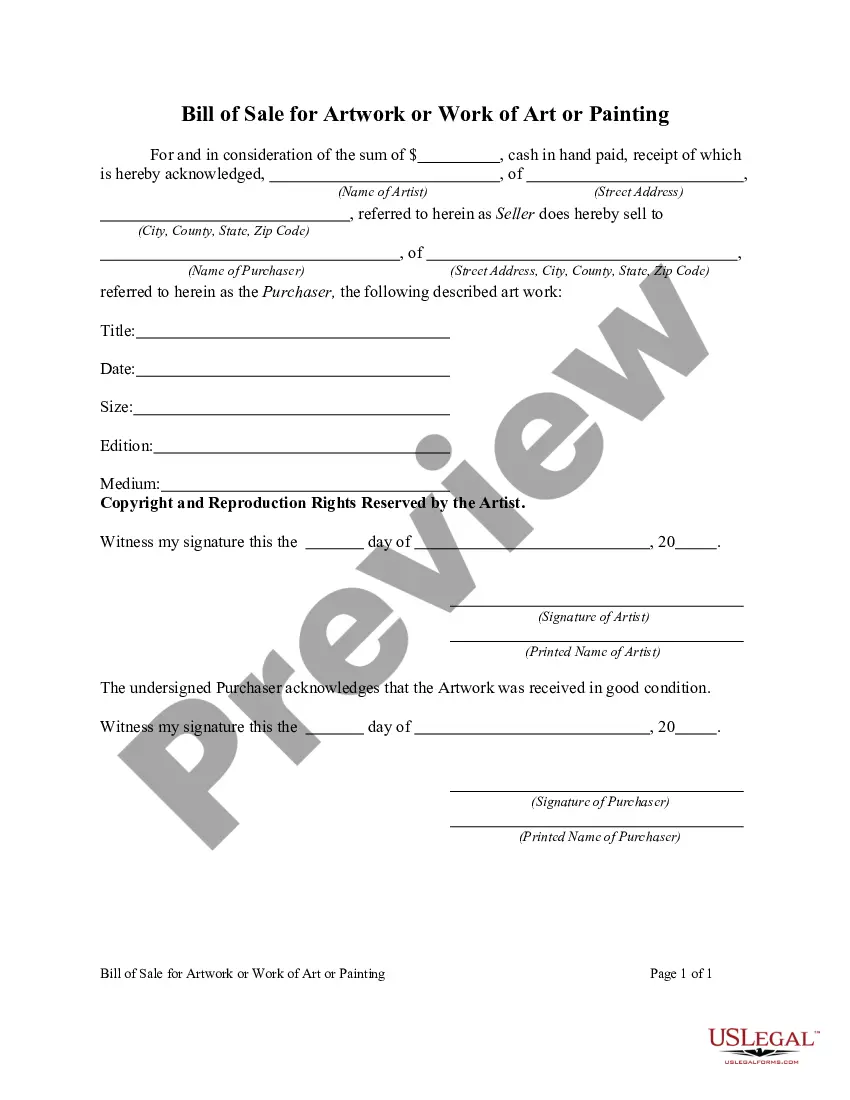
Bill Sale Art Sample For Job In Collin
Description
Get your form ready online
Our built-in tools help you complete, sign, share, and store your documents in one place.
Make edits, fill in missing information, and update formatting in US Legal Forms—just like you would in MS Word.
Download a copy, print it, send it by email, or mail it via USPS—whatever works best for your next step.
Sign and collect signatures with our SignNow integration. Send to multiple recipients, set reminders, and more. Go Premium to unlock E-Sign.
If this form requires notarization, complete it online through a secure video call—no need to meet a notary in person or wait for an appointment.
We protect your documents and personal data by following strict security and privacy standards.

Make edits, fill in missing information, and update formatting in US Legal Forms—just like you would in MS Word.

Download a copy, print it, send it by email, or mail it via USPS—whatever works best for your next step.

Sign and collect signatures with our SignNow integration. Send to multiple recipients, set reminders, and more. Go Premium to unlock E-Sign.

If this form requires notarization, complete it online through a secure video call—no need to meet a notary in person or wait for an appointment.

We protect your documents and personal data by following strict security and privacy standards.
Looking for another form?


Form popularity
FAQ
Ask questions at an opening, or an event, or a party about the current artists show, about the gallery, and show that you understand what the dealer or staff are trying to do. Let them know that you like it. Do all of this before you broach the subject of your own work.
To get gallery representation, build a strong portfolio, research galleries aligned with your style, and submit a well-crafted proposal. Networking at art events helps. Artists can represent themselves by creating a website, engaging on social media, and directly approaching buyers or exhibiting in independent shows.
I would recommend introducing yourself as an artist and have a portfolio ready. Be respectful and let them know you are seeking representation, ask about possible opportunities, and if they would like to see a portfolio, show them. Most galleries in my experience have waitlists, but this is normal.
On your invoice, you should include: Your details. Your business name and address. Your buyer's details. Your buyer's name and address. Information about the artwork. Separate line items for each product or service delivered. Information about the payment terms. Your hourly rate, if relevant.
I would recommend introducing yourself as an artist and have a portfolio ready. Be respectful and let them know you are seeking representation, ask about possible opportunities, and if they would like to see a portfolio, show them. Most galleries in my experience have waitlists, but this is normal.
Offer Special Promotions and Incentives: To attract potential buyers and generate interest in your artwork, consider offering special promotions, discounts, or incentives. Host online sales events, limited-time offers, or exclusive previews for your loyal followers and subscribers.
Typical commission rates for art galleries range anywhere between 30% and 60%, with the industry average being 50%.
How To Describe Your Art Stand in Their Shoes First. Before you start talking too much about how elegant your composition is, understand your audience. Bring Out the Touch and Feel of Your Work. Leave Your Ego at Home. Make Your Words Lively. Keep It Simple.
Invoices should contain information about: you the artist. your billing address. your client or customer. their taxable address. your tax reference code (UTR - unique tax reference code if in the UK) the tax date for the product or service rendered. description of the artwork provided or artistic service rendered.
A strong artist's statement, whether it's written on a wall label or simply the way you talk about your work, is the best way I know how to sell your art. Be ready to talk about your work, and share your passion for it when you do. Tell a story, take them on a journey.