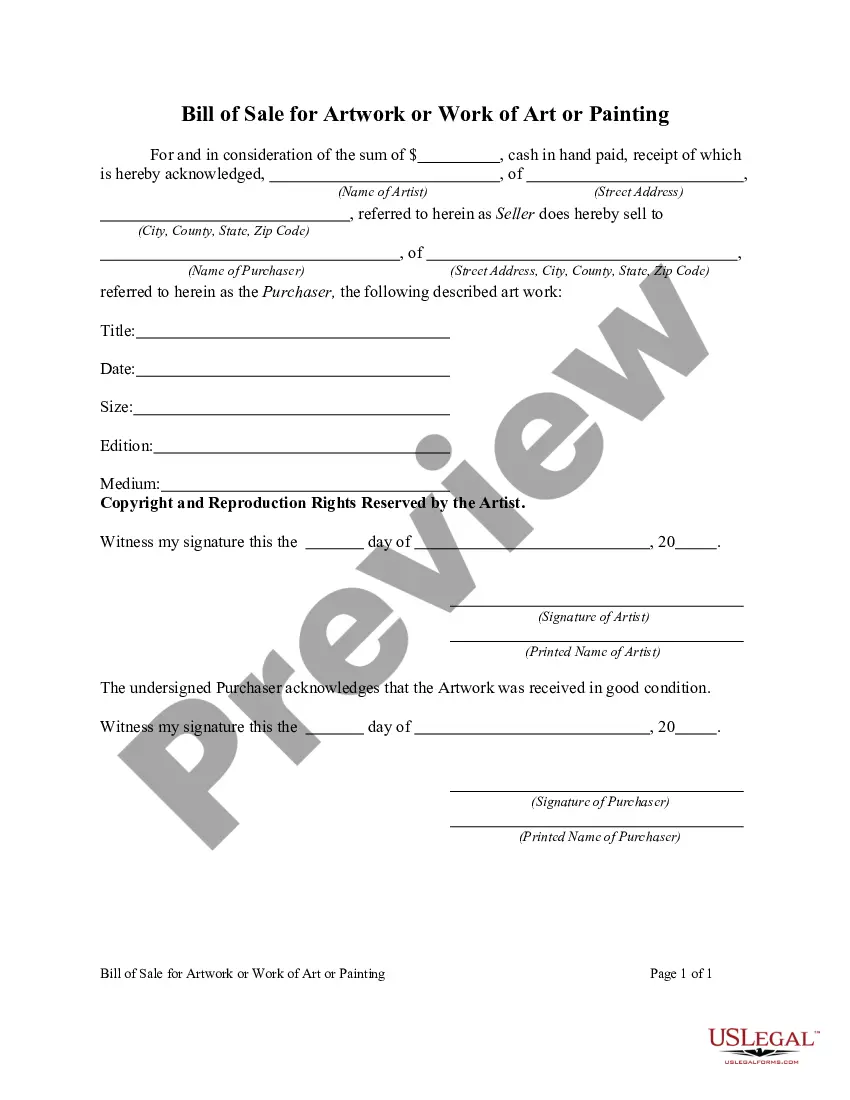
Bill Sale Art Sample Without Permission In Chicago
Description
Get your form ready online
Our built-in tools help you complete, sign, share, and store your documents in one place.
Make edits, fill in missing information, and update formatting in US Legal Forms—just like you would in MS Word.
Download a copy, print it, send it by email, or mail it via USPS—whatever works best for your next step.
Sign and collect signatures with our SignNow integration. Send to multiple recipients, set reminders, and more. Go Premium to unlock E-Sign.
If this form requires notarization, complete it online through a secure video call—no need to meet a notary in person or wait for an appointment.
We protect your documents and personal data by following strict security and privacy standards.

Make edits, fill in missing information, and update formatting in US Legal Forms—just like you would in MS Word.

Download a copy, print it, send it by email, or mail it via USPS—whatever works best for your next step.

Sign and collect signatures with our SignNow integration. Send to multiple recipients, set reminders, and more. Go Premium to unlock E-Sign.

If this form requires notarization, complete it online through a secure video call—no need to meet a notary in person or wait for an appointment.

We protect your documents and personal data by following strict security and privacy standards.
Looking for another form?







Form popularity
FAQ
It is illegal. Once any piece of work is created, it is automatically copyrighted. This includes art, photography, music, etc. You have to have the creator's written permission before you use it anyway at all. If you want more information, you can search for copyright infringement.
Additionally, it is important to find out if another person is profiting off of your work or not. If the work is clearly plagiarized and they are using it to their advantage, it is highly recommended you pursue legal action for art theft.
Copyright law is a form of intellectual property that protects the unique expression of ideas, empowering artists to control how their work is used. If you're looking to reproduce an artist's work, you'll need permission from the copyright owner in the form of a license.
The first words out of your mouth should be “thank you… thank you for appreciating and purchasing the art that I create”…or something in a similar vein.
Consult with an attorney who specializes in intellectual property law to understand your rights and legal options. They can guide you through the process of sending cease and desist letters, filing copyright infringement claims, or taking other appropriate legal actions to protect your work.
They can perhaps claim ownership over the physical work of art. But that does not confer ownership of the copyright to that work, That can only be transferred by a written document, explicitly saying so, signed by the copyright owner or the owner's agent, under US law.
Copying a painting for personal use is typically legal, as long as you do not intend to sell or distribute the reproduction. Personal use implies that the copy is for private enjoyment and not for profit. However, public display or sale could breach copyright laws, even for personal reproductions.
Contact the Infringing Parties: Reach out to the individuals or businesses selling your artwork without permission. Be professional and clear in your communication, explaining the infringement, providing your copyright registration number if applicable, and requesting the immediate removal of the infringing listings.
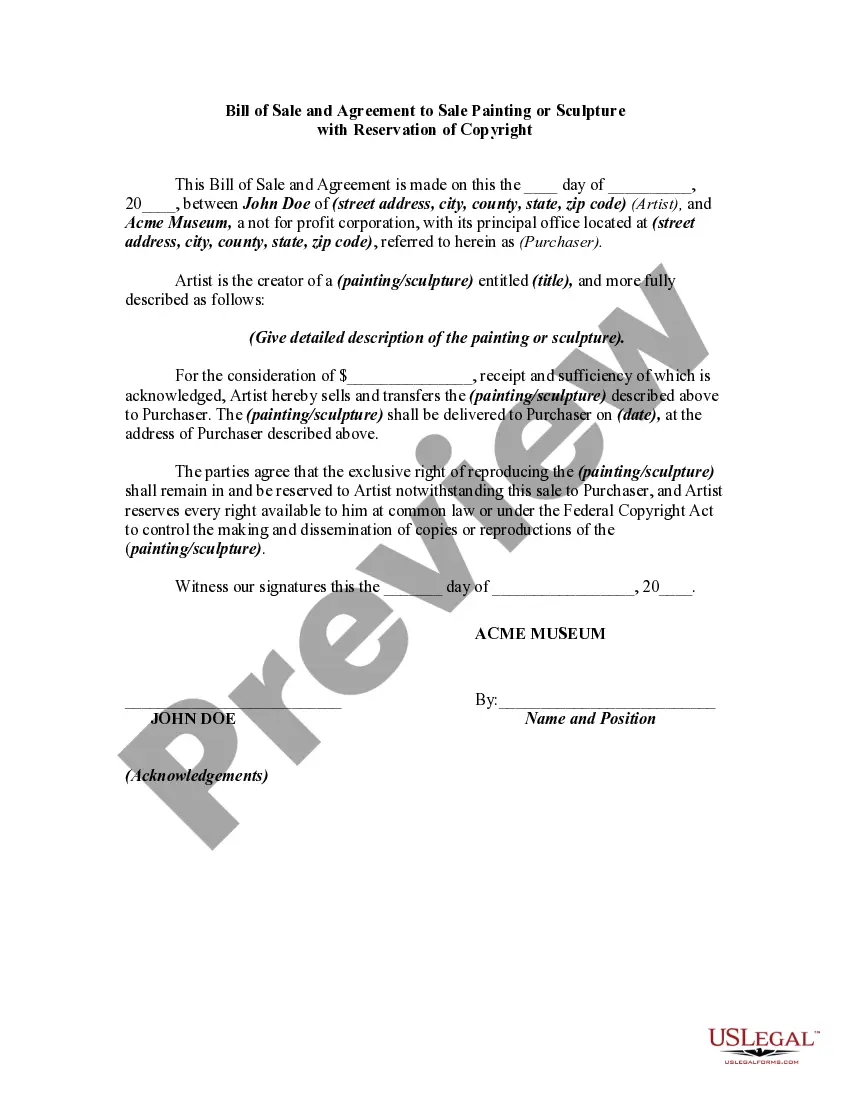
Illinois doesn't require notarization for a bill of sale. However, it should include both the new owner and previous owner's, and the seller's report should be accurate for the document to be considered valid.
Artist's Bill of Sale Date of sale and invoice number. Invoice numbers can be used as a unique reference ID and will prove very helpful should you need to quickly find the documentation later. Artist's contact information. Buyer's contact information. Artwork sold. Subtotal. Taxes. Other charges. Total.