Contingency Lawyer For Defamation In North Carolina
Description





Get your form ready online
Our built-in tools help you complete, sign, share, and store your documents in one place.
Make edits, fill in missing information, and update formatting in US Legal Forms—just like you would in MS Word.
Download a copy, print it, send it by email, or mail it via USPS—whatever works best for your next step.
Sign and collect signatures with our SignNow integration. Send to multiple recipients, set reminders, and more. Go Premium to unlock E-Sign.
If this form requires notarization, complete it online through a secure video call—no need to meet a notary in person or wait for an appointment.
We protect your documents and personal data by following strict security and privacy standards.

Make edits, fill in missing information, and update formatting in US Legal Forms—just like you would in MS Word.

Download a copy, print it, send it by email, or mail it via USPS—whatever works best for your next step.

Sign and collect signatures with our SignNow integration. Send to multiple recipients, set reminders, and more. Go Premium to unlock E-Sign.

If this form requires notarization, complete it online through a secure video call—no need to meet a notary in person or wait for an appointment.

We protect your documents and personal data by following strict security and privacy standards.
Looking for another form?
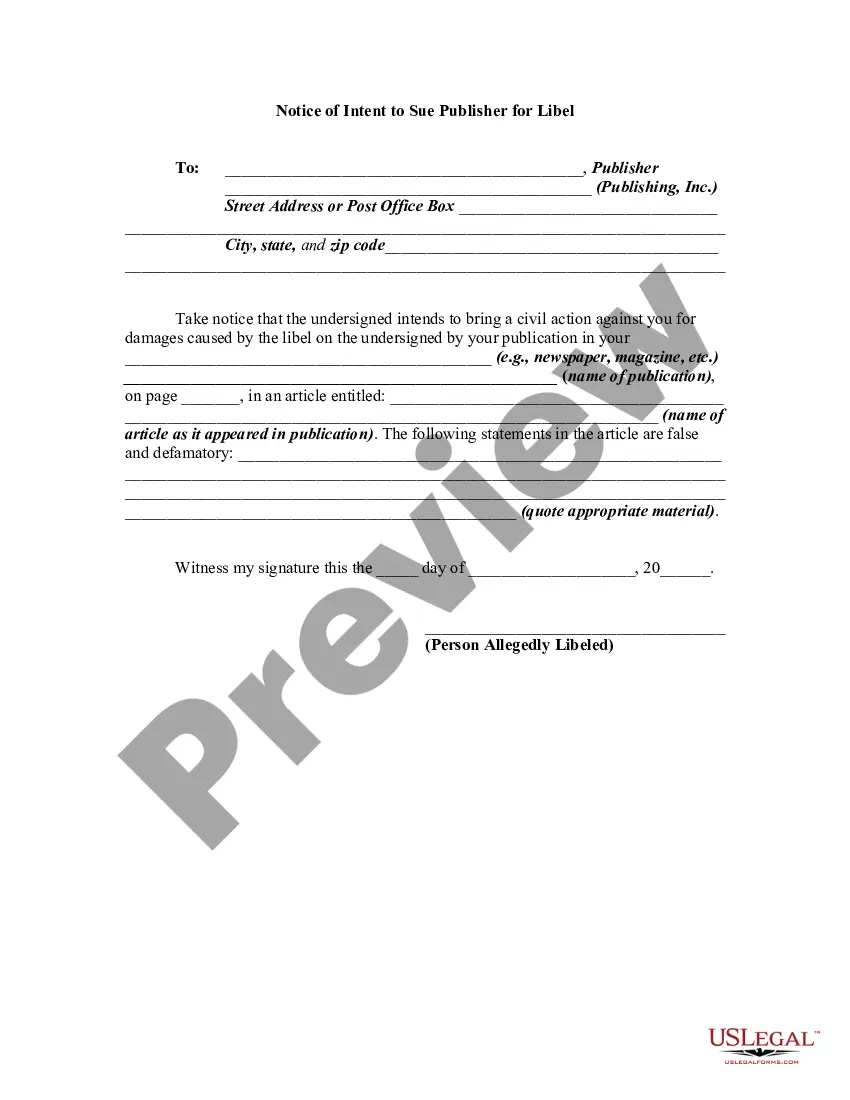

Form popularity
FAQ
The statement must be untrue and presented as a factual claim rather than an opinion to be defamation. Additionally, there must be evidence that the statement caused or has the potential to cause significant damage to the reputation of the individual or entity targeted.
Once you have decided that you want to file a grievance with the North Carolina State Bar, it is easy to get started. Just fill out a State Bar grievance form or send us a letter describing the problem. You can get a grievance form by clicking here or by calling our office at 919-828-4620.
Truth is an absolute defence to defamation. The defendant must prove that the defamatory statements were, in fact, true. For instance, if the statements concern the quality of goods or services, the defendant could provide independent testing or other evidence supporting the truth of the claims.
To prevail on a defamation claim, a plaintiff must establish the following: That the defendant made a defamatory statement to a third person; That the statement was false; That the defendant was legally at fault in making the statement, and.
In North Carolina, a successful claim for defamation, whether it be under libel or slander, requires the plaintiff to prove four main elements: (1) the statements are false; (2) the statements concern the plaintiff; (3) the statements were published to a third person; and (4) the statements caused injury to the ...
Most defamation cases are filed in North Carolina's Superior Court, which hears lawsuits where the plaintiff is asking for more than $25,000 in damages from the defendant. If a libel or slander plaintiff is asking for $25,000 or less, they can sue in the state's District Court.
The plaintiff must allege that: (1) the defendant caused injury to the plaintiff's reputation; (2) the defendant made a false, defamatory statement; (3) the statement was of or concerning the plaintiff; and (4) the statement was published to a third party.
The statement must be untrue and presented as a factual claim rather than an opinion to be defamation. Additionally, there must be evidence that the statement caused or has the potential to cause significant damage to the reputation of the individual or entity targeted.
If you believe that you have a case for defamation, it is important to act quickly. The statute of limitations in North Carolina mandates that a defamation claim must be brought within one year of the publication of the defamatory statements.
