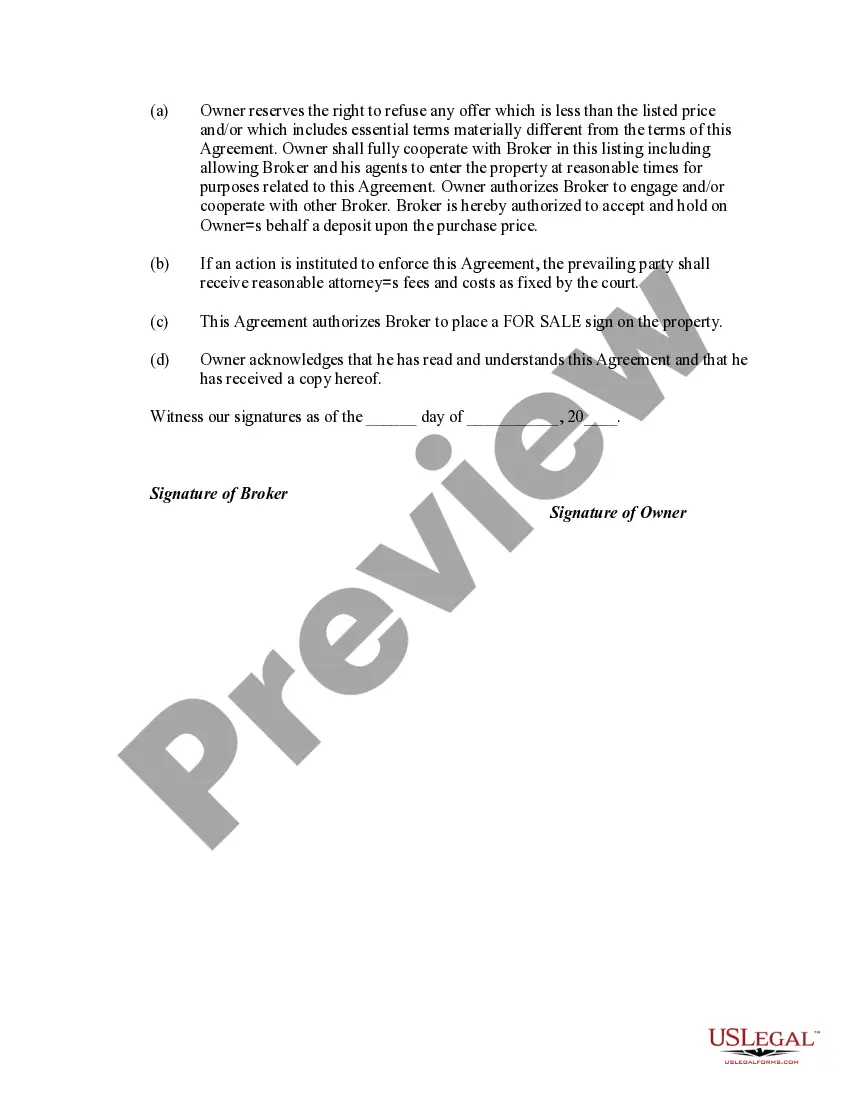
Listing Agreement For Unimproved Property In Washington
Description


Get your form ready online
Our built-in tools help you complete, sign, share, and store your documents in one place.
Make edits, fill in missing information, and update formatting in US Legal Forms—just like you would in MS Word.
Download a copy, print it, send it by email, or mail it via USPS—whatever works best for your next step.
Sign and collect signatures with our SignNow integration. Send to multiple recipients, set reminders, and more. Go Premium to unlock E-Sign.
If this form requires notarization, complete it online through a secure video call—no need to meet a notary in person or wait for an appointment.
We protect your documents and personal data by following strict security and privacy standards.

Make edits, fill in missing information, and update formatting in US Legal Forms—just like you would in MS Word.

Download a copy, print it, send it by email, or mail it via USPS—whatever works best for your next step.

Sign and collect signatures with our SignNow integration. Send to multiple recipients, set reminders, and more. Go Premium to unlock E-Sign.

If this form requires notarization, complete it online through a secure video call—no need to meet a notary in person or wait for an appointment.

We protect your documents and personal data by following strict security and privacy standards.
Looking for another form?


Form popularity
FAQ
The Act (codified as RCW 49.44. 211) makes it illegal for employers in an agreement to prohibit employees from discussing conduct the employee reasonably believed to be an illegal act of discrimination, harassment, retaliation, wage and hour violation, or sexual assault.
Washington State requires sellers of residential real property to thoroughly disclose material facts on a form called the Residential Real Property Disclosure Statement (often referred to as Form 17).
Most seller property disclosures are required for residential properties and vacant land. This means that when selling a residential property, the seller is legally obligated to disclose any known defects or issues with the property to potential buyers.
Homeowners are required to disclose any mold issues during a sale. § 339.730. 1. This states that an agent must disclose to any potential buyer all adverse material facts actually known or that should have been known by the agent.
Nearly all real estate sales in Washington State require a seller disclosure statement, also known as Form 17, to be given to the buyer.
And their agents understand their rights. And responsibilities the ment is more than just aMoreAnd their agents understand their rights. And responsibilities the ment is more than just a formality. It's a crucial step in the home buying.
The history of a concept known as "caveat emptor" (or, "buyer beware") in real estate transactions led many states, including Washington in 1994, to pass laws mandating that sellers provide disclosures about all aspects of the property. You'll find these beginning at Revised Washington Code (RCW) § 64.06. 005.
Now, under the newly adopted law, it is a gross misdemeanor to knowingly have or use illegal drugs in public. Providing a referral or diversion option is no longer required, although officers have discretion in this regard, based upon the totality of the circumstances.
What You Need to Know about the Washington State Seller Property Disclosure – Form 17. Washington State requires sellers of residential real property to thoroughly disclose material facts on a form called the Residential Real Property Disclosure Statement (often referred to as Form 17).
Washington law says that when you sell your home, you must fill out a Seller Disclosure Statement (also known as Form 17). You must tell the buyer any problems with the property that you know about.