Listing Agreement For Condominium In Travis
Description

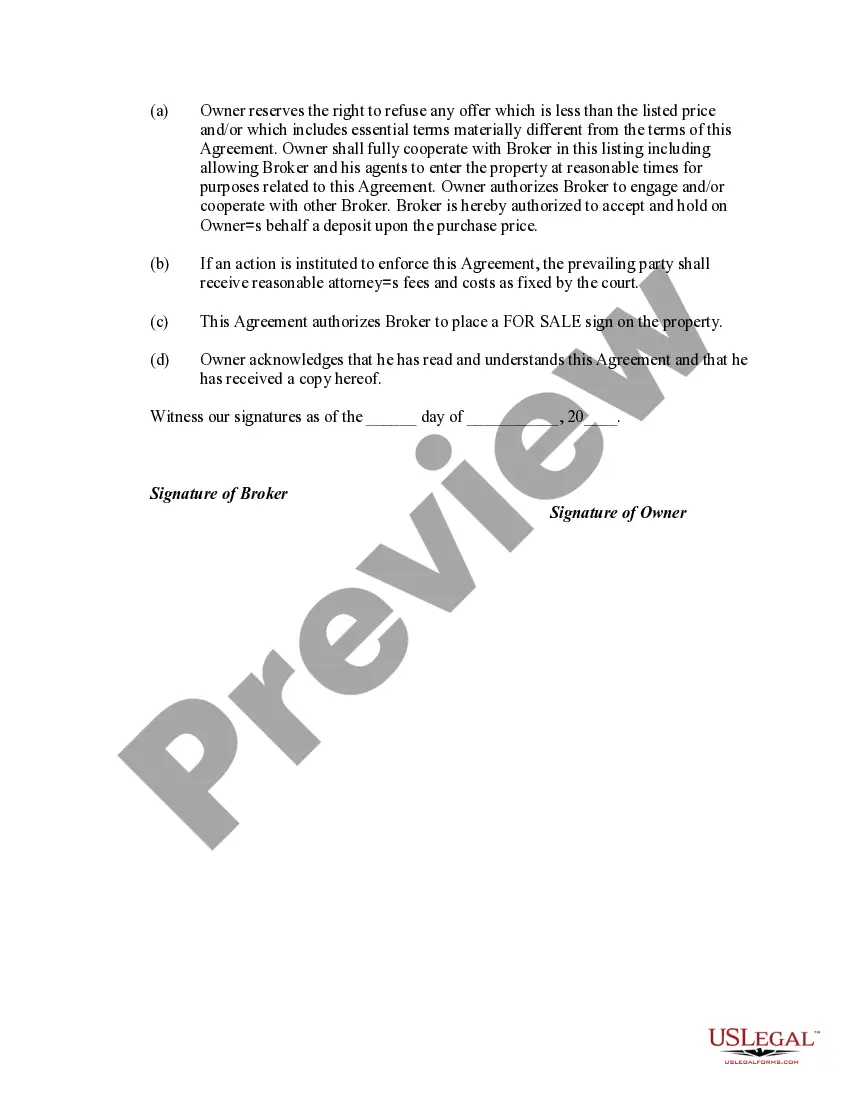

Get your form ready online
Our built-in tools help you complete, sign, share, and store your documents in one place.
Make edits, fill in missing information, and update formatting in US Legal Forms—just like you would in MS Word.
Download a copy, print it, send it by email, or mail it via USPS—whatever works best for your next step.
Sign and collect signatures with our SignNow integration. Send to multiple recipients, set reminders, and more. Go Premium to unlock E-Sign.
If this form requires notarization, complete it online through a secure video call—no need to meet a notary in person or wait for an appointment.
We protect your documents and personal data by following strict security and privacy standards.

Make edits, fill in missing information, and update formatting in US Legal Forms—just like you would in MS Word.

Download a copy, print it, send it by email, or mail it via USPS—whatever works best for your next step.

Sign and collect signatures with our SignNow integration. Send to multiple recipients, set reminders, and more. Go Premium to unlock E-Sign.

If this form requires notarization, complete it online through a secure video call—no need to meet a notary in person or wait for an appointment.

We protect your documents and personal data by following strict security and privacy standards.
Looking for another form?
Form popularity
FAQ
Exclusive Right of Sale Listing Agreement Transaction Broker (ERS-20tb). This is a listing agreement in which the seller grants the listing broker the sole right to list the property and establishes that the broker has a transaction broker agency relationship with the seller.
Often, smaller, less valuable transactions, or short-term services, may not require a written agreement at all. Depending on your comfort level, however, a written agreement can make sure both buyer and seller are on the same page.
The "Exclusive Right to Sell" is the most common, but there is the "open listing," the "exclusive agency listing," and the "one-time show." The "open listing" is mostly used by people trying to sell their home by owner who are also willing to work with real estate agents.
Contract Formation: A listing agreement is a contract for services. It is not required to be in writing in order for it to be enforceable.
This Practice Note considers the specific situations where a contract is required by law to be in writing: assignments, contracts for the sale of land, equitable mortgages, assents, transfers of shares, transfers of intellectual property rights, and guarantees.
How to Terminate a Listing Agreement Step 1 – Have You Chosen a New Agent? ... Step 2 – Contact Your Current Agent or Broker. Step 2 – Execute a Listing Termination Agreement. Step 3 – Listing is Withdrawn From the MLS. Step 4 – New Photos & Marketing. Step 5 – New Listing Goes Active in the MLS.
The seller can back out for reasons written into the contract, including (but not limited to) contingencies. The buyer is in breach of the contract. If the buyer is “failing to perform” — a legal term meaning that they're not holding up their side of the contract — the seller can likely get out of the contract.
The simplest way to terminate a listing agreement is through mutual consent. If both you and your agent agree to part ways, you can cancel the agreement without penalties. Make sure to document this agreement in writing, as it will serve as evidence in case of any disputes later on.
The cancellation provisions are found in Paragraphs 14C (1) and (2), and in Paragraph 14E of the CA-RPA. Regardless of the reason, the seller must give some type of notice to the buyer, however (either a Notice to Perform or a Demand to Close Escrow) before the seller can cancel.
This legal document outlines the terms between a property owner and a real estate broker or agent, detailing what they can expect from each other during the process of selling a property. Let's explore what a listing agreement involves, the different types available, and why it's important for both parties involved.