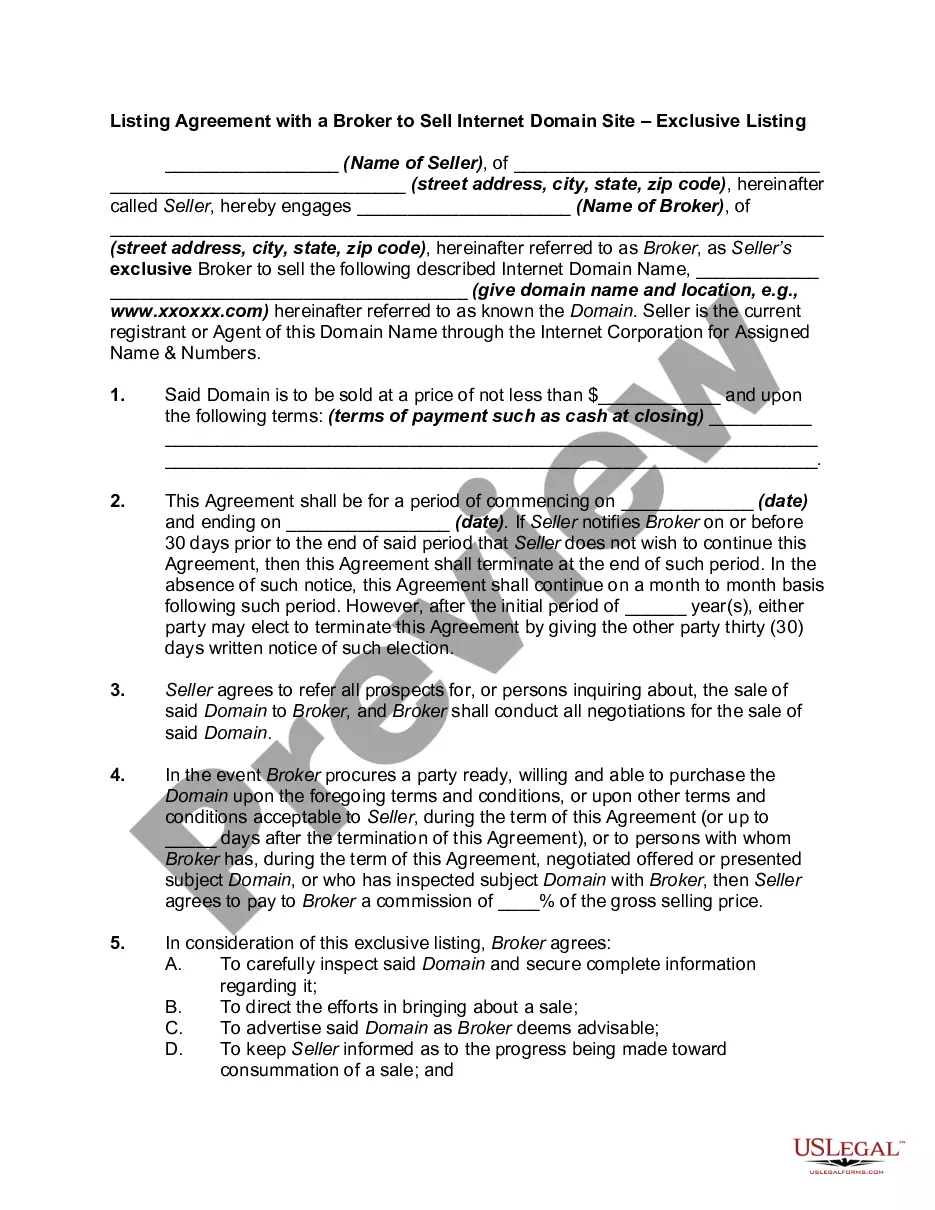
Listing Agreement Commercial With No Brokerage Representation In Chicago
Description


Get your form ready online
Our built-in tools help you complete, sign, share, and store your documents in one place.
Make edits, fill in missing information, and update formatting in US Legal Forms—just like you would in MS Word.
Download a copy, print it, send it by email, or mail it via USPS—whatever works best for your next step.
Sign and collect signatures with our SignNow integration. Send to multiple recipients, set reminders, and more. Go Premium to unlock E-Sign.
If this form requires notarization, complete it online through a secure video call—no need to meet a notary in person or wait for an appointment.
We protect your documents and personal data by following strict security and privacy standards.

Make edits, fill in missing information, and update formatting in US Legal Forms—just like you would in MS Word.

Download a copy, print it, send it by email, or mail it via USPS—whatever works best for your next step.

Sign and collect signatures with our SignNow integration. Send to multiple recipients, set reminders, and more. Go Premium to unlock E-Sign.

If this form requires notarization, complete it online through a secure video call—no need to meet a notary in person or wait for an appointment.

We protect your documents and personal data by following strict security and privacy standards.
Looking for another form?







Form popularity
FAQ
There are four common types of listings: open listings, exclusive right-to-sell listings, exclusive agency listings, and net listings. Open listing agreement. An open listing is a non-exclusive contract. Exclusive right to sell listing agreement. Exclusive agency listing agreement. Net listing agreement.
An open listing is a non-exclusive agreement where the property seller retains the right to sell independently without owing commission. To have an open listing, the seller grants permission for an agent to offer the property for sale, but does not guarantee compensation if procuring their own buyer.
Alternatively, a non-exclusive buyer agreement does not lock you into a long-term commitment with an agent, or it allows you to work with more than one agent. You might decide to work with two or more agents if you're searching for homes in two different cities.
Final answer: The Exclusive Right of Sale listing is the best option to protect a broker's compensation as it gives them exclusive rights to represent the seller and earn a commission, regardless of who brings the buyer.
The disadvantage of of a non-exclusive agreement is that agents are more likely to put your needs behind those of their clients who have signed exclusive buyer brokerage agreements with them. What does the Exclusive Buyer Brokerage Agreement state about dual agency?
An exclusive right to sell agreement gives one real estate agent and their brokerage the sole right to market and sell a property. That agent is guaranteed a commission on the sale as long as it occurs during the duration of the contract, even if they did not bring in the buyer.
4 Common Types of Listing Agreements in Real Estate Open listing agreement. An open listing is a non-exclusive contract. Exclusive right to sell listing agreement. An exclusive right to sell listing is the most widely-used listing agreement. Exclusive agency listing agreement. Net listing agreement.
Exclusive agreements limit a party's ability to work with another, meaning that the exclusive party offers services or products not provided elsewhere. Non-exclusive indicates that the non-exclusive party can work with anyone, including employees, competing products, and customers.
Buyer-Broker Agreement: A legally binding contract that ensures your real estate agent is fully committed to representing your best interests. Transparency & Protection: The agreement outlines responsibilities, clarifies expectations, compensation, and ensures your agent works in your best interest.
