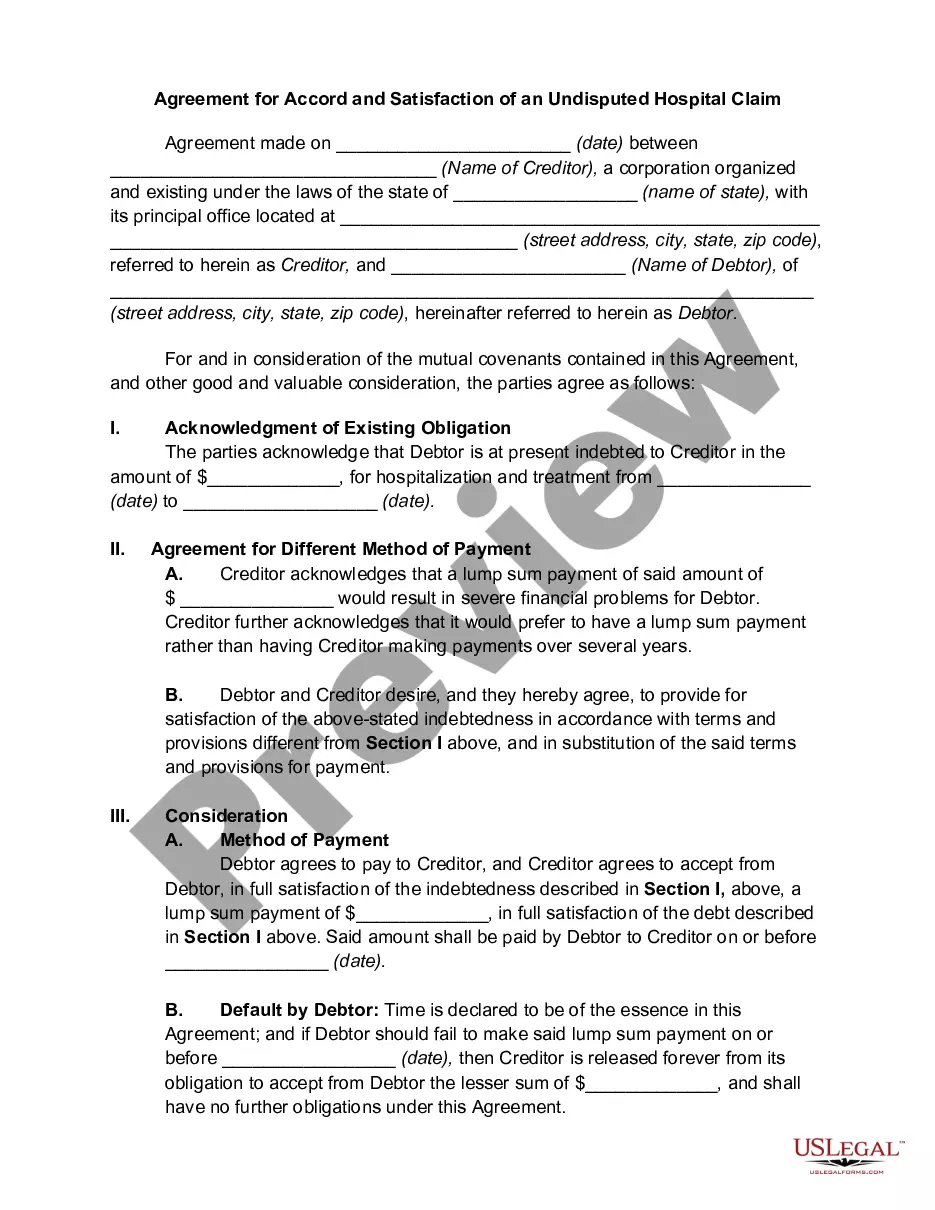
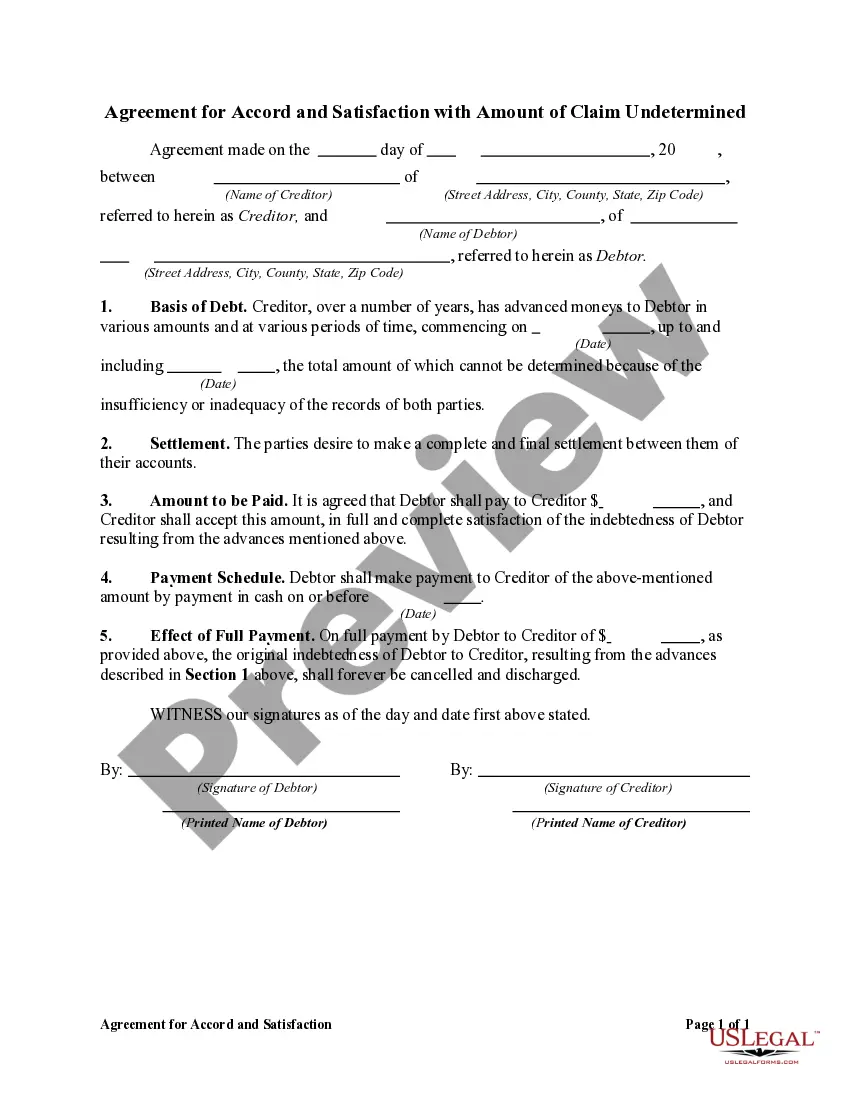
Satisfaction Agreement Form In Kings
Description

Get your form ready online
Our built-in tools help you complete, sign, share, and store your documents in one place.
Make edits, fill in missing information, and update formatting in US Legal Forms—just like you would in MS Word.
Download a copy, print it, send it by email, or mail it via USPS—whatever works best for your next step.
Sign and collect signatures with our SignNow integration. Send to multiple recipients, set reminders, and more. Go Premium to unlock E-Sign.
If this form requires notarization, complete it online through a secure video call—no need to meet a notary in person or wait for an appointment.
We protect your documents and personal data by following strict security and privacy standards.

Make edits, fill in missing information, and update formatting in US Legal Forms—just like you would in MS Word.

Download a copy, print it, send it by email, or mail it via USPS—whatever works best for your next step.

Sign and collect signatures with our SignNow integration. Send to multiple recipients, set reminders, and more. Go Premium to unlock E-Sign.

If this form requires notarization, complete it online through a secure video call—no need to meet a notary in person or wait for an appointment.

We protect your documents and personal data by following strict security and privacy standards.
Looking for another form?
Form popularity
FAQ
Students who do not achieve the qualifying mark will be reassessed in all components of assessment of the module. The final module mark will be capped at the relevant pass mark.
Achieved a pass mark in all core modules and in a minimum of 90 credits overall.
What's the pass mark for a module? To pass a module at undergraduate level (S, 4, 5 or 6) you will need to achieve a module mark of 40% as well as the minimum component mark specified by the Course Regulations. To pass a postgraduate module the module pass mark is 50%.
Most Common ScaleGrade DescriptionDivision 60.00 - 64.99 Second Class Honours Upper Division 50.00 - 59.99 Second Class Honours Lower Division 45.00 - 49.99 Third class 40.00 - 44.99 Pass 5 more rows
Pass marks (and therefore capped marks) stay at 40% (UG, Pre-UG) and 50% (PG).
Satisfaction is the fulfillment of an obligation . The term is often used in the context of contract law when one performs their duties under the contract. The term is also often found in the context of judgments in determining whether a party discharged their liability from a judgment.
If the lender agrees to reduce the closing costs by an extra $1000 and the borrowers agree, then there has been an and satisfaction.
The element “” means an agreement to discharge the debt, while “satisfac- tion” denotes the execution of the agreement 1. A valid and satisfaction will discharge the debt in question.
: an accepted offer by which the parties agree that a specified future performance will discharge in full an obligation when performed even though the performance is of less value than the original obligation. also : the defense that an was agreed upon.
A 'pacte' suggests a less formal agreement which can be between various parties for strategic reasons. An '' is a general term for any agreement reached through negotiation and can be used in contexts ranging from international politics to everyday agreements.
