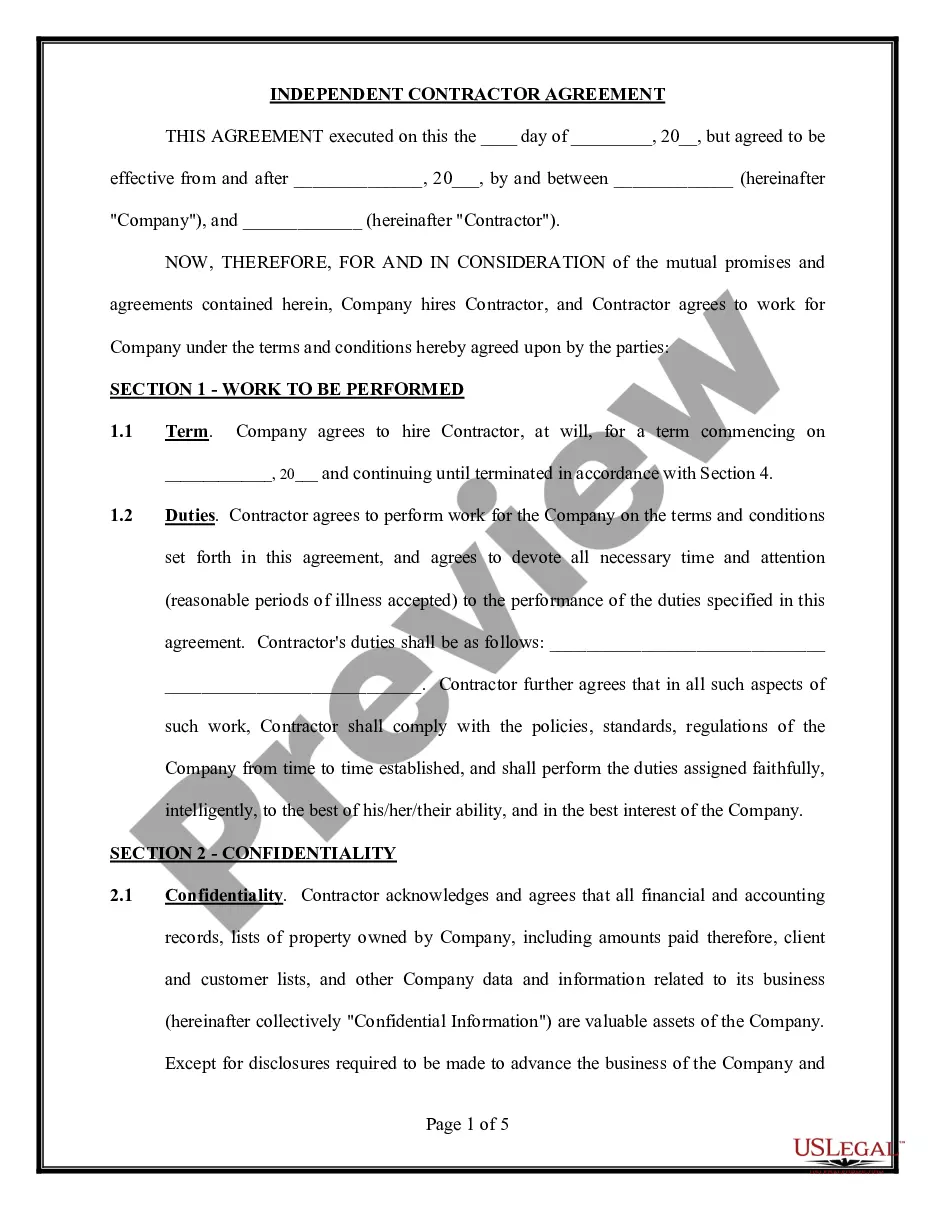
Independent Contractor Agreement Requirements In Minnesota
Description

Get your form ready online
Our built-in tools help you complete, sign, share, and store your documents in one place.
Make edits, fill in missing information, and update formatting in US Legal Forms—just like you would in MS Word.
Download a copy, print it, send it by email, or mail it via USPS—whatever works best for your next step.
Sign and collect signatures with our SignNow integration. Send to multiple recipients, set reminders, and more. Go Premium to unlock E-Sign.
If this form requires notarization, complete it online through a secure video call—no need to meet a notary in person or wait for an appointment.
We protect your documents and personal data by following strict security and privacy standards.

Make edits, fill in missing information, and update formatting in US Legal Forms—just like you would in MS Word.

Download a copy, print it, send it by email, or mail it via USPS—whatever works best for your next step.

Sign and collect signatures with our SignNow integration. Send to multiple recipients, set reminders, and more. Go Premium to unlock E-Sign.

If this form requires notarization, complete it online through a secure video call—no need to meet a notary in person or wait for an appointment.

We protect your documents and personal data by following strict security and privacy standards.
Looking for another form?






Form popularity
FAQ
You may be eligible for benefits some weeks while working in self-employment and not others. To be eligible for benefits for any week, you must meet three requirements: Work less than 32 hours (in any combination of employment, self-employment, or volunteer work) and earn less than your weekly benefit amount.
Minnesota's statute of repose prohibits suing a contractor for most construction defects after between 10-12 years after the home is substantially completed. First, the statute provides that a claim can be asserted only for causes of action that “accrue” during the 10 years after the home is substantially completed.
It is illegal for an employer to classify a worker as an independent contractor if the worker qualifies as an employee. An employer also cannot make a worker an independent contractor by having workers to sign a contract saying that they are independent contractors, when in reality they are employees.
Below are eight important points to consider including in an independent contractor agreement. Define a Scope of Work. Set a Timeline for the Project. Specify Payment Terms. State Desired Results and Agree on Performance Measurement. Detail Insurance Requirements. Include a Statement of Independent Contractor Relationship.
Independent contractors receive a Form 1099 for taxes while employees receive a Form W-2.
Form W-9. The IRS requires contractors to fill out a Form W-9, a request for a Taxpayer Identification Number and Certification, which you should keep on file for at least four years after the hiring. This form is used to request the correct name and Taxpayer Identification Number, or TIN, of the worker or their entity ...
Minnesota has a graduated state individual income tax, with rates ranging from 5.35 percent to 9.85 percent. Minnesota has a 9.8 percent corporate income tax rate. Minnesota also has a 6.875 percent state sales tax rate and an average combined state and local sales tax rate of 8.04 percent.
The total Minnesota self employment tax is 15.3%, divided into a Social Security amount of 12.4% and a Medicare amount of 2.9%.
You need to apply through Minnesota's Department of Labor and Industry. Every general contractor needs a residential building license and subcontractors need a license if they perform work in more than one area.
If there is any state tax withholding, you must file 1099 Forms directly with the state. If there is no state tax withholding, the IRS will automatically forward your federal 1099 forms to the state agency since Minnesota is part of the CF/SF program.
