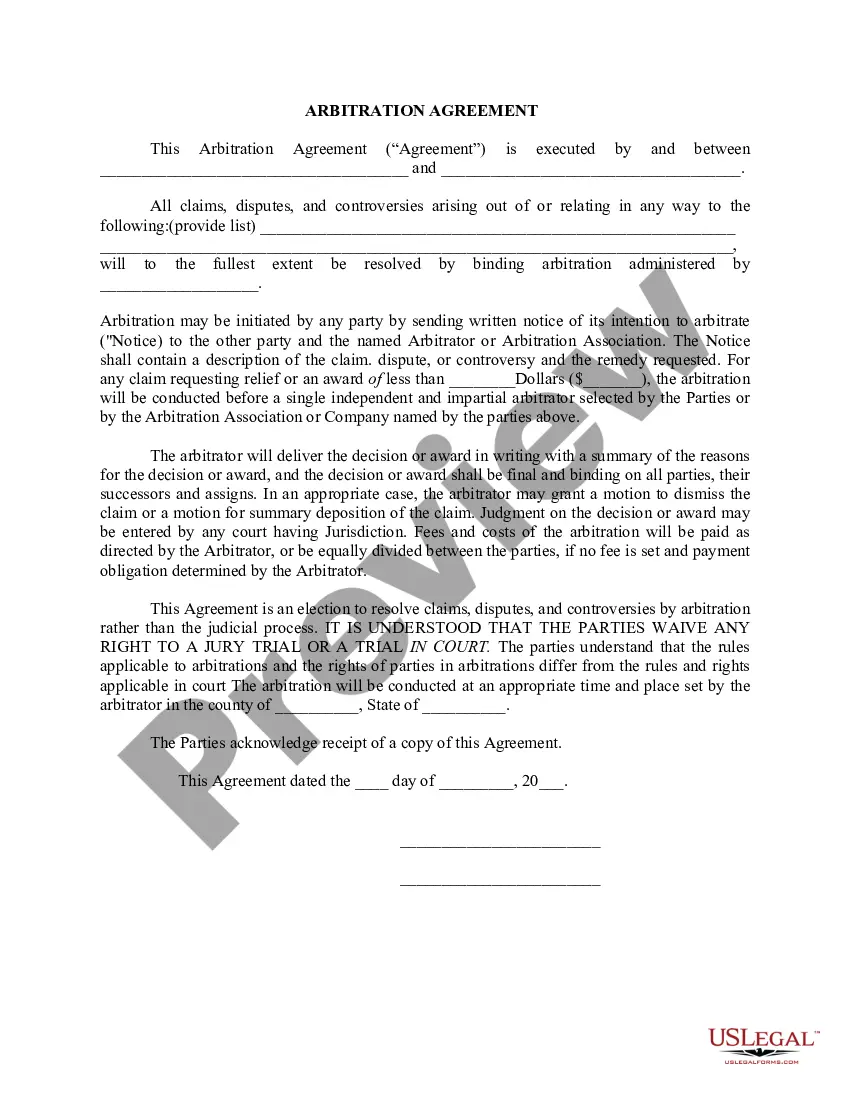
Arbitration In Dispute Resolution In Minnesota
Description

Get your form ready online
Our built-in tools help you complete, sign, share, and store your documents in one place.
Make edits, fill in missing information, and update formatting in US Legal Forms—just like you would in MS Word.
Download a copy, print it, send it by email, or mail it via USPS—whatever works best for your next step.
Sign and collect signatures with our SignNow integration. Send to multiple recipients, set reminders, and more. Go Premium to unlock E-Sign.
If this form requires notarization, complete it online through a secure video call—no need to meet a notary in person or wait for an appointment.
We protect your documents and personal data by following strict security and privacy standards.

Make edits, fill in missing information, and update formatting in US Legal Forms—just like you would in MS Word.

Download a copy, print it, send it by email, or mail it via USPS—whatever works best for your next step.

Sign and collect signatures with our SignNow integration. Send to multiple recipients, set reminders, and more. Go Premium to unlock E-Sign.

If this form requires notarization, complete it online through a secure video call—no need to meet a notary in person or wait for an appointment.

We protect your documents and personal data by following strict security and privacy standards.
Looking for another form?









Form popularity
FAQ
Insolvency proceedings are subject to a statutory regime under the Insolvency Act 1996 and are therefore not capable of arbitration. Criminal matters and family law issues are also not arbitrable.
The following matters shall be excluded from arbitration under this Agreement: (i) any disputes involving third Persons; (ii) breach of confidentiality by either Party; and (iii) intellectual property claims, whether initiated by third Persons or by one of the Parties to this Agreement.
Arbitration and mediation are both non-judicial forms of dispute resolution. While in most instances attorneys will be present, the outcomes are not decided by a court of law, but by the arbitration panel; or with the assistance of a mediator.
Arbitration often involves a binding agreement and occurs when an arbitrator, often a lawyer, applies law and facts to the case resulting in a reward or solution. Mediation, which is non-binding, involves a mediator assisting both parties with communication, in hopes of coming to a shared agreement.
Matrimonial disputes such as divorce, judicial separation, restitution of conjugal rights and child custody. Winding up and insolvency. Matters of testamentary like grant of probate, letters of administration and succession of certificates. Disputes regarding trust deeds involving trust, trustees and beneficiaries.
Rule 114.01(a) of the Minnesota General Rules of Practice requires that most civil and family case types filed in district court are subject to ADR processes. Solving your differences outside of court can provide greater satisfaction to the parties. ADR can have many advantages as well, such as: It can save you time.
Disputes that cannot be resolved through arbitration. Criminal offences. Matrimonial disputes. Guardianship matters. Insolvency petitions. Testamentary suits. Trust disputes. Labour and industrial disputes. Tenancy and eviction matters governed by rent control statutes.
1 of Act 49 of 1996. A reference to arbitration shall not be permissible in respect of- (a) any matrimonial cause or any matter incidental to any such cause; or (b) any matter relating to status.
Cons: Limited Appeal Options: One of the most significant downsides of arbitration is that it offers very limited options for appeal. Potentially Less Oversight: The informal nature of the arbitration process could lead to less regulatory oversight, making it crucial to choose a reputable arbitrator.
(a) An agreement contained in a record to submit to arbitration any existing or subsequent controversy arising between the parties to the agreement is valid, enforceable, and irrevocable except upon a ground that exists at law or in equity for the revocation of contract.