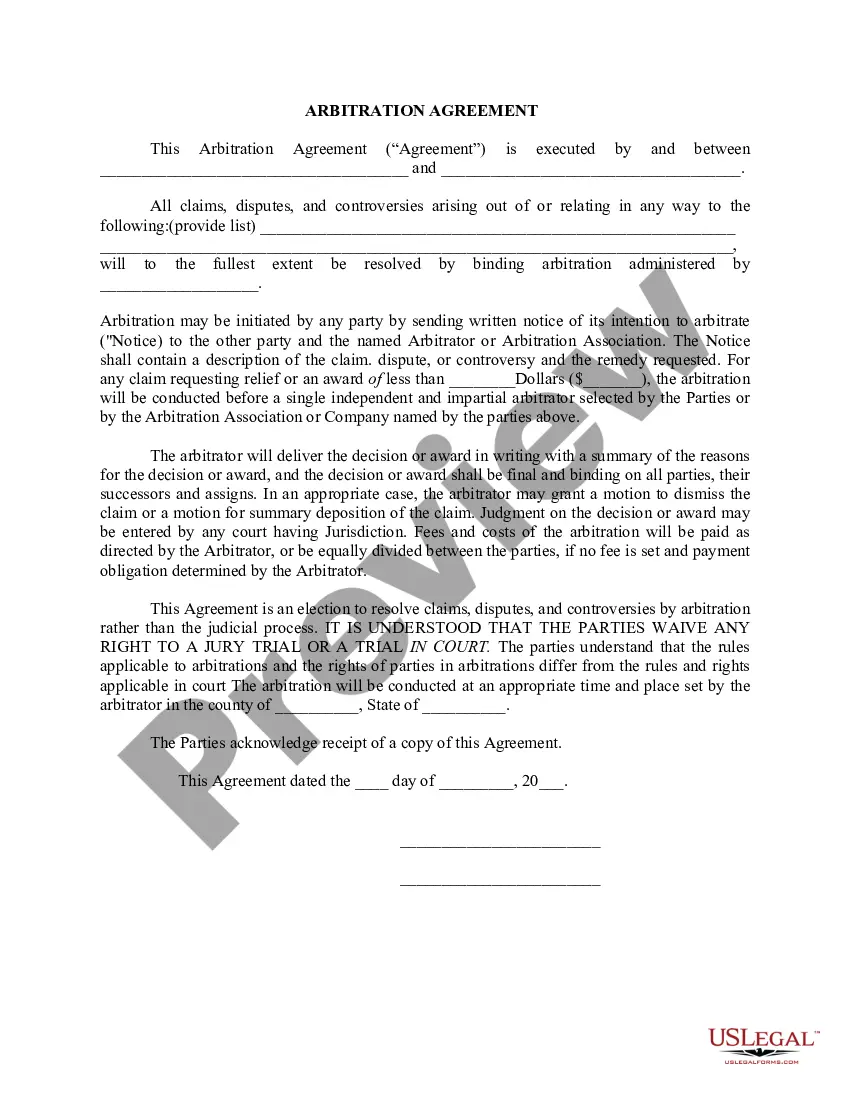
Arbitration Process For Dispute Resolution In Georgia
Description

Get your form ready online
Our built-in tools help you complete, sign, share, and store your documents in one place.
Make edits, fill in missing information, and update formatting in US Legal Forms—just like you would in MS Word.
Download a copy, print it, send it by email, or mail it via USPS—whatever works best for your next step.
Sign and collect signatures with our SignNow integration. Send to multiple recipients, set reminders, and more. Go Premium to unlock E-Sign.
If this form requires notarization, complete it online through a secure video call—no need to meet a notary in person or wait for an appointment.
We protect your documents and personal data by following strict security and privacy standards.

Make edits, fill in missing information, and update formatting in US Legal Forms—just like you would in MS Word.

Download a copy, print it, send it by email, or mail it via USPS—whatever works best for your next step.

Sign and collect signatures with our SignNow integration. Send to multiple recipients, set reminders, and more. Go Premium to unlock E-Sign.

If this form requires notarization, complete it online through a secure video call—no need to meet a notary in person or wait for an appointment.

We protect your documents and personal data by following strict security and privacy standards.
Looking for another form?






Form popularity
FAQ
Case Initiation: A request for arbitration is the formal document that kicks off the arbitration process. The request is submitted by the claimant to the arbitrator and usually to the respondent. Arbitrator Invitation: Arbitrators are invited to review the case details, ensuring there are no conflicts of interest.
The Five Steps to Conflict Resolution Step 1: Identify the source of the conflict. The more information about the cause of the conflict, the more easily it can be resolved. Step 2: Look beyond the incident. Step 3: Request solutions. Step 4: Identify solutions both disputants can support. Step 5: Agreement.
Arbitration is a dispute resolution mechanism agreed on by parties, which involves the appointment of one or more ar- bitrators to preside over and to make a final decision on a dispute between two or more parties – instead of approaching a court of law to resolve the dispute.
(a) A consumer shall request arbitration by filing a written application for arbitration with the Attorney General.
What is an example of arbitration? If two companies contract to engage in commerce and the contract includes an arbitration agreement, then the two companies are required to use arbitration rather than the court system to settle disputes.
In arbitration, a neutral third party serves as a judge who is responsible for resolving the dispute. The arbitrator listens as each side argues its case and presents relevant evidence, then renders a binding decision.
Arbitration has four types of functions: resolving contractual disputes between management and labor, addressing interests of different parties in bargaining situations such as public sector labor relations, settling litigated claims through court-annexed programs, and resolving community disputes.
Arbitration is a quasi-judicial proceeding, wherein the parties in dispute appoint an arbitrator by agreement to adjudicate the said dispute and to that extent differs from court proceedings. The power and functions of arbitral tribunal are statutorily regulated.
To give you an idea of the process that arbitration typically involves, the American Arbitration Association describes artibtration as having five main steps: Filing and initiation. Arbitrator selection. Preliminary hearing. Information exchange and preparation. Hearings. Post hearing submissions. Award.
5. Extent of judicial intervention.—Notwithstanding anything contained in any other law for the time being in force, in matters governed by this Part, no judicial authority shall intervene except where so provided in this Part.