Agreements For Restrictive Covenant In Sacramento
Description

Get your form ready online
Our built-in tools help you complete, sign, share, and store your documents in one place.
Make edits, fill in missing information, and update formatting in US Legal Forms—just like you would in MS Word.
Download a copy, print it, send it by email, or mail it via USPS—whatever works best for your next step.
Sign and collect signatures with our SignNow integration. Send to multiple recipients, set reminders, and more. Go Premium to unlock E-Sign.
If this form requires notarization, complete it online through a secure video call—no need to meet a notary in person or wait for an appointment.
We protect your documents and personal data by following strict security and privacy standards.

Make edits, fill in missing information, and update formatting in US Legal Forms—just like you would in MS Word.

Download a copy, print it, send it by email, or mail it via USPS—whatever works best for your next step.

Sign and collect signatures with our SignNow integration. Send to multiple recipients, set reminders, and more. Go Premium to unlock E-Sign.

If this form requires notarization, complete it online through a secure video call—no need to meet a notary in person or wait for an appointment.

We protect your documents and personal data by following strict security and privacy standards.
Looking for another form?








Form popularity
FAQ
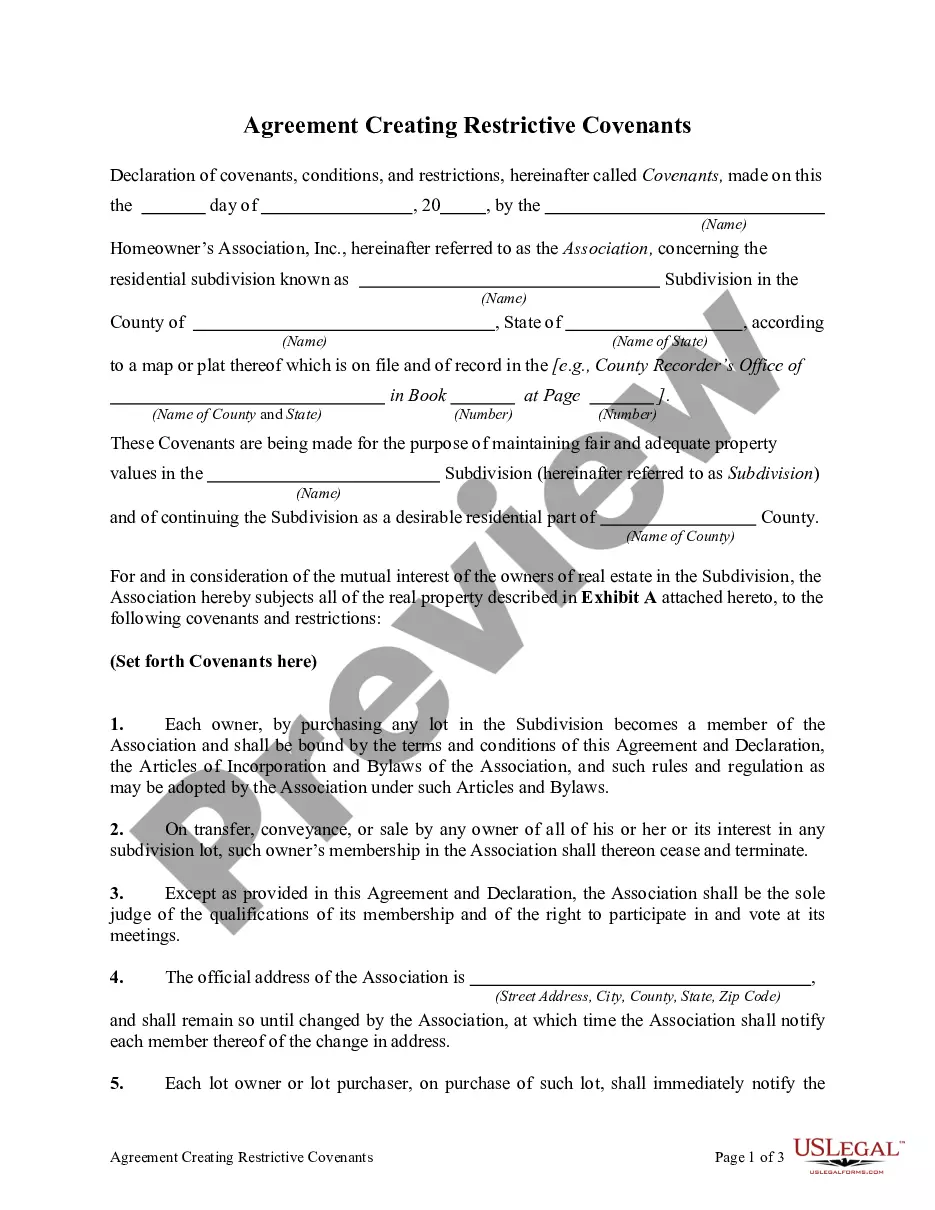
Restrictive covenants can cover a wide variety of issues, but most lean towards: Preventing homeowners from altering a property (e.g. a building extension, house conversion); Restricting any buildings or other large structures from being built on the land; or. Stopping businesses from operating on the land.
Recently, Governor Gavin Newsom signed two bills into law that amend the California Business and Professions Code to further strengthen California's laws against restrictive covenants. Effective January 1, 2024, the ban on virtually all non-compete clauses is now codified.
Restrictive Covenants, Explained This restricts how homeowners can manage and modify their land. Examples include restrictions on fence options, the type of animals allowed and the use of outbuildings, such as sheds.
Employers often include in employment contracts what are referred to as “restrictive covenants.” This term is generally used to describe two main types of contractual clause: the non-solicitation clause and the non-compete clause.
Courts have held that restrictive covenants are presumptively unenforceable on the basis that they are considered a restraint of trade contrary to public policy.
Restrictive covenants may contain 4 different types of promises: (1) a promise not to compete with one's former employer; (2) a promise not to solicit or accept business from customers of the former employer; (3) a promise not to recruit or hire away employees of the former employer; and (4) the promise not to use or ...
Restrictive covenants are clauses that prevent, prohibit, restrict, or limit the actions of a person or entity named in a contract. Restrictive covenants are common in real estate transactions and apply to everything from the colors you can paint your house to how many tenants can live in a building.
Some of the most common restrictive covenants include: Alterations and extensions to the building. Changes to the use of a property, for example, converting a building into flats or turning a house into business premises. Rent and lease restrictions. Limitations on pets. Limitations on home colour.
How do I challenge a restrictive covenant? Express release: It may be possible to negotiate the release or variation of a restrictive covenant. Indemnity insurance: It is possible to obtain indemnity insurance to protect against the risk of a person with the benefit of a restrictive covenant seeking to enforce it.