Restrictive Covenants For Consultants In Orange
Description

Get your form ready online
Our built-in tools help you complete, sign, share, and store your documents in one place.
Make edits, fill in missing information, and update formatting in US Legal Forms—just like you would in MS Word.
Download a copy, print it, send it by email, or mail it via USPS—whatever works best for your next step.
Sign and collect signatures with our SignNow integration. Send to multiple recipients, set reminders, and more. Go Premium to unlock E-Sign.
If this form requires notarization, complete it online through a secure video call—no need to meet a notary in person or wait for an appointment.
We protect your documents and personal data by following strict security and privacy standards.

Make edits, fill in missing information, and update formatting in US Legal Forms—just like you would in MS Word.

Download a copy, print it, send it by email, or mail it via USPS—whatever works best for your next step.

Sign and collect signatures with our SignNow integration. Send to multiple recipients, set reminders, and more. Go Premium to unlock E-Sign.

If this form requires notarization, complete it online through a secure video call—no need to meet a notary in person or wait for an appointment.

We protect your documents and personal data by following strict security and privacy standards.
Looking for another form?






Form popularity
FAQ
Is a 12-month restrictive covenant enforceable? Each case turns on its own facts, but a court is generally reluctant to enforce restrictive covenants longer than 12 months. Market practice dictates a period of between 3 and 6 months is appropriate for more junior employees.
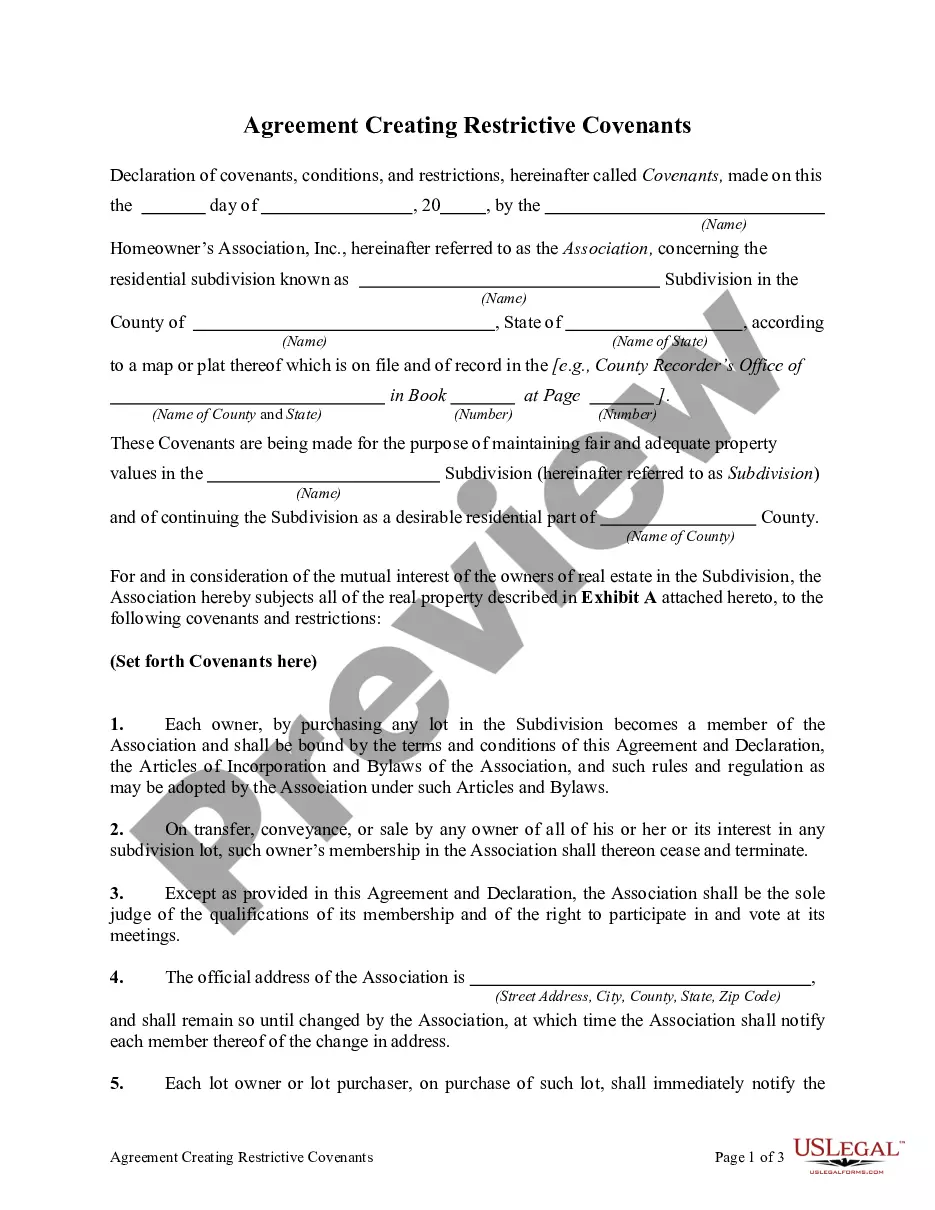
Restrictive Covenants, Explained This restricts how homeowners can manage and modify their land. Examples include restrictions on fence options, the type of animals allowed and the use of outbuildings, such as sheds.
The three types of covenants are positive, negative, and financial. Each contains a unique set of requirements and stipulations. Positive and negative covenants are not interchangeable as good or bad but rather refer to what borrowers can or cannot do.
Over time, Brazilian Courts have come to the understanding that non-compete clauses are enforceable provided that they meet four specific criteria: (i) a reasonable time limit; (ii) a geographical limit only to the market in which the employee has worked at or was involved in projects related to; (iii) specific post- ...
In the United States, employers generally use four types of restrictive covenants: (1) covenants not to compete for a certain period of time following the employee's termination from employment (or following a business transaction such as a sale, merger, etc.); (2) covenants not to solicit customers or clients for a ...
Some of the most common restrictive covenants include: Alterations and extensions to the building. Changes to the use of a property, for example, converting a building into flats or turning a house into business premises. Rent and lease restrictions. Limitations on pets. Limitations on home colour.
For more than 150 years, California has declared non-compete agreements unenforceable. In 1941, California codified its prohibition on non-competes in California Business and Professions Code sections 16600-16607.
Recently, Governor Gavin Newsom signed two bills into law that amend the California Business and Professions Code to further strengthen California's laws against restrictive covenants. Effective January 1, 2024, the ban on virtually all non-compete clauses is now codified.
In the case of an HOA, restrictive covenants are general rules that members of your HOA vote on that all property owners living in the area must follow. The covenant may include actions you can't take with your property, like raising livestock or running a business from your home.
Clawback provisions are legally permissible because the bonus is not “earned” until the employee fulfills the contractual obligations. However, under California law, the employer cannot withhold the bonus from the employee's final wages, even if the employee fails to meet the conditions.
