Mutual Covenants And Agreements Meaning In Georgia
Description

Get your form ready online
Our built-in tools help you complete, sign, share, and store your documents in one place.
Make edits, fill in missing information, and update formatting in US Legal Forms—just like you would in MS Word.
Download a copy, print it, send it by email, or mail it via USPS—whatever works best for your next step.
Sign and collect signatures with our SignNow integration. Send to multiple recipients, set reminders, and more. Go Premium to unlock E-Sign.
If this form requires notarization, complete it online through a secure video call—no need to meet a notary in person or wait for an appointment.
We protect your documents and personal data by following strict security and privacy standards.

Make edits, fill in missing information, and update formatting in US Legal Forms—just like you would in MS Word.

Download a copy, print it, send it by email, or mail it via USPS—whatever works best for your next step.

Sign and collect signatures with our SignNow integration. Send to multiple recipients, set reminders, and more. Go Premium to unlock E-Sign.

If this form requires notarization, complete it online through a secure video call—no need to meet a notary in person or wait for an appointment.

We protect your documents and personal data by following strict security and privacy standards.
Looking for another form?








Form popularity
FAQ
Generally speaking, it is hard to enforce a restrictive covenant after 20 years. The Limitation Act 1980 also states that claims in land should be brought within 12 years, within 12 years from the time the breach occurred, not when the deed came into force.
Under Georgia law, for a contract to be valid, there must be an offer, acceptance, consideration, and mutual assent. See O.C.G.A. § 13-3-1. In the context of email communications, an offer can be made through an email, or contemporaneous emails, containing terms of a proposed agreement.
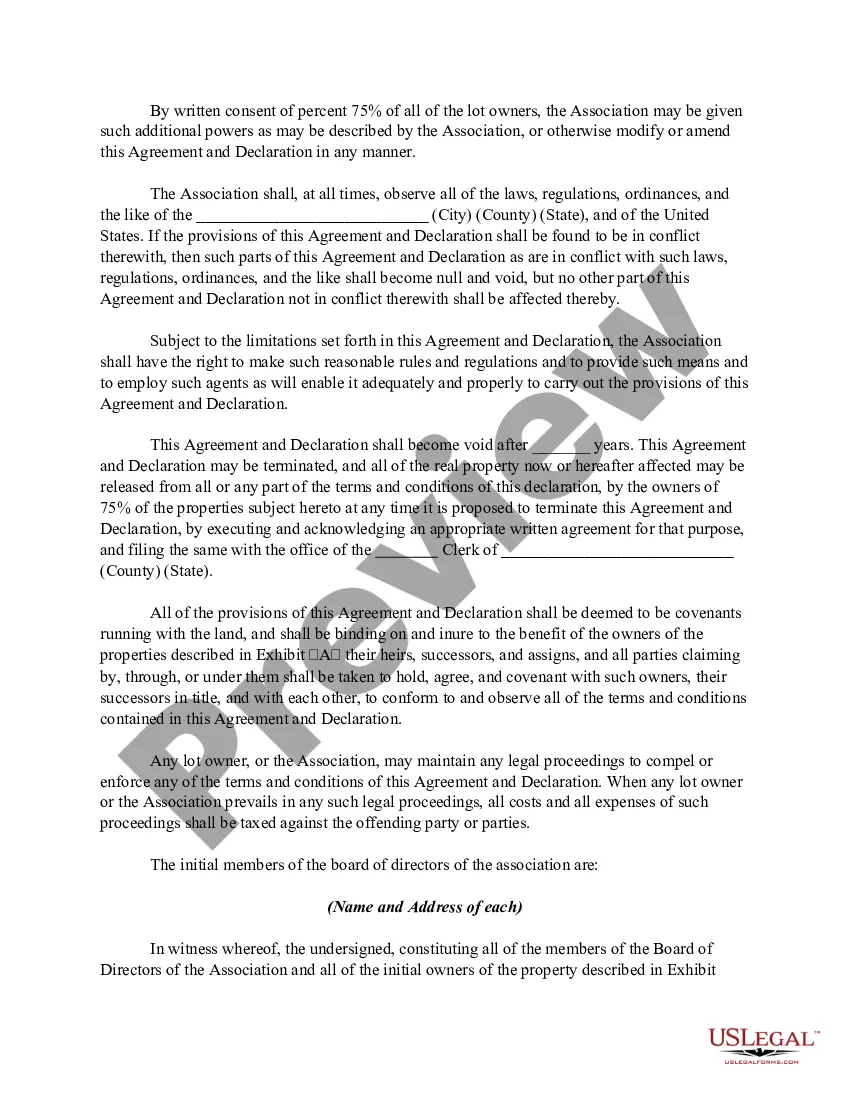
A covenant agreement is akin to a contractual agreement between parties. It often outlines terms and conditions where a party will perform a certain action or refrain from performing a certain action. Covenants are legally binding and enforceable.
Perpetual Duration: Prior to 1993, Georgia law generally provided that covenants expire after 20 years. In 1994, the law was amended to permit covenants to automatically renew. Yet, Georgia courts have subsequently held that covenants in communities recorded prior to 1994 do not receive the benefit of the 1994 law.
Statute of Limitations The HOA or COA must initiate an action to enforce the lien within four years after the assessment or installment first became due. Otherwise, the lien will lapse and won't be effective. (Ga. Code § 44-3-232(c), § 44-3-109(c)).
In Georgia, the enforceability of restrictive covenants is governed by the GRCA, OCGA § 13-8-50 et seq. The GRCA provides that employment contracts that restrict competition must be “reasonable in time, geographic area, and scope of prohibited activities.” OCGA § 13-8-53(a).
In Georgia, the enforceability of restrictive covenants is governed by the GRCA, OCGA § 13-8-50 et seq. The GRCA provides that employment contracts that restrict competition must be “reasonable in time, geographic area, and scope of prohibited activities.” OCGA § 13-8-53(a).
Perpetual Duration: Prior to 1993, Georgia law generally provided that covenants expire after 20 years. In 1994, the law was amended to permit covenants to automatically renew. Yet, Georgia courts have subsequently held that covenants in communities recorded prior to 1994 do not receive the benefit of the 1994 law.
Q: Are non-compete agreements enforceable in Georgia even if signed after employment commences and/or without any additional consideration? A: Yes, continued employment is generally considered sufficient consideration for a non-compete in Georgia.
