Covenants Deal With In Clark
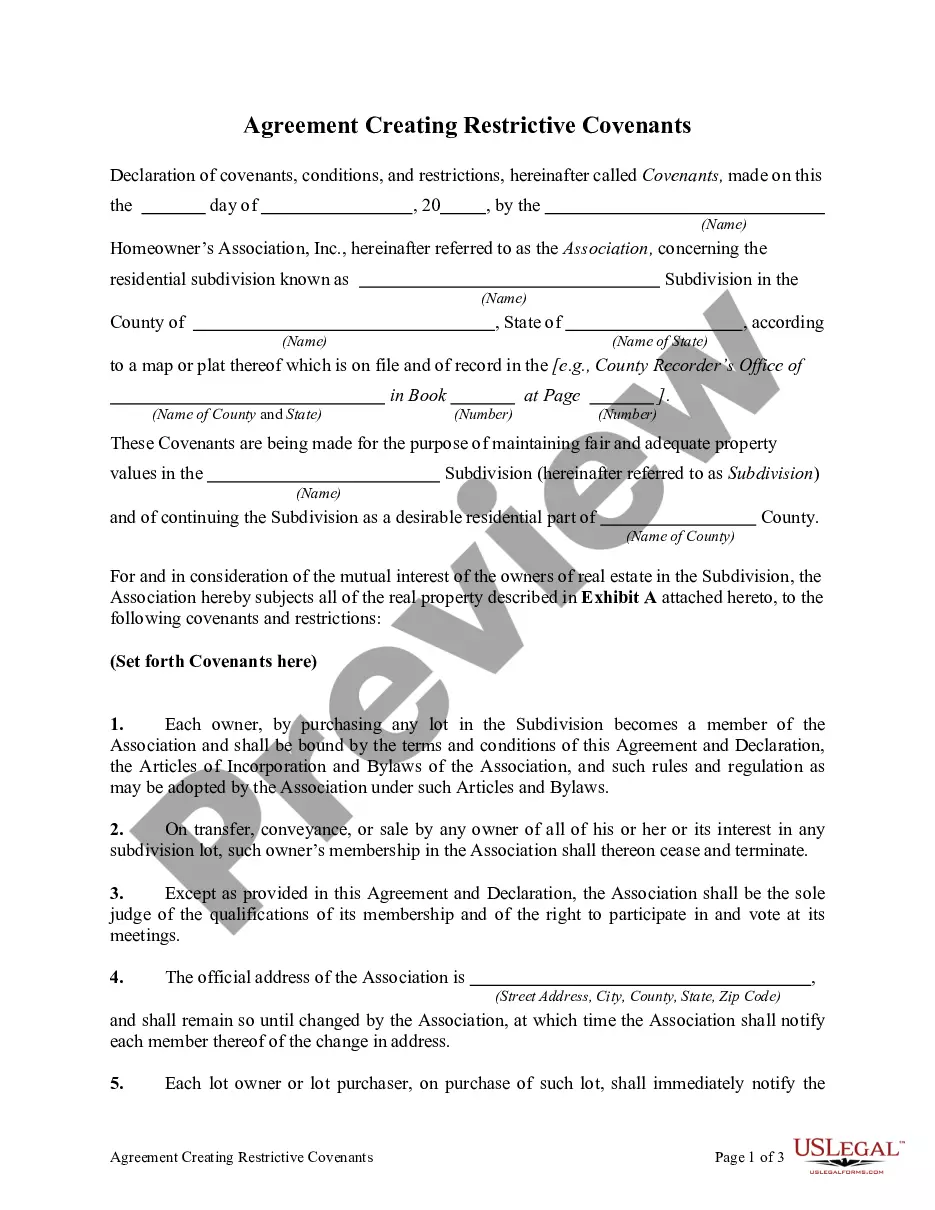
Description

Get your form ready online
Our built-in tools help you complete, sign, share, and store your documents in one place.
Make edits, fill in missing information, and update formatting in US Legal Forms—just like you would in MS Word.
Download a copy, print it, send it by email, or mail it via USPS—whatever works best for your next step.
Sign and collect signatures with our SignNow integration. Send to multiple recipients, set reminders, and more. Go Premium to unlock E-Sign.
If this form requires notarization, complete it online through a secure video call—no need to meet a notary in person or wait for an appointment.
We protect your documents and personal data by following strict security and privacy standards.

Make edits, fill in missing information, and update formatting in US Legal Forms—just like you would in MS Word.

Download a copy, print it, send it by email, or mail it via USPS—whatever works best for your next step.

Sign and collect signatures with our SignNow integration. Send to multiple recipients, set reminders, and more. Go Premium to unlock E-Sign.

If this form requires notarization, complete it online through a secure video call—no need to meet a notary in person or wait for an appointment.

We protect your documents and personal data by following strict security and privacy standards.
Looking for another form?










Form popularity
FAQ
The short answer is that you can apply to the courts for an order that the restrictive covenant be amended or removed for title to your property. The authority for this application is section 35 of the Property Law Act.
Covenants are particularly relevant in the fields of contract law and property law. An example of a contractual covenant is a non-compete agreement . Examples of common covenants in property law include agreements not to build a fence or agreements to maintain a shared driveway.
It is possible to apply to the Lands Chamber of the Upper Tribunal to have a restrictive covenant “discharged or modified”, as the statute puts it, in order to get the covenant removed or changed so that development can take place or the use of the land can be changed.
It is possible to apply to the Lands Chamber of the Upper Tribunal to have a restrictive covenant “discharged or modified”, as the statute puts it, in order to get the covenant removed or changed so that development can take place or the use of the land can be changed.
How do I challenge a restrictive covenant? Express release: It may be possible to negotiate the release or variation of a restrictive covenant. Indemnity insurance: It is possible to obtain indemnity insurance to protect against the risk of a person with the benefit of a restrictive covenant seeking to enforce it.
Restrictive covenants often include rules on changes to buildings or what the land can be used for. Breaching a covenant can have serious consequences for the party who has broken the rules and legal action may be taken against them.
Potential Options to Deal with a Restrictive Covenant Check if the beneficiary exists. You must undertake checks to check who benefits from the covenant. Negotiate. Indemnity insurance, shielding against covenant enforcement risks. Legal route.
Heading to court Or you can go to the Upper Tribunal (Lands Chamber) and ask them to consider modifying or discharging the covenant. The Tribunal will examine whether it is in the public interest, review the covenant's rationale and validity, and assess whether there are grounds to develop or modify the land use.
The potential for apostasy and condemnation is not merely hypothetical. People really do break the covenant. Hebrews –17 proves that people really can and really do break the covenant with God. The people with whom God was angry in the wilderness were not those who were outside the covenant.
