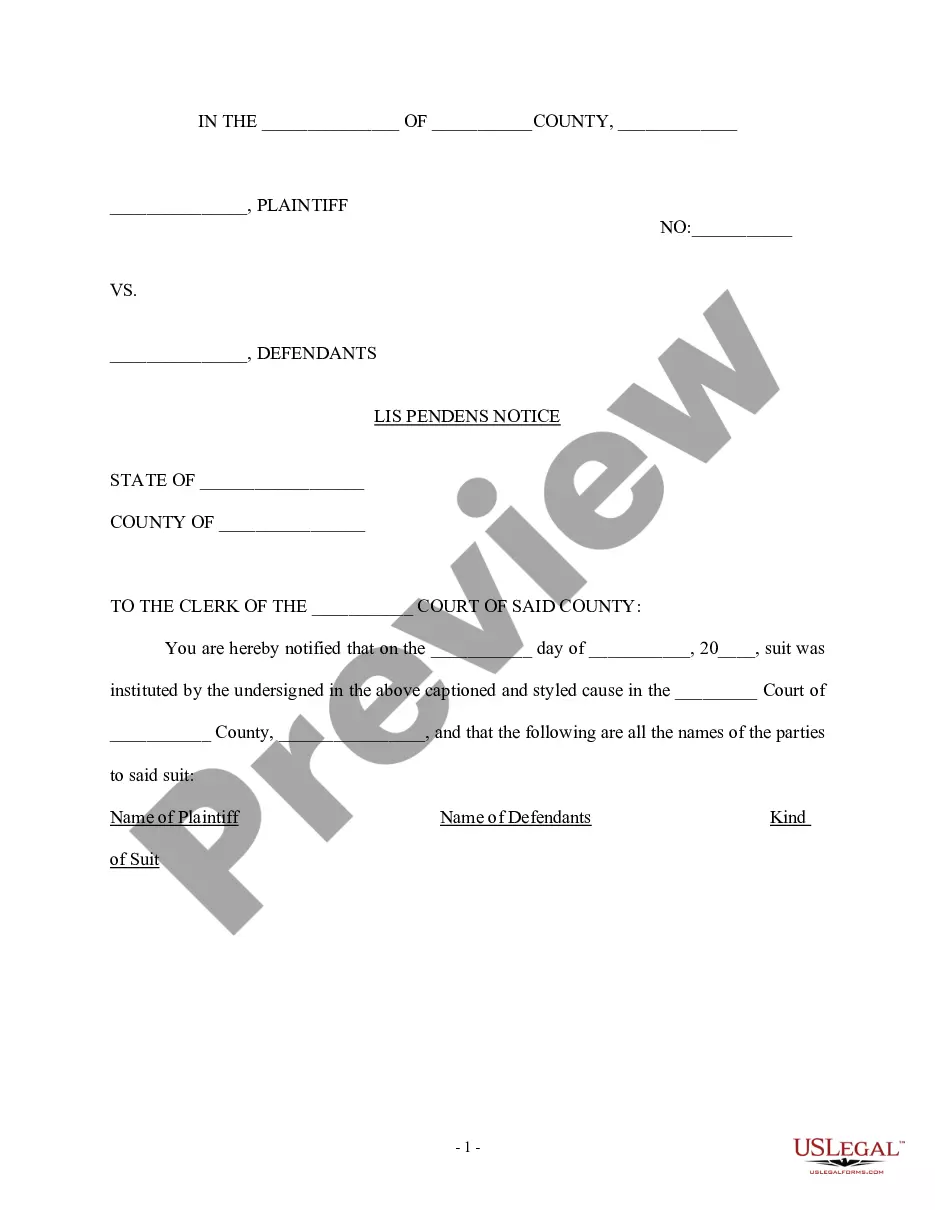
File Notice Lis Pendens Foreclosure In Phoenix
Description

Get your form ready online
Our built-in tools help you complete, sign, share, and store your documents in one place.
Make edits, fill in missing information, and update formatting in US Legal Forms—just like you would in MS Word.
Download a copy, print it, send it by email, or mail it via USPS—whatever works best for your next step.
Sign and collect signatures with our SignNow integration. Send to multiple recipients, set reminders, and more. Go Premium to unlock E-Sign.
If this form requires notarization, complete it online through a secure video call—no need to meet a notary in person or wait for an appointment.
We protect your documents and personal data by following strict security and privacy standards.

Make edits, fill in missing information, and update formatting in US Legal Forms—just like you would in MS Word.

Download a copy, print it, send it by email, or mail it via USPS—whatever works best for your next step.

Sign and collect signatures with our SignNow integration. Send to multiple recipients, set reminders, and more. Go Premium to unlock E-Sign.

If this form requires notarization, complete it online through a secure video call—no need to meet a notary in person or wait for an appointment.

We protect your documents and personal data by following strict security and privacy standards.
Looking for another form?








Form popularity
FAQ
Non-judicial foreclosure auctions are often more expedient, though they may be subject to judicial review to ensure the legality of the proceedings.
Arizona's foreclosure rates are up sharply in the past year. A report from Attom Data shows one in every 4,683 homes in the state is in some stage of the foreclosure process. That's a 27% increase in the past year.
Basically, a Lis Pendens is written notice that's recorded in the county recorder's records where the real estate is located and that gives notice than an action, a lawsuit involving title to the real estate is pending.
Pre-foreclosure is a legal process that occurs before the lender repossesses a property. If a homeowner is late on a certain number of payments, the lender may issue a notice of default, sending the home into pre-foreclosure. Mortgage borrowers may still have some options during pre-foreclosure to save their homes.
In Arizona, there are two types of foreclosure: Judicial and Non-Judicial/Trustee Sale. A judicial foreclosure, is a foreclosure by court action, similar to other common civil actions where one party sues another (i.e. bank files a lawsuit against the homeowner).
Answer: After a judicial foreclosure in Arizona, the debtor or his successors in interest ordinarily may redeem at any time at any time within six months after the date of the sale (A.R.S. 33-12-1282).
Notice of a Nonjudicial Foreclosure To officially start a nonjudicial foreclosure in Arizona, the trustee records a notice of sale in the land records. The sale date can't be any sooner than 91 days after the date the trustee records the notice. (Ariz.
Timelines for distressed borrowers Borrowers have the most protections if a complete application for mortgage assistance is submitted within 120 days of the first missed payment because the servicer is not allowed to start a foreclosure process during those 120 days.
Under federal law, the servicer usually can't start a foreclosure until the borrower is over 120 days delinquent on payments, subject to a few exceptions. (12 C.F.R. § 1024.41). This 120-day period provides most homeowners ample opportunity to submit a loss mitigation application to the servicer.
Basically, a Lis Pendens is written notice that's recorded in the county recorder's records where the real estate is located and that gives notice than an action, a lawsuit involving title to the real estate is pending.

