Patent Application For Prosecution In San Bernardino
Description




Get your form ready online
Our built-in tools help you complete, sign, share, and store your documents in one place.
Make edits, fill in missing information, and update formatting in US Legal Forms—just like you would in MS Word.
Download a copy, print it, send it by email, or mail it via USPS—whatever works best for your next step.
Sign and collect signatures with our SignNow integration. Send to multiple recipients, set reminders, and more. Go Premium to unlock E-Sign.
If this form requires notarization, complete it online through a secure video call—no need to meet a notary in person or wait for an appointment.
We protect your documents and personal data by following strict security and privacy standards.

Make edits, fill in missing information, and update formatting in US Legal Forms—just like you would in MS Word.

Download a copy, print it, send it by email, or mail it via USPS—whatever works best for your next step.

Sign and collect signatures with our SignNow integration. Send to multiple recipients, set reminders, and more. Go Premium to unlock E-Sign.

If this form requires notarization, complete it online through a secure video call—no need to meet a notary in person or wait for an appointment.

We protect your documents and personal data by following strict security and privacy standards.
Looking for another form?





Form popularity
FAQ
You can file a patent application on behalf of yourself or your co-inventors.
Here is the procedure on how to apply for patent in India: STEP 1: Invention Disclosure. STEP 2: Patentability Search. STEP 3: Filing an Application for a Patent. STEP 4: Patent Drafting. STEP 5: Filing the Patent Application. STEP 6: Request for Examination. STEP 7: Responding to Objections (if any) ... STEP 8: Grant of Patent.
The prosecution process is broadly divided into two phases: pre-grant and post-grant prosecution. Pre-grant prosecution includes the drafting and filing of patent applications, responding to patent office actions, and navigating the examination process to meet all legal requirements for patentability.
To practice patent law, you would register with the USPTO. This involves submitting an application and passing the multiple-choice exam, also called the patent bar exam. Some coursework or experience in science or engineering is a prerequisite for this exam, but a bachelor's degree may be adequate.
Patent application forms can be found on the USPTO website. All of the forms related to patent applications can be found on the link here, or by navigating to the USPTO website and clicking on the “Forms” link under the “Apply for a Patent” section on the “Patents” page.
The forms to apply for a patent may be found at the U.S. Patent and Trademark Office (USPTO) website. (Applications filed before September 16, 2012 involved a different set of forms.)
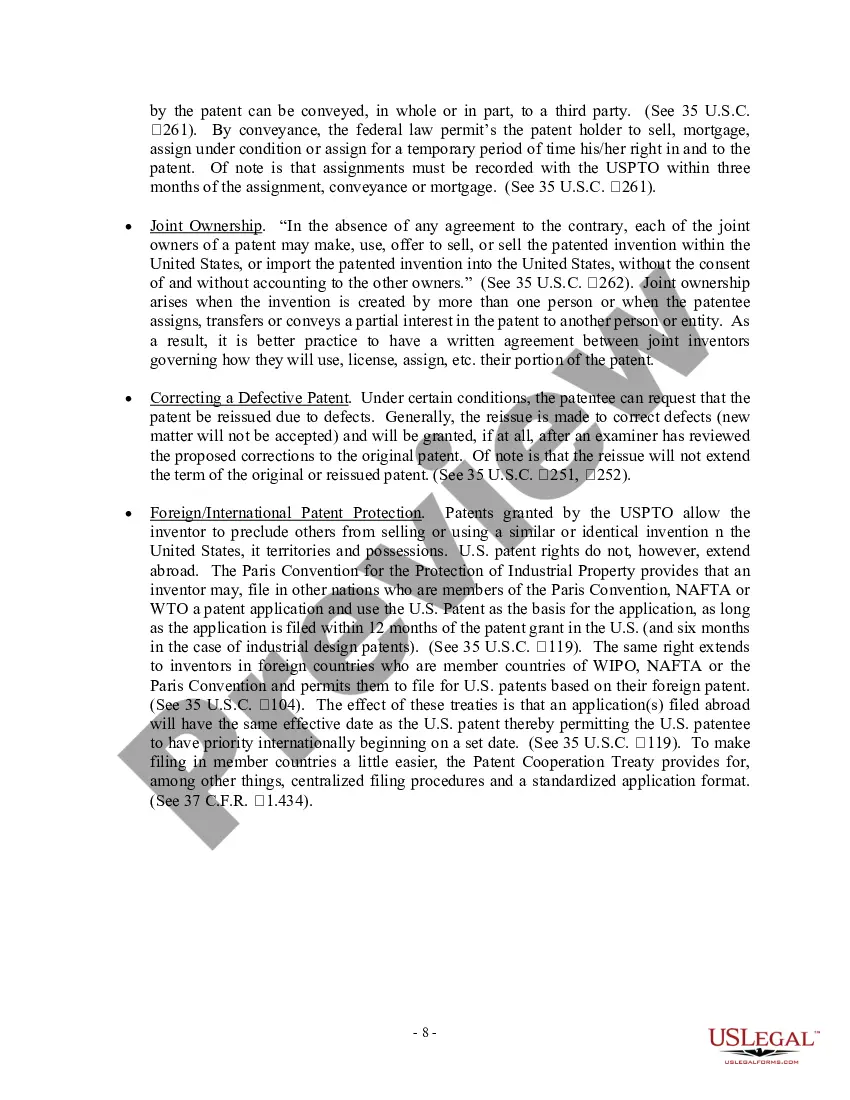
Patent prosecution is the process of drafting, filing, and negotiating with the U.S. Patent and Trademark Office (USPTO) in order to obtain patent protection and rights for an invention.
A patent litigator is an attorney who represents clients in patent lawsuits, such as patent infringement litigation in federal court. Patent litigators are not necessarily registered patent attorneys. There is no requirement that a patent litigator must be registered to practice before the USPTO.
Patent prosecution is the process of drafting, filing, and negotiating with the U.S. Patent and Trademark Office (USPTO) in order to obtain patent protection and rights for an invention.
Key Differences Between Patent Prosecution and Litigation Focus: Patent prosecution focuses on obtaining patent rights from the patent office, while patent litigation is adversarial involving the enforcement, validity, or defense of rights in court or before an administrative board.
