Patent Application For Software In Salt Lake
Description




Get your form ready online
Our built-in tools help you complete, sign, share, and store your documents in one place.
Make edits, fill in missing information, and update formatting in US Legal Forms—just like you would in MS Word.
Download a copy, print it, send it by email, or mail it via USPS—whatever works best for your next step.
Sign and collect signatures with our SignNow integration. Send to multiple recipients, set reminders, and more. Go Premium to unlock E-Sign.
If this form requires notarization, complete it online through a secure video call—no need to meet a notary in person or wait for an appointment.
We protect your documents and personal data by following strict security and privacy standards.

Make edits, fill in missing information, and update formatting in US Legal Forms—just like you would in MS Word.

Download a copy, print it, send it by email, or mail it via USPS—whatever works best for your next step.

Sign and collect signatures with our SignNow integration. Send to multiple recipients, set reminders, and more. Go Premium to unlock E-Sign.

If this form requires notarization, complete it online through a secure video call—no need to meet a notary in person or wait for an appointment.

We protect your documents and personal data by following strict security and privacy standards.
Looking for another form?







Form popularity
FAQ
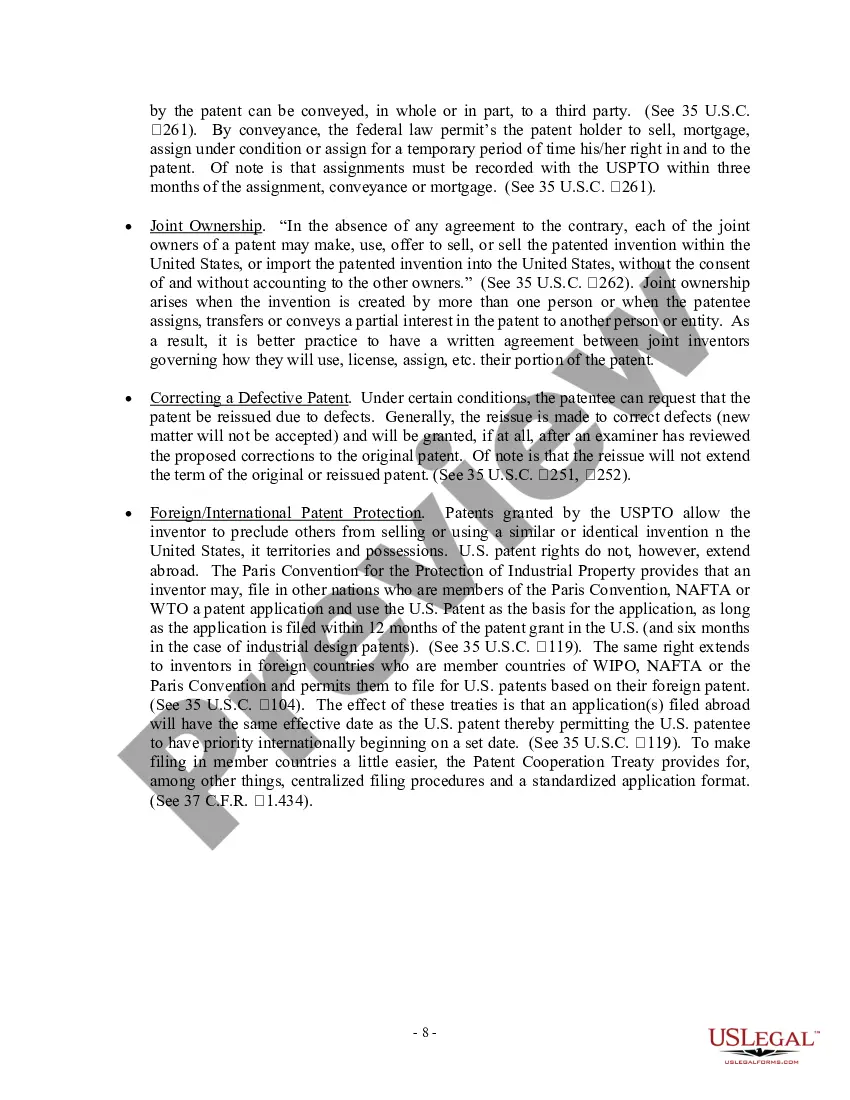
The truth is that software is patentable, but what gets patent protection is not the software code itself. In order to be eligible for patent protection, a software invention must meet the requirements of patentability: it must be novel, non-obvious, and of practical utility.
If you want to protect your software through the patent system, you must submit a patent application. Your application must describe your invention in detail (the specification), should include drawings, and must truthfully name the inventors of the invention.
The simple answer is yes, you can patent software. However, there are strict rules to follow as to what software or software-related inventions can be patented.
The real question is whether software-related inventions can be patented. The answer to this question is YES!
A software invention, for example, could be protected under copyrights (how human expression authored computer-readable code), patents (a useful, novel, and non-obvious method, device, or system), or both.
For software or an app to be patentable it needs to meet specific criteria. A patentable invention must provide a technical solution to a technical problem. This means the software or application should offer something beyond a simple business method or abstract idea—it must contribute to the way technology functions.
A patent application often includes the following primary sections: Invention Title. The title's objective is to provide a clear understanding of the invention or idea. Prior Art: Context and Novelty. Invention Summary. Drawings and Descriptions. Detailed Description. Claims. Scope. Characteristics.
When drafting descriptions, a step-by-step approach can be highly beneficial. Start with a broad overview of your software, then drill down into specific components or processes. For each section, clearly describe the problem it addresses, how it operates, and why it represents an improvement over existing solutions.
It should be brief, but must clearly indicate the matter to which the invention relates. The same title should appear both on the specification and the request for grant form. The description immediately follows the title. It is a detailed explanation of the invention.
One thing that makes the patent application process complex is that describing software technology and innovations is often difficult. This is because they entail abstract ideas, making it difficult to understand and establish whether the innovation should enjoy copyright protection.
