Patent Draft With Keepers In Pennsylvania
Description




Get your form ready online
Our built-in tools help you complete, sign, share, and store your documents in one place.
Make edits, fill in missing information, and update formatting in US Legal Forms—just like you would in MS Word.
Download a copy, print it, send it by email, or mail it via USPS—whatever works best for your next step.
Sign and collect signatures with our SignNow integration. Send to multiple recipients, set reminders, and more. Go Premium to unlock E-Sign.
If this form requires notarization, complete it online through a secure video call—no need to meet a notary in person or wait for an appointment.
We protect your documents and personal data by following strict security and privacy standards.

Make edits, fill in missing information, and update formatting in US Legal Forms—just like you would in MS Word.

Download a copy, print it, send it by email, or mail it via USPS—whatever works best for your next step.

Sign and collect signatures with our SignNow integration. Send to multiple recipients, set reminders, and more. Go Premium to unlock E-Sign.

If this form requires notarization, complete it online through a secure video call—no need to meet a notary in person or wait for an appointment.

We protect your documents and personal data by following strict security and privacy standards.
Looking for another form?








Form popularity
FAQ
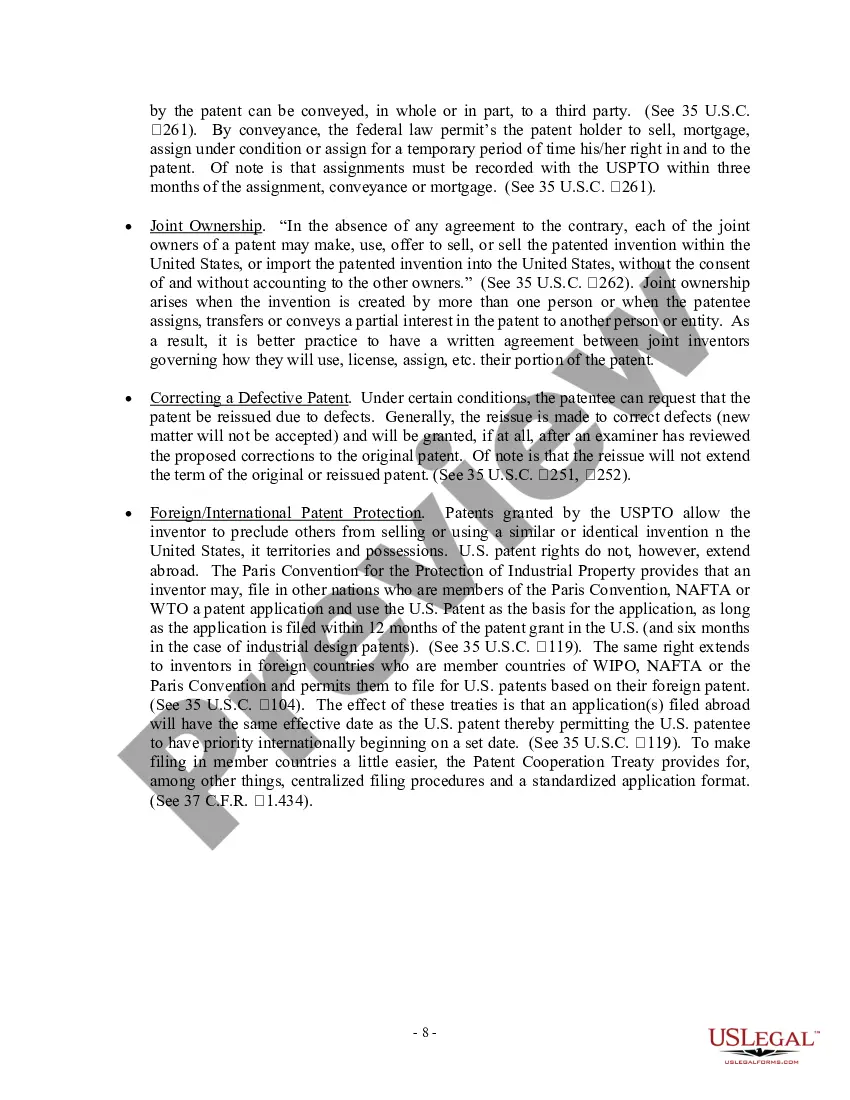
To transfer patent ownership to a company or another entity, each inventor must sign a document called a patent assignment which should then be recorded with the USPTO. First-time patent clients sometimes hesitate to identify inventors, especially when the principals of the company are not the inventors.
Format of a Patent Application The Specification. The Title. The Description. The Claims. The Drawings. The Abstract. Sample Specifications. Minimum Requirements for a Filing Date.
A patent application often includes the following primary sections: Invention Title. The title's objective is to provide a clear understanding of the invention or idea. Prior Art: Context and Novelty. Invention Summary. Drawings and Descriptions. Detailed Description. Claims. Scope. Characteristics.
No, the use of an attorney or registered agent is not required for filing a patent application. However, an attorney or registered agent is often a useful resource and the USPTO recommends the use of such for preparing a patent application and conducting the proceedings in the USPTO.
Parts of a Patent Specification Title of the invention; Field of the invention; Background of the invention; Object of the invention; Summary of the invention; Brief description of the drawing; Detailed description of the invention; Claim(s); and.