Wo Patent Vs Us Patent In Harris
Description



Get your form ready online
Our built-in tools help you complete, sign, share, and store your documents in one place.
Make edits, fill in missing information, and update formatting in US Legal Forms—just like you would in MS Word.
Download a copy, print it, send it by email, or mail it via USPS—whatever works best for your next step.
Sign and collect signatures with our SignNow integration. Send to multiple recipients, set reminders, and more. Go Premium to unlock E-Sign.
If this form requires notarization, complete it online through a secure video call—no need to meet a notary in person or wait for an appointment.
We protect your documents and personal data by following strict security and privacy standards.

Make edits, fill in missing information, and update formatting in US Legal Forms—just like you would in MS Word.

Download a copy, print it, send it by email, or mail it via USPS—whatever works best for your next step.

Sign and collect signatures with our SignNow integration. Send to multiple recipients, set reminders, and more. Go Premium to unlock E-Sign.

If this form requires notarization, complete it online through a secure video call—no need to meet a notary in person or wait for an appointment.

We protect your documents and personal data by following strict security and privacy standards.
Looking for another form?









Form popularity
FAQ
Country codes CCName VN Vietnam WO World Intellectual Property Organisation (WIPO) YU Yugoslavia (Serbia and Montenegro) ZA South Africa92 more rows
Since the rights granted by a U.S. patent extend only throughout the territory of the United States and have no effect in a foreign country, an inventor who wishes patent protection in other countries must apply for a patent in each of the other countries or in regional patent offices.
Is a patent valid in every country? Patents are territorial rights. In general, the exclusive rights are only applicable in the country or region in which a patent has been filed and granted, in ance with the law of that country or region.
A patent is valid in the particular country in which it is granted and for a certain period of time, generally 20 years from the date of filing the patent application.
Intellectual property ( IP ) rights are territorial. They only give protection in the countries where they are granted or registered. If you only have UK protection, others may be allowed to use your IP abroad without infringing your rights.
Although the WO designation itself does not confer patent rights, it simplifies the process by offering a common standard across the 184 PCT member countries, including the U.S., China, and European nations.
General Format: Inventor1, Inventor2, et al. Title of patent. Patent number (include country code, the word “Patent”, and patent number with retained commas), date of filing (format Month Date, Year), and issued date of publication (format Month Date, Year).
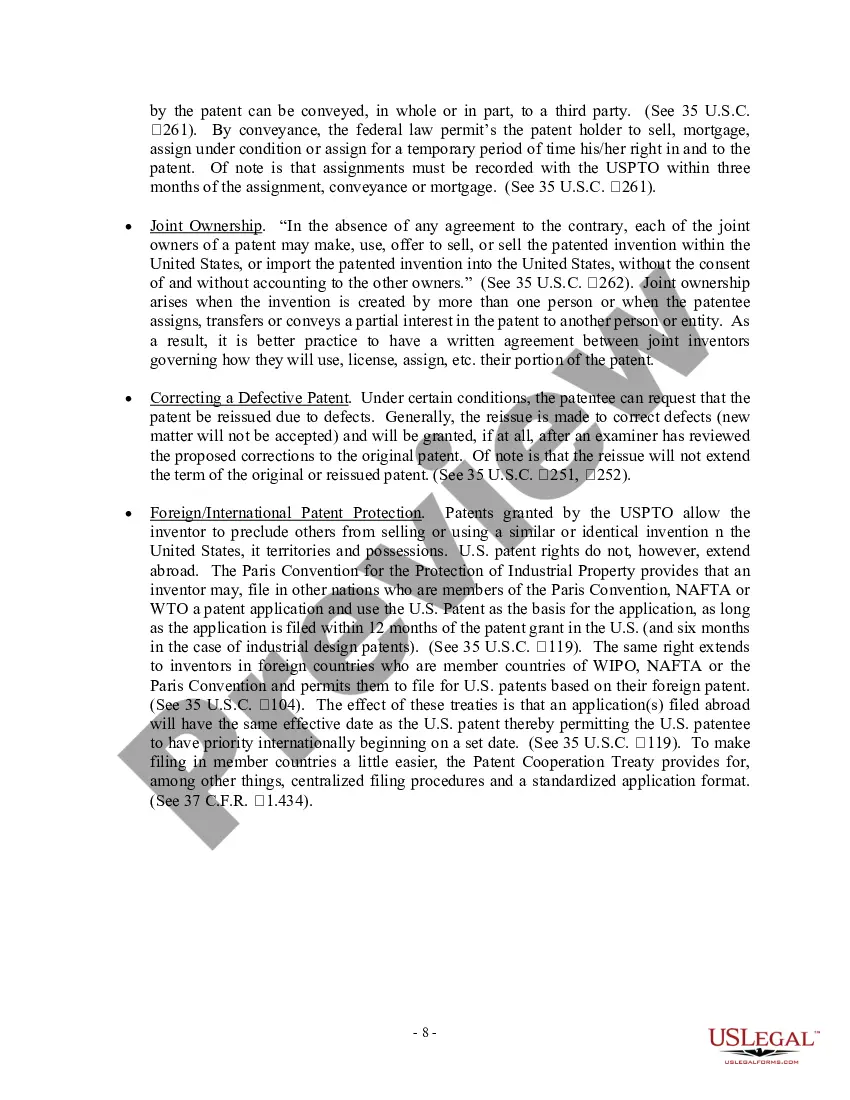
"WO" is a suffix to a patent number that indicates that the original patent application was filed under the Patent Cooperation Treaty, an international treaty that harmonizes the patent application process among member nations.
A WO patent is granted by the World Intellectual Property Organization, or WIPO. The prefix WO, which is short for WIPO, indicates that the patent will be administered by this body. In general, the protection conferred on an invention by patent law will only extend to the country or territory in which it is patented.
