Decedent Account Bank With Online In Franklin
Description




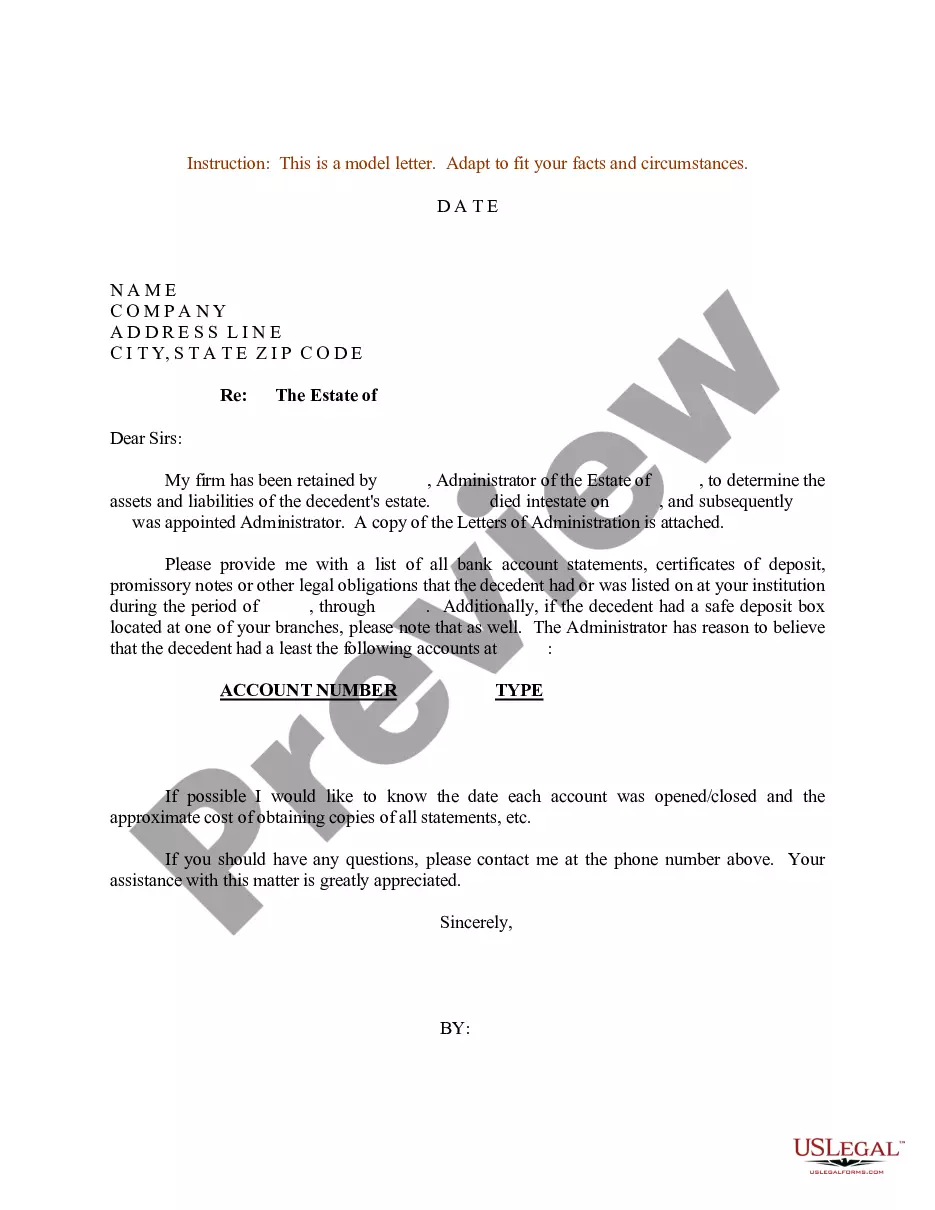
Get your form ready online
Our built-in tools help you complete, sign, share, and store your documents in one place.
Make edits, fill in missing information, and update formatting in US Legal Forms—just like you would in MS Word.
Download a copy, print it, send it by email, or mail it via USPS—whatever works best for your next step.
Sign and collect signatures with our SignNow integration. Send to multiple recipients, set reminders, and more. Go Premium to unlock E-Sign.
If this form requires notarization, complete it online through a secure video call—no need to meet a notary in person or wait for an appointment.
We protect your documents and personal data by following strict security and privacy standards.

Make edits, fill in missing information, and update formatting in US Legal Forms—just like you would in MS Word.

Download a copy, print it, send it by email, or mail it via USPS—whatever works best for your next step.

Sign and collect signatures with our SignNow integration. Send to multiple recipients, set reminders, and more. Go Premium to unlock E-Sign.

If this form requires notarization, complete it online through a secure video call—no need to meet a notary in person or wait for an appointment.

We protect your documents and personal data by following strict security and privacy standards.
Looking for another form?





Form popularity
FAQ
Setting up a TOD account is relatively easy, and it's usually as simple as filling out a TOD designation form provided by your broker or financial institution. This form will ask you to name the beneficiaries and specify the proportions of assets each will receive upon your death.
Do the paperwork: You'll likely need to fill out some beneficiary designation forms with your institution (bank, brokerage, insurer, etc.). This can usually be done online or over the phone, but some institutions may require mail-in forms or even an in-person visit at a local branch.
Visit Banks in Their Area You will need to provide documentation to prove both that the account holder died and you have the legal authority (as a designated beneficiary, joint account holder or executor/administrator) to access the account.
When a bank account owner dies, the process is fairly straightforward if the account has a joint owner or beneficiary. Otherwise, the account typically becomes part of the owner's estate or is eventually turned over to the state government and the disbursement of funds is handled in probate court.
No Beneficiary on Bank Account If there is no beneficiary listed on the bank account, the account typically goes through probate, and the funds will be distributed ing to the deceased's will or state laws if there is no will.
The bank account will be frozen until the probate process is complete. If the bank isn't informed of the owner's passing and the account goes dormant, the account may be subject to escheatment, which turns the funds over to the state government.
If you have a retirement plan with Fiduciary Trust International of the South (part of the Franklin Templeton organization) as custodian and would like to change your beneficiary of record, please visit franklintempleton (click the “Forms and Literature” tab, search for “beneficiary”) or call (800) 527-2020 to ...
Most financial institutions will require you to contact your local branch or call customer service to add a beneficiary. However, some may also let you make changes to your account through online banking. Bank account beneficiaries may be added at any time.
No Beneficiary on Bank Account If there is no beneficiary listed on the bank account, the account typically goes through probate, and the funds will be distributed ing to the deceased's will or state laws if there is no will.
