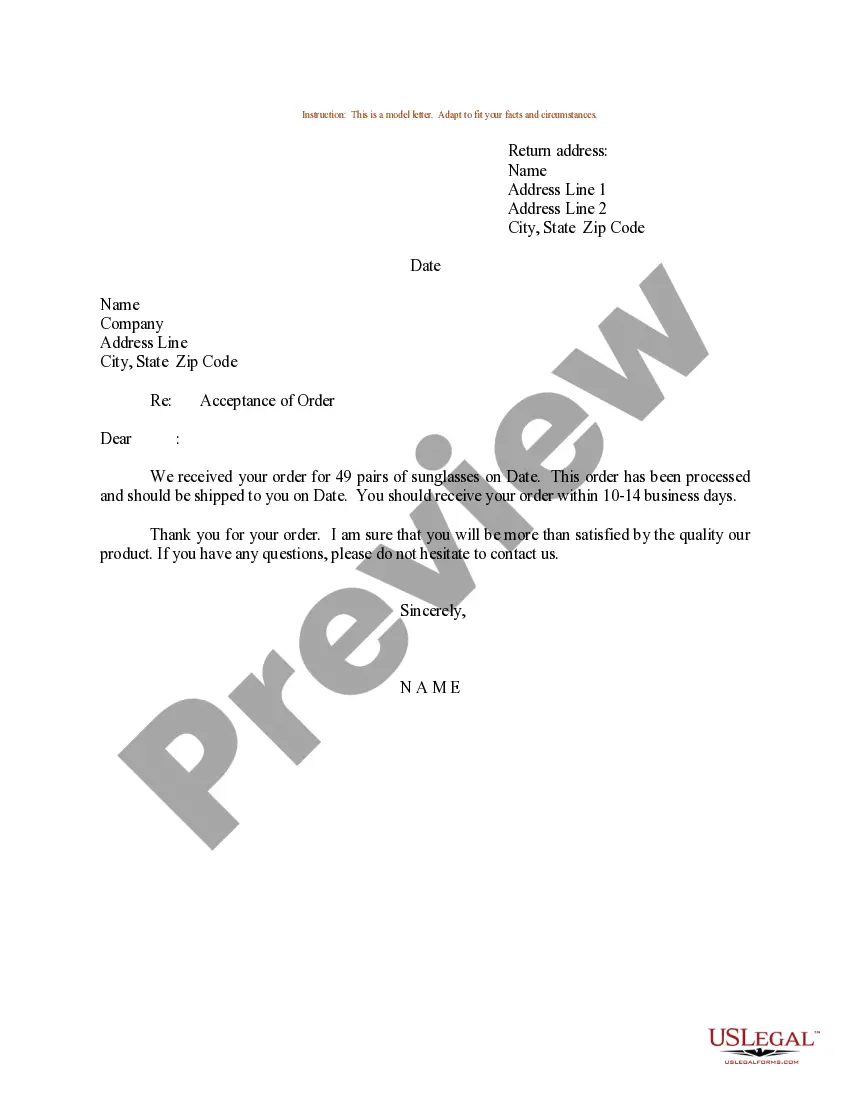
Sample Acceptance Order With Early Release In Los Angeles
Description

Get your form ready online
Our built-in tools help you complete, sign, share, and store your documents in one place.
Make edits, fill in missing information, and update formatting in US Legal Forms—just like you would in MS Word.
Download a copy, print it, send it by email, or mail it via USPS—whatever works best for your next step.
Sign and collect signatures with our SignNow integration. Send to multiple recipients, set reminders, and more. Go Premium to unlock E-Sign.
If this form requires notarization, complete it online through a secure video call—no need to meet a notary in person or wait for an appointment.
We protect your documents and personal data by following strict security and privacy standards.

Make edits, fill in missing information, and update formatting in US Legal Forms—just like you would in MS Word.

Download a copy, print it, send it by email, or mail it via USPS—whatever works best for your next step.

Sign and collect signatures with our SignNow integration. Send to multiple recipients, set reminders, and more. Go Premium to unlock E-Sign.

If this form requires notarization, complete it online through a secure video call—no need to meet a notary in person or wait for an appointment.

We protect your documents and personal data by following strict security and privacy standards.
Looking for another form?









Form popularity
FAQ
Minimizing Prejudice or Harassment: Sealing documents can be used to prevent the release of information that may lead to prejudice or harassment against individuals involved in a legal case, especially in sensitive matters like family law or criminal cases.
Filing a document “under seal” is a way that a document's information can be kept hidden for a specified period. Documents under seal may be placed in an envelope and stored somewhere secure such as a safe until the seal can legitimately be broken and the information revealed.
Sealing of records refers to state laws that allow civil or criminal records to be stored away from public access. The nature of storing records varies widely by state with some states and the federal courts not recognizing the option at all; but in those that do, normally only a court can seal records.
When you eFile your ex parte Application in Los Angeles Superior Court, you must select ex parte as the document type in the workflow. Ex parte documents will be expedited when received by the clerk, so it's important to designate your document properly.
The Motion for Leave to File Under Seal and all accompanying documents will not be available to the public, unless the Court orders otherwise. Filing the Motion for Leave to File Under Seal will generate and send a Redacted NEF to all parties in the case.
In some circumstances, you file a petition or a motion. The court has several complaint forms that you may use in drafting your complaint. The forms are available online and at the Pro Se Intake Unit. You may also write your own complaint without using a court form.
(b) Motion or application to seal a record A party requesting that a record be filed under seal must file a motion or an application for an order sealing the record. The motion or application must be accompanied by a memorandum and a declaration containing facts sufficient to justify the sealing.
Keep it concise; a page or two is ideal. Use clear and respectful language. Be truthful and avoid exaggerations. Additionally: Consider consulting an attorney for specific guidance on your case. Remember, a well-written letter can be helpful, but it may not guarantee a particular outcome.
Use formal language and avoid slang. Thank the judge for their time and consideration. Offer your willingness to provide further information if needed. Use a formal closing such as ``Sincerely'' or ``Respectfully,'' followed by your name. Dear Honorable (Judge's Last Name),
Motions to transfer venue may be brought on the grounds that the action was filed in the wrong court, or that the convenience of the witnesses and the ends of justice would be promoted by the change in venue. CCP § 396b; CCP § 397(c). If venue is improper, a court must grant an "improper court" motion. CCP § 396b.