1031 Exchange Agreement Form For Uk In Tarrant
Description

Get your form ready online
Our built-in tools help you complete, sign, share, and store your documents in one place.
Make edits, fill in missing information, and update formatting in US Legal Forms—just like you would in MS Word.
Download a copy, print it, send it by email, or mail it via USPS—whatever works best for your next step.
Sign and collect signatures with our SignNow integration. Send to multiple recipients, set reminders, and more. Go Premium to unlock E-Sign.
If this form requires notarization, complete it online through a secure video call—no need to meet a notary in person or wait for an appointment.
We protect your documents and personal data by following strict security and privacy standards.

Make edits, fill in missing information, and update formatting in US Legal Forms—just like you would in MS Word.

Download a copy, print it, send it by email, or mail it via USPS—whatever works best for your next step.

Sign and collect signatures with our SignNow integration. Send to multiple recipients, set reminders, and more. Go Premium to unlock E-Sign.

If this form requires notarization, complete it online through a secure video call—no need to meet a notary in person or wait for an appointment.

We protect your documents and personal data by following strict security and privacy standards.
Looking for another form?









Form popularity
FAQ
A 1031 exchange is a tax-deferred transaction. If a business owner has property they currently own, they can sell that property, and if they reinvest the proceeds into a replacement property, they can defer any capital gains taxes associated with that sale.
This means that you cannot perform a 1031 exchange between a U.S. property and a non-U.S. property. If your relinquished property is located within the United States, then your replacement property must also be located within the United States (or certain U.S. territories) to qualify for 1031 tax deferral.
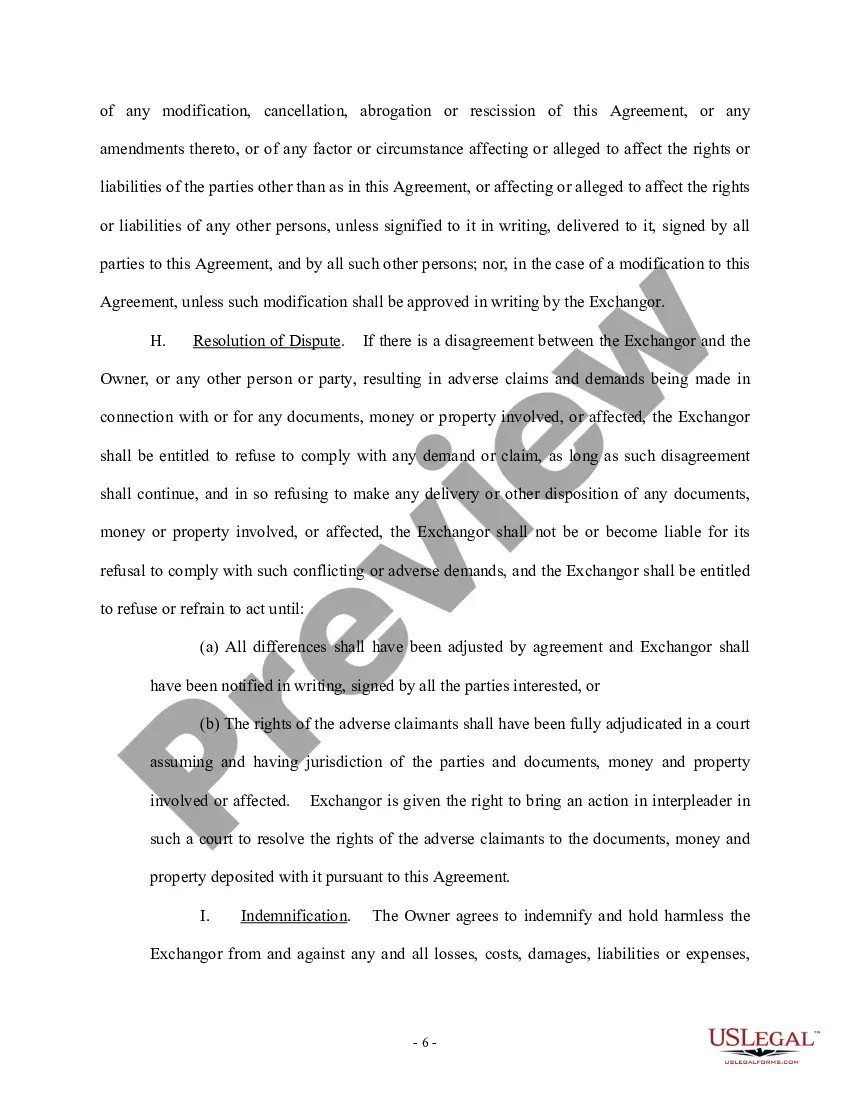
Relinquished Property – This is the property you are selling: Buyer acknowledges that it is the intention of the Seller to complete a tax-deferred exchange under Internal Revenue Code Section 1031. Buyer agrees to cooperate as long as it does not delay the closing or cause additional expense to the Buyer.
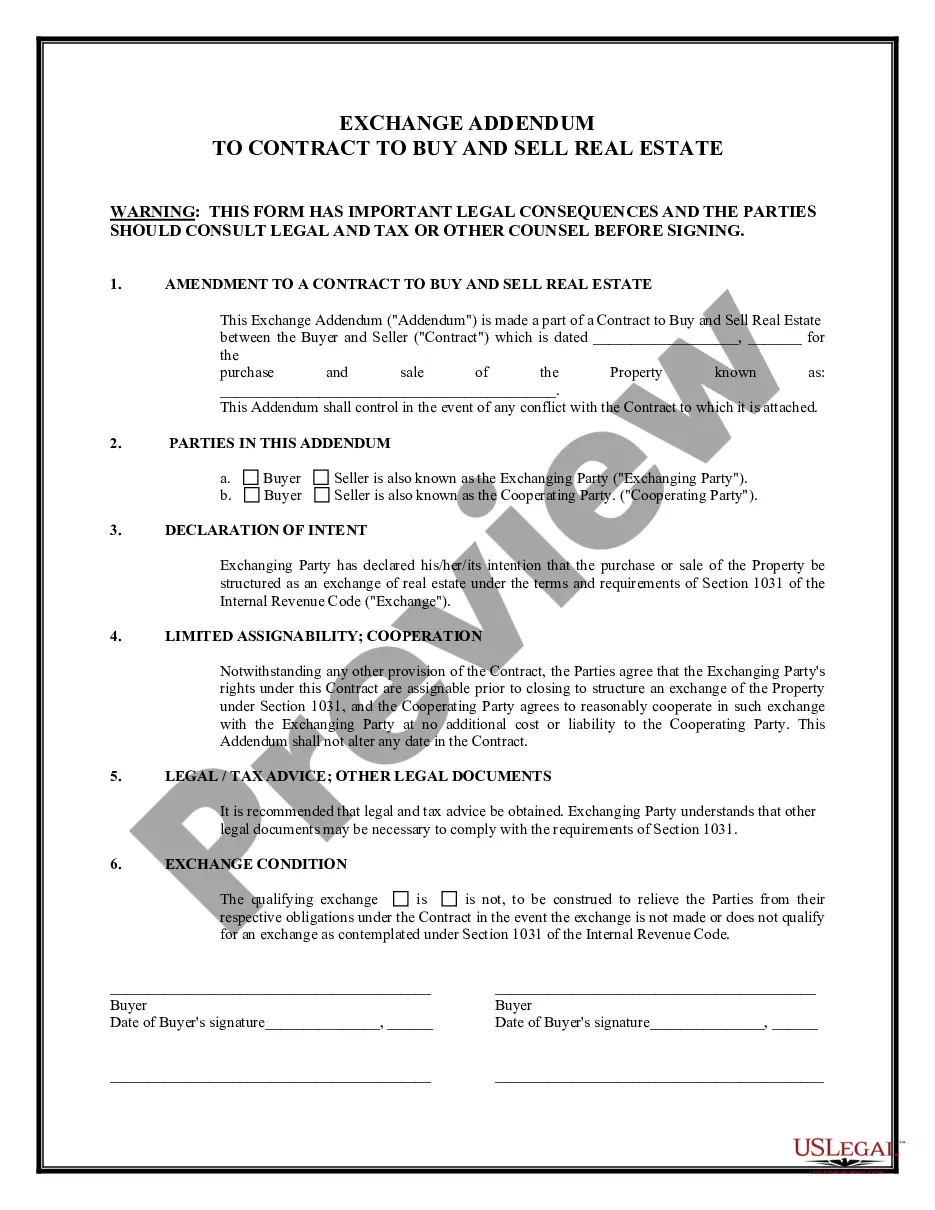
Notes and the 1031 Exchange Though a contract sale can be incorporated in an exchange, it may not be possible to accomplish this goal all the time. In order for a note to be used in an exchange, you, the Exchangor, must not have actual or constructive receipt of the note.
When signing your Agreement of Sale, insert the appropriate 1031 Exchange Cooperation Clause. This clause will document your intent to complete an exchange and provide notification to the other party of your intent to exchange.
The key concept is that the transaction is treated as an exchange rather than a sale, enabling the taxpayer to defer capital gains taxes that would normally be triggered by the sale of an asset. A transaction qualifies as a 1031 exchange if it's an exchange of eligible like-kind properties.
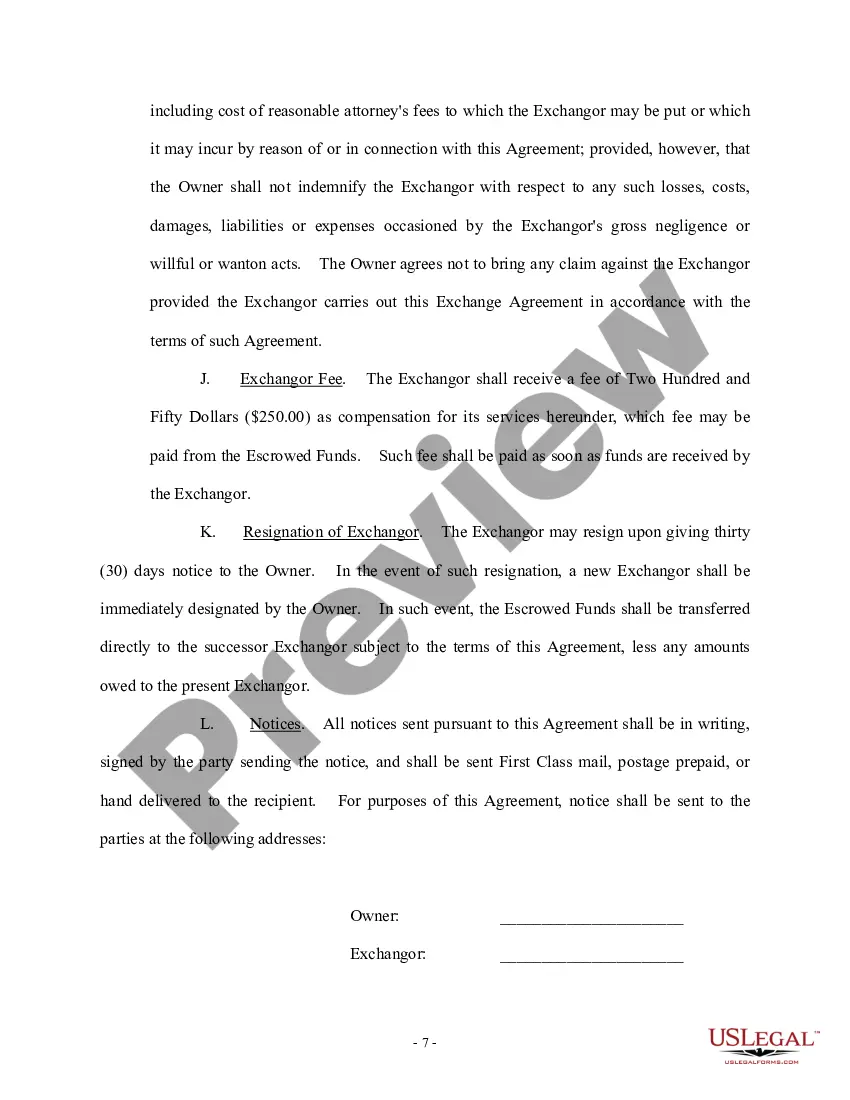
A 1031 addendum will normally clearly show intent to do a 1031 exchange, permit assignment, and advise the other party there will be no expense or liability as a result of the exchange. Sometimes there is “cooperation” language asserting that both parties to the contract will cooperate with a 1031 exchange.
Key Steps in the 1031 Exchange Process Determine if a 1031 Exchange is Right for You. Develop a Tax-Deferred Transition Strategy. Inform Your Advisors & Attorney About your 1031 Exchange. Enter into a Contract to Sell Your Existing Investment Property. Select a Qualified Intermediary and Open an Exchange.
Section 1031 is part of federal law, so it applies to federal taxes, which are the same no matter what state you're in. You can perform a 1031 exchange between business or investment properties located anywhere in the United States, so long as they meet all other 1031 requirements.
